Ukrainians Strike Major Russian Oil Refinery for Second Time This Week
Ukrainians Strike Major Russian Oil Refinery for Second Time This Week
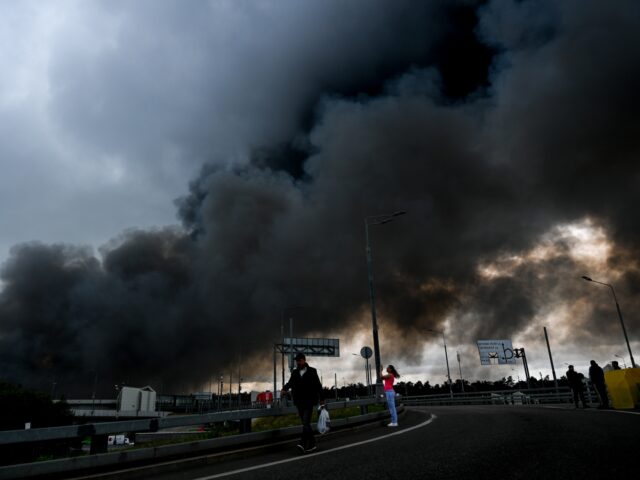

KYIV, Ukraine (AP) – Ukrainian forces struck Russia’s major Ufa oil refinery for the second time in a week, Ukrainian President Volodymyr Zelenskyy said Wednesday.
Almost daily long-range attacks on Russian oil facilities have created a fuel crisis and heaped political pressure on the Kremlin as its all-out invasion of Ukraine stretches into its fifth year.
The Ufa refinery is one of Russia’s largest producers of lubricants and is located more than 1,000 kilometers (600 miles) from Ukraine, Zelenskyy said on social media.
Ukraine also struck a plant producing missile components in Russia’s Penza region southeast of Moscow, some 500 kilometers (300 miles) from Ukraine, Zelenskyy said.
Russian officials did not confirm the strikes, which could not be independently verified. The Russian Defense Ministry reported intercepting 179 Ukrainian drones over 16 Russian regions, the annexed Crimea and waters of the Azov and the Black Sea.
Penza regional Gov. Oleg Melnichenko said that Ukrainian drones struck two industrial plants in the city of Penza, injuring two people at one of them. He didn’t name the plants or describe the damage.
The explosions shattered windows in two apartment buildings in Penza, Melnichenko said, while downed drone debris damaged a power line and fell on a building under construction.
Ukraine’s domestically developed and manufactured drones and missiles have been hammering Russian oil facilities, including refineries, terminals, storage depots and pipeline pumping stations, for months.
Many regions of Russia, one of the world’s biggest energy producers, have introduced fuel rationing.
Ukraine has developed new weaponry and in recent months has gained an edge, according to Western officials. Its strikes on supply routes behind the front line have robbed the Russian army of momentum on the battlefield, officials and analysts say.
“Russians now have great problems with delivering infantry to the front line and supplying it,” Ukrainian Minister of Defense Mykhailo Fedorov said Wednesday.
Ukraine has become a provider of military technology sought by countries around the world, especially drones.
With European countries fearing what Moscow’s territorial ambitions might lie beyond Ukraine, leaders have described Kyiv as a bulwark against Russian advances.
Ukraine is “becoming a security provider for the whole of Europe,” Swedish Minister of Defense Paul Jonsson said in Kyiv, where he held talks with Fedorov.
Ukraine signed an agreement on Tuesday for Sweden to provide Kyiv with Gripen fighter jets. They will help Ukraine stop Russian aircraft carrying powerful glide bombs, Fedorov said.
Jonsson said European countries want Ukraine to be integrated into Euro-Atlantic defenses, although Ukraine´s NATO membership has been a contentious issue and likely will be discussed at an alliance summit in Turkey next week.
“The sooner it happens, the better it is for you, the better it is for our security and prosperity as well,” Jonsson told a press conference.
Ukraine also wants to join the European Union, though the process could take years. Zelenskyy arrived Wednesday in Ireland, which currently holds the EU’s rotating presidency.
“Ukraine proves every day that it deserves to be an equal partner of our common European home. And we hope that during Ireland´s presidency of the EU Council, we will be able to achieve tangible progress on the path to membership and open all negotiations clusters,” Zelenskyy said.
Russian long-range attacks on Ukraine continued, with at least five civilians reported killed Wednesday.
A Russian drone struck a bus in the southern Kherson region, killing two people and injuring six others, regional head Oleksandr Prokudin said.
Glide bombs hit the northeastern city of Kharkiv, Ukraine’s second largest, killing two people, including a 15-year-old boy, Mayor Ihor Terekhov said. At least 26 people were wounded, including a 1-year-old, he added.
A 43-year-old woman was killed and three were injured, including a 35-year-old pregnant woman, when Russia attacked five gas stations in the central Dnipropetrovsk region overnight, according to regional authorities.
Russian forces have increasingly targeted Ukrainian gas stations.
Follow Breitbart London on Facebook: Breitbart LondonBurnham calls for grooming gang leader to be deported
Andy Burnham has said that ‘nothing is off the table’ as pressure grows for the leader of the notorious Rochdale grooming gang to be deported.
The prospective prime minister weighed into the row after it emerged that Shabir Ahmed, 73, will be freed from jail on Thursday.
Despite his conviction in 2012 for multiple rape and sexual offences against young girls, his victims have been told that he cannot be deported to Pakistan.
They have also expressed fears for their safety once the Rochdale gang leader is out of prison after serving 14 years in jail.
Ahmed had dual British-Pakistani citizenship and was stripped of his British citizenship following his conviction.
Mr Burnham – who is expected to replace Sir Keir Starmer by the end of this month – has said he would ask senior ministers to find a way to deport him.
He tweeted: ‘Like everyone, I want this vile criminal out of the country. Victims must come first.
‘I will ask the home and foreign secretaries to review all possible options - and they should consider nothing is off the table.’

Shabir Ahmed, 73, will be released from prison on July 2 - but cannot be deported
In 2022, when he was mayor of Greater Manchester, Mr Burnham called on the Tory government ‘to do everything within [its] power’ to deport grooming gang members.
The failure to deport members of grooming gangs has caused deep anger in communities and among victims.
In 2012, Sir Keir – then head of the Crown Prosecution Service – oversaw the jailing of the gang.
But last year, one of those jailed – Abdul Aziz – won a human rights battle that prevented his deportation to Pakistan.
Justice minister Jake Richards told the BBC's Politics Live there were long-standing issues with ‘our ability to deport foreign national offenders to Pakistan’.
‘We need to try and work on that and see whether it's possible, but in this case, it seems unlikely,’ he said.
When asked if the law should be changed to allow the deportation, he said: ‘I think it's very difficult to change the law to look retrospectively.’
But he added he was ‘absolutely looking at this individual and if he is to be released from prison, looking at what we are doing to ensure, firstly, to look after his victims and keeping the community safe’.
Meanwhile, one victim – identified only as ‘Ruby’ – said: ‘I’m scared for my safety and my kids’ safety.
‘The main ringleader is getting out of prison, who is well known in Rochdale, Oldham and Middleton, so even if he’s not in that area, he still knows people and has a chance to talk to people from that area and that makes me unsafe.’
She said victims of abuse had been given ‘false promises’ and left to ‘fend for themselves’ through a lack of support from the authorities.
Documents published online – understood to be from the Probation Service – state that he cannot be deported back to Pakistan due to provisions in the Immigration Act 1971 which bar his removal.
These are that he arrived in the UK before 1973 and has lived in the UK for at least five years before his deportation was considered.
A national inquiry into grooming gangs was announced earlier this year after the Government came under increasing criticism.
The Home Office said Ahmed's crimes were ‘appalling’ and that he would be subject to stringent licence conditions upon his release from prison.
He must initially live in supervised accommodation 24/7 and will be subject to an ‘exclusion zone’ centred on Rochdale.
Ahmed was jailed for 19 years in 2012 at Liverpool Crown Court as one of nine men in the Rochdale grooming gang convicted of offences against five girls.
Police said as many as 50 girls could have been victims of the gang, and that many of them had come from ‘chaotic’, ‘council estate’ backgrounds.
Judge Gerald Clifton said victims were treated ‘as though they were worthless and beyond any respect’ because they were not part of the gang's community or religion.
Greater Manchester Police said at the time there was no ‘racial or cultural’ element to the crimes.
A report later found that police had not acted despite multiple concerns being raised. It said there had been ‘serious multiple failures’ by police and local authorities.