UK unprepared for Ebola? MPs raise alarm over lack of published plan
Concerned MPs have written to the Government demanding details of its plans to protect Britain against the deadly Ebola outbreak - a day after it was feared the virus had arrived in the UK.
The Health and Social Care Committee (HSCC), a cross-party group of 11 MPs, has asked chief medical officer, Sir Chris Whitty, and public health minister Sharon Hodgson MP to explain 'how prepared the Government is for a future outbreak'.
They are also requesting to know 'what steps are being taken to reduce the risk to the public from this high-consequence infectious disease', including measures at borders and the deployment of surveillance and testing.
The letter, sent to Sir Whitty and Ms Hodgson this morning, comes just over 24 hours after a suspected Ebola case prompted the precautionary shutdown of part of the Queen Elizabeth University Hospital in Glasgow before the patient tested negative.
Europe's only confirmed Ebola case is currently in France, where a doctor tested positive last week after returning from a humanitarian mission in the Democratic Republic of the Congo (DRC) - the epicentre of the current outbreak.
At least 1,300 cases of the virus and 360 deaths have been recorded in the DRC, and small numbers of infections are reported in neighbouring Uganda. The outbreak is being driven by the rare bundibugyo strain, for which there is currently no vaccine.
Although the suspected case in Glasgow proved to be a false alarm, the developments in Scotland and France have heightened concerns that the virus could reach the UK - prompting the HSCC's request for further information.
In a letter, the committee's chair Layla Moran MP wrote: 'Dear Sharon and Chris, I am writing to you both for more information on how the Government is responding to the ongoing Ebola outbreak in the Democratic Republic of the Congo, in light of France identifying its first case on 24 June.

Health workers wearing protective gear in the Ituri province of the Democratic Republic of the Congo on June 08, 2026

Chief medical officer Sir Chris Witty - and public health minister Sharon Hodgson MP - has been asked to explain how the UK is prepared for an Ebola outbreak
'The Committee is keen to understand how prepared the Government is for a future outbreak, and what steps are being taken to reduce the risk to the public from this high-consequence infectious disease.'
Ms Moran requested that a briefing be put in place to answer their questions, including if the Department of Health and Social Care (DHSC) is working with global health bodies to 'prepare and respond to this health threat'.
She added: 'With so many major stories and issues taking up the Government's bandwidth, we are seeking assurance that preparations have been made to prevent Ebola from arriving in the UK, and that any detected cases would be safely contained.
'The fact that France has recorded its first Ebola case should be a wake-up call. And with plenty of lessons to learn from the Covid pandemic, we should expect our public health system to have its act together.'
The DHSC have been given a deadline of July 9 to respond to the letter. The Daily Mail has also approached the department for comment.
Fears were raised on Tuesday when a patient returning from one of the affected countries presented with Ebola symptoms at the QEUH.
However, the hospital immediately initiated protocols and confined the patient for treatment and further examination before they later tested negative. Had it been confirmed, it would have been the first case of Ebola in the UK for more than a decade.
Nurse Pauline Cafferkey, from South Lanarkshire, fell ill with the virus in December 2014 after arriving back in the UK from Sierra Leone - one of the countries at the centre of West Africa's devastating epidemic which resulted in 28,000 cases and 11,000 deaths.
Despite initially recovering, Ms Cafferkey later developed meningitis. She went on to give birth to twin boys in June 2019. Speaking at the time, she said: 'This shows that there is life after Ebola.'
The current outbreak of the disease is the third-largest in history, behind those in 2014 to 2016 and 2018 to 2020.
It was declared an international health emergency by the World Health Organisation (WHO) on May 17, but it is thought the virus may have been circulating for months, undetected, beforehand.

Fears were raised on Tuesday when a patient returning from one of the affected countries presented with Ebola symptoms at Glasgow's Queen Elizabeth University Hospital
In previous Ebola outbreaks, the virus has killed more than half of those infected, many of whom died due to internal bleeding and organ failure. It is feared that the Bundibugyo strain can kill at a similar rate, particularly without a vaccine.
Experts have warned that the situation could also worsen in the DRC as global funding to the region has been cut by almost half to around £1billion - the lowest figure in a decade.
The US's health protection agency declared that the current outbreak could become the largest on record, while NHS staff have also been told to prepare for a potential outbreak on British shores.
The UK Health Security Agency (UKHSA) has urged hospitals, GPs and frontline services to ensure they are ready to identify and isolate suspected Ebola patients, warning that while the risk to Britain remains low, imported cases are possible.
Read More
Parasite horror: I had a metre long tapeworm in my gut and 38 more in my brain... these were the warning signs - some of them nearly killed me

Symptoms of the current Bundibugyo strain are similar to other Ebola variants, starting with a flu-like fever, headache, muscle pain, vomiting and diarrhoea before progressing to internal bleeding, organ failure and death.
The origin of this variant is unknown but some researchers believe it was passed on to humans by fruit bats.
Scientists at Oxford University are racing to develop a vaccine, but warn that it will take two to three months before the jab can be tested on humans, meaning patients in Africa will be in a race against time to get the drug before the end of the year.
A successful vaccine would likely protect patients from severe illness and death as well as limit the spread of the virus. However, there is also no guarantee that the jab will be effective.
The Bundibugyo strain is not new, but it is rare. It was first recorded in 2007 and takes its name from the area of western Uganda, where it was spotted.
It arose for a second time in the DRC in 2012. But both outbreaks were limited in size - with just over 200 cases and around 66 deaths.
The virus is thought to spread through direct contact with the blood or bodily fluids of a person who is sick or has died from Ebola, or through contact with contaminated surfaces.
Patients can carry the virus for up to 21 days before symptoms begin, which is when experts believe they become infectious.
Is France the Best Team at This World Cup or Is It Yet to Be Properly Tested?
Is France the Best Team at This World Cup or Is It Yet to Be Properly Tested?
France has blown opponents away at this tournament, becoming the first team to score three or more goals in five straight World Cup matches.Conor Orr|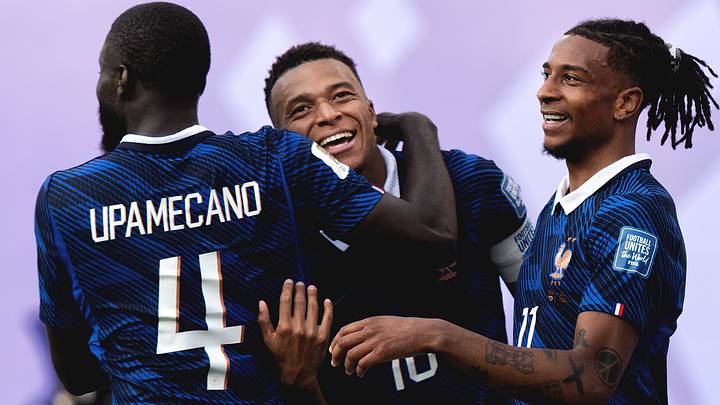
EAST RUTHERFORD, N.J. — Truly the stuff of fever dreams over here in section 225 along the stadium’s north side. Pass the man in the tight striped shirt wearing a red beret and holding a fake plastic baguette and you turn the corner to find a pair of men dressed as mimes. They are waving a French flag to fan a young supporter of Les Bleus who has overheated and is slumped down in a chair as security forms a wall around him to cool down.
Around the corner comes Max, an athletically built male of about 5’10” who is dripping sweat beneath what looks like a heavy, non-breathable blonde wig decorated in a kind of braided pigtail. He’s wearing a traditional Swedish dress for Midsommar atop shin guards, soccer socks and tennis shoes. Follow him through the concourse and onto the patio, and you’ve arrived at Camp Sweden.
The fan section of Swedish football—which also cleverly featured fans wearing yellow shirts with the word IKEA written on them—was paltry in size to the overwhelming number of French supporters here among the 83,000 attendants in New Jersey, but for the first 40 minutes, the chants of ‘Allez, Allez, Allez’ (‘Onward Sweden’) did not relent.
Max said Swedish fans took pride in their FIFA ranking for kindness, but when informed that France were heavy favorites, his eyes narrowed and he assumed a joking fighter’s posture. When asked if he believed, as Sweden seemed to escape one piercing attempt on goal after another (including a 19th-minute goal by Kylian Mbappe that was called back upon review) by the blistering French attack over the course of the first 40 minutes, he smiled.
“Of course I do,” he says. “I f—- flew here.”
France and Kylian Mbappé Take Charge

Of course, in rapid succession just before halftime, just after halftime and a third time at the 73rd minute, France eventually honed its eye for the goal and obliterated any chance of a stunning upset. Gone were the scattershot follows, the moments where Les Bleus’ incredible strikers were slapping their heads in frustration.
Kylian Mbappé sliced between two defenders and pounded the ball in the far side of the net. Bradley Barcola slipped between a pair of Swedish defenders, took a quick touch and scored again. Then Mbappé, one last time, punched the ball to the far corner of the net, just off the outstretched hand of Sweden's keeper, Jacob Widell Zetterström. After the last one Mbappé found an open swath of space and skied into the air, a bit like a toddler pretending he was a rocket ship blasting off to the moon.
Outside of the confidence that momentarily reverberated from Camp Sweden, though, the eventual 3-0 result was heavily expected. France became the first team in World Cup history to score three or more goals in five straight matches, though those matches were against some of the Cup’s lowliest opponents: A lukewarm Senegal, Iraq and a second-string Norway, none of which are in the FIFA top 15 World Rankings (Iraq hovers in the mid 60s). Sweden was in organizational tatters leading into the World Cup as well.
WIN FIFA WORLD CUP 2026™ FINAL TICKETS & OTHER PRIZES

Just How Good is This France Team?

It brings up the important question, as France advances to play Paraguay (another team outside of the Top 30 in FIFA World Rankings, though riding high after a stunning upset over Germany in the opening round) in the second stage of the knockout tournament: Are we responsible for believing what our eyes tell us to believe? Or, is it merely another victory over a small, bright-eyed, understaffed army like we saw in Camp Sweden?
“We knew we had to be perfect,” Graham Potter, Sweden’s manager said afterward, noting that, even if Sweden was perfect, it may not have been enough. “We needed a couple of miracles.”
When asked if he thought any team could beat France, he said: “Of course, it’s football, anything is possible, but I haven’t personally seen a better team.”
As Mbappé was subbed off in the 86th minute, France manager Didier Deschamps stretched out his arms and bowed several times, welcoming the 27-year-old star to the bench. Mbappé has now played in 18 World Cup games and has scored 18 goals. He is now the lone record holder, passing Ronaldo and Leonidas, for the most goals ever scored in the knockout stage of the World Cup (10).
What France Does to Opponents

French soccer, at this very moment, is the picture of versatility, with an amoebic attack that is grounded in a concept that is simple theoretically but almost impossible to achieve in real time: Make yourselves fluid enough to empower your goalscorers. France has dominated by mastering width, drawing double teams at both ends of the pitch and thinning out defenses that still cannot manage to bracket the team’s fleet of strikers. Even with quarterly hydration breaks, the tiring effect this has on defenders is debilitating.
They are also appropriately dominant. Before Mbappé’s first goal, he made a backward no-look pass to Ousmane Dembélé that looked more like a dance step (the pair have more mutual assists for one another than any tandem dating back more than 50 years). Every part of his facial expression suggested that he planned for the moment to go viral. France possessed the ball more than 60% of the game and had a shot advantage of 12-3.
Les Bleus appear comfortable enough, then, to sidestep the question of opponent quality. Deschamps admitted that “for us, it wasn’t that difficult” to reach the round of 16 but cautioned a reporter who mentioned the cementing confidence among French fans and journalists.
“Slow down, please,” he said. “There are issues, there’s always room for improvement.”
READ THE LATEST WORLD CUP NEWS, ANALYSIS AND INSIGHT FROM SI FC
Published 2 hours ago | Modified 17 minutes ago
 CONOR ORR
Conor Orr is a Senior Writer for Sports Illustrated with more than 15 years of experience covering the NFL. His work has been cited in Best American Sportswriting and has won a PFWAA award. Prior to Sports Illustrated, he covered both the Giants and Jets for The Star-Ledger. Conor lives in New Jersey with his amazing wife and three children.
Home/Soccer