Chicago Bears 2027 3-Round Mock Draft: Righting the Wrongs of 2026 Offseason
Chicago Bears 2027 3-Round Mock Draft: Righting the Wrongs of 2026 Offseason
Our way-too-early 2027 mock draft for the Chicago Bears takes care of two positions that were considered big needs going into the 2026 offseason.Mike Moraitis|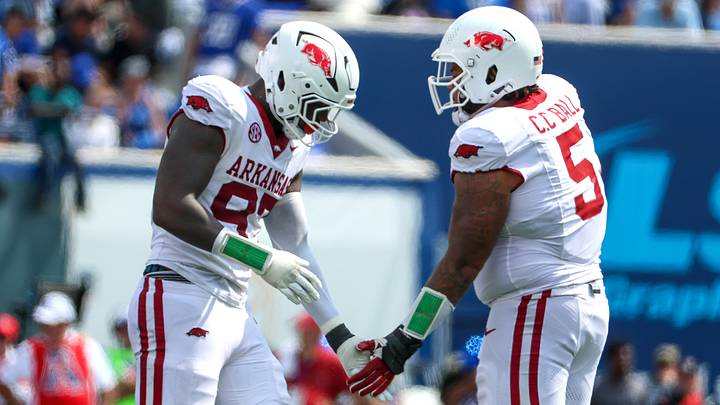
In this story:
Chicago BearsThe Chicago Bears made what we believe could be two critical errors by not adequately addressing edge rusher and interior defensive line this offseason.
The Bears did not sign or draft an edge rusher, and the signing of Neville Gallimore and draft selection of Jordan van den Berg in the sixth round were the most notable moves on the inside.
Safe to say, Bears fans weren't pleased after those two positions were pegged as huge needs going into the offseason after the Bears struggled in run defense and with getting after the quarterback last season.
In our latest way-too-early 2027 mock draft, we're righting the wrongs of this offseason and giving the Bears an edge rusher, interior defensive lineman and a running back.
Round 1: EDGE Quincy Rhodes, Arkansas

We can only hope the Bears' faith in the uncertain trio of Austin Booker, Dayo Odeyingbo and Shemar Turner pans out, but if not Chicago simply cannot afford to pass up on drafting an edge rusher again next year.
Rhodes has the potential to be one of the very best edge rushers in the 2027 NFL draft after he saw a huge leap in sack production in 2025, when Rhodes posted eight sacks and 35 pressures with an uptick in snaps.
At 6-foot-6 and 277 pounds, Rhodes fits the mold of the big, long and athletic edge rushers Dennis Allen likes. Rhodes also offers the kind of versatility Allen covets with his experience sliding inside.
Round 2: DT A'Mauri Washington, Oregon

Chicago could be facing a total overhaul of the defensive line in 2027, as Gervon Dexter will be a free agent and Grady Jarrett is going to be a prime cut candidate.
The Bears need to add someone who specializes against the run after dealing with the woes of Jarrett's and Dexter's run defense.
Washington checks that box after posting a top-notch 82.0 run defense grade in 2025, according to Pro Football Focus.
Rushing the passer certainly isn't what Washington does best, but he has shown promise in that area after tallying 1.5 sacks and 22 pressures last season.
Round 3: RB Raleek Brown, Texas

There is a very real chance that D'Andre Swift is in his last season with the Bears as he prepares to be a free agent in 2027. It's hard to envision the Bears paying what it would take to re-sign him, especially if Kyle Monangai continues to ascend.
Brown has the tools to be a true impact player. He's got breakaway speed (4.32 40 time) that makes him a threat from anywhere on the football field, and he has shown pass-catching ability after racking up 34 receptions for 239 yards last season.
He needs to improve his pass protection and is not very physical as a runner at 5-foot-9 and 195 pounds, but the latter is not a big deal because Monangai offers physicality in spades. Brown still amounts to a fine complement to Monangai.
Published 46 minutes ago
 MIKE MORAITIS
Mike Moraitis is a freelance writer who has covered the NFL for major outlets such as Sports Illustrated and The Sporting News. He has previously written for USA TODAY Sports Media Group and FanSided, and got his start in sports media at Bleacher Report.
Home/News
Brain cancer breakthrough as new drug shows 'promising results'
A groundbreaking immunotherapy treatment could help push the deadliest form of brain cancer into remission, a study suggests.
Researchers in London and Canada have found that a new CAR-T cell therapy may eliminate aggressive glioblastoma tumours and lead to long-term disease survival.
It could be a major breakthrough in the fight against the currently incurable cancer, which affects 3,200 Britons per year and devastatingly kills 95 per cent of patients within just five years of diagnosis.
Scientists have spent decades searching for ways to manage glioblastoma but it has proved difficult because the disease spreads through the brain by sending tiny, thread-like extensions into healthy tissue.
Unlike many other cancers, it also cannot typically be fully removed with surgery and remaining cells often resist chemotherapy and radiotherapy, allowing the disease to thrive.
Now, however, teams at King's College London and McMaster University believe CAR-T therapy could be the answer.
Already available on the NHS, CAR-T is used to treat around 2,500 patients in Britain each year - often for blood cancers - and works by instructing a patient's own immune cells to recognise cancer cells in the body and destroy them.
In the new study, published in the journal Nature, scientists tested a new version of the treatment in animals with glioblastoma using models designed to mimic the human disease.

Researchers in London and Canada have found that a new CAR-T cell therapy may eliminate aggressive glioblastoma tumours and lead to long-term disease survival
Strikingly, in two of the main experiments, the therapy completely eliminated tumours in 12 out of 13 mice treated.
The mice also remained tumour-free for longer than four months in one group, and for more than five months in another.
The scientists' method involved identifying a protein, named GPNMB, on glioblastoma and macrophages - immune cells that normally help defend the body from infection but are hijacked by cancer to resist treatment.
They then engineered the CAR-T therapy to recognise the protein, allowing them to attack both the tumour and the cells protecting it.
Sheila Singh, professor of neuro-oncology and neurosurgery at King's College London and McMaster University, and the study's lead author, said: 'Instead of treating glioblastoma as only a mass of cancer cells, we need to think of it as a connected tumour-immune ecosystem.

Glioblastoma affects 3,200 Britons per year and kills 95 per cent of patients within just five years of diagnosis. Labour politician Dame Tessa Jowell died from the disease in 2018
'Our approach targets both the tumour and the environment that allows it to thrive.
'By going beyond the cancer cells alone, we are also targeting immune cells that help shield the tumour from treatment.'
Although the treatment has not yet been tested on humans, authors say their results demonstrated 'strong preclinical efficacy'. This could open the door for the therapy to one day be used for human treatment if any future trials are successful.
Most glioblastoma patients currently live on average for between 12-18 months, and charity Brain Tumour Research say there have been no advances on a cure for two decades.
CAR-T therapy, meanwhile, is typically used for treating children and adults with leukaemia and for some adults with lymphoma. Both leukaemia and lymphoma are forms of blood cancer.
The process involves collecting white blood cells from a patient's immune system, which the body uses to help fight disease. The cells are then genetically modified to recognise proteins found on cancer cells before being put back into the bloodstream.
The study's co-author Shan Grewal, from McMaster University, said their method of attacking the disease with the CAR-T therapy differs from most previous approaches which focused on killing cancer cells alone.
This is because the new treatment attacks two parts of the disease at once: the tumour itself and the immune cells that help it evade the body's defences.
He said: 'Our work suggests we may also need to dismantle the immune support system that helps glioblastoma survive.'
The use of CAR-T therapy in the trial is part of a growing drive to investigate how effective the treatment can be against brain tumours.
Read More
I'm a hospital consultant and missed my own prostate cancer. These are the signs you MUST not ignore

Glioblastoma is the most common type of cancerous brain tumour in adults and killed Labour politician Dame Tessa Jowell in 2018. The Wanted singer Tom Parker also died following an 18-month battle with the disease in March 2022.
Symptoms of brain tumours include persistent or worsening headaches, seizures, feeling sick or drowsy and suffering with memory problems.
Other signs can also include feeling weak on one side of the body or having new problems with vision or speech.
Anyone experiencing persistent or unusual symptoms should speak to their GP.
Professor Singh concluded: 'Only through collaboration with scientists across the world and with clinicians can we tackle this devastating disease.
'I've seen first-hand through my work as a neurosurgeon the impact glioblastoma has on patients and their family members and I am committed to developing new treatments to improve outcomes for those affected by brain cancer.'