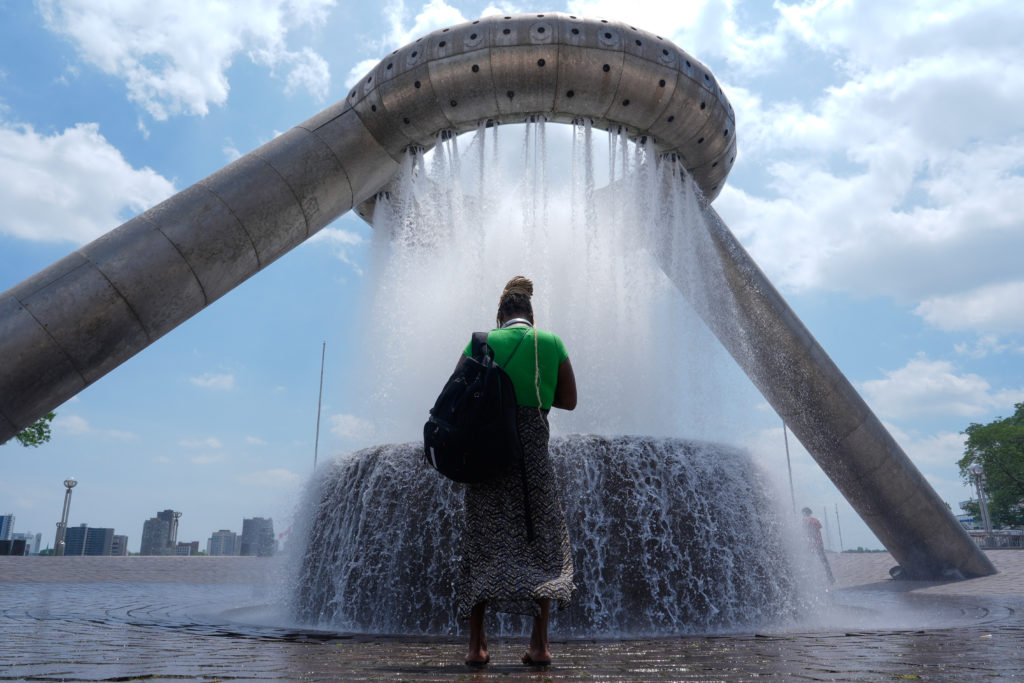
Several US states enter 'zone of sweaty despair' TODAY
Many Americans are entering what meteorologists call the 'zone of sweaty despair,' with humidity in two US states set to become more stifling than the Amazon rainforest.
The extreme humidity in Illinois and Iowa, however, is not amplified by a weather pattern - but by corn.
As corn reaches its peak growth phase across the Corn Belt, the fields start acting like steam machines, fueling dangerous heat that could last through the weekend.
A single acre of mature corn can release between 2,000 and 4,000 gallons of water vapor into the atmosphere each day through a process known as evapotranspiration, essentially causing the plants to 'sweat.'
That moisture builds up near the ground, driving dew points to potentially reach 80 degrees in parts of Iowa and Illinois and making conditions feel even more stifling.
For comparison, forecasters noted that the highest dew point they could find in the Amazon rainforest was 79 degrees, meaning parts of the Midwest could briefly become even more humid than one of the wettest places on Earth.
The National Weather Service (NWS) has issued an Extreme Heat Warning for the entire state of Illinois and most of Iowa. Both states are experiencing dangerously hot conditions with heat index values up to 110°F.
A relentless high-pressure system parked over the Tennessee River Valley is baking the region, while a surge of moisture in the atmosphere is creating dangerously suffocating humidity.

Many Americans are entering what meteorologists call the 'zone of sweaty despair,' with humidity in two US states set to become more stifling than the Amazon rainforest
Read More
EXCLUSIVE I saw unreleased UFO files at a secret meeting in the Tennessee mountains. We prayed after seeing what these 'humanoid beings' did... the world is not prepared

MyRadar Weather shared online that the two states have entered the 'zone of sweaty despair,' saying: 'Congratulations, Iowa and Illinois – you're more humid than the Amazon Rainforest.'
The corn fields have started pumping thousands of gallons of water per acre into the air each day through a process called evapotranspiration, or corn sweat.
That moisture gets trapped under the heat dome, turning the region into a huge sauna.
Justin Glisan, an Iowa State University climatologist, said: 'The phenomenon is thick and oppressive, particularly if there is no wind, like being fully clothed in a sauna or steam room.'
The humidity is also being trapped by a heat dome developing over much of the US, which works like a lid of high pressure. It builds overhead, trapping hot air at the surface level, suppressing clouds and intensifying sunlight.
Meteorologists have called this particular summer event a 'mega' or 'double heat dome' because two separate high-pressure systems, one over the Southwest and another being influenced by the subtropical Atlantic, have merged into one massive dome over the US.
In Illinois, nearly the entire state is under an Extreme Heat Warning.
Central and southeast Illinois, including Springfield, Peoria, Champaign, Decatur, Bloomington and Effingham, are expected to endure heat index values between 105°F and 110°F through Thursday night.

A week-long heat dome is causing heat and humidity to build over more than 30 states, causing temperatures to rise dangerously high
Northern Illinois, including Rockford, Aurora, Joliet and communities in the Chicago suburbs, is also under a warning through Thursday, with heat index values expected to hover around 105°F each afternoon.
Forecasters warned that thunderstorms may bring some relief to portions of northern Illinois by Thursday afternoon or evening, but dangerous heat will persist until then.
Iowa is facing a similar ordeal.
Southern and southeast Iowa, including Des Moines, Ottumwa, Indianola, Pella and Creston, remain under an Extreme Heat Warning until Thursday evening, with heat index values expected to reach 104°F.
Central and eastern parts of the state, including Ames, Waterloo, Cedar Falls and Marshalltown, are under warnings through Wednesday night, while portions of northwest Iowa, including Estherville, Algona and Carroll, are enduring heat index values up to 102°F.
The prolonged nature of the heat wave is adding to concerns.
In both states, overnight temperatures are expected to remain in the mid- and upper 70s, offering little relief after sunset and making it harder for people without air conditioning to cool their homes and recover from the daytime heat.
'Heat-related illnesses increase significantly during extreme heat and high humidity events,' the National Weather Service warned in its advisories.
Officials are urging residents to drink plenty of fluids, remain in air-conditioned spaces and avoid strenuous outdoor activities during the hottest parts of the day. People who must work outside are encouraged to take frequent breaks and limit activities to the early morning or evening.
The NWS also stressed that young children and pets should never be left unattended in vehicles, warning that temperatures inside a car can become lethal within minutes.
With the heat wave expected to linger for several more days, forecasters are urging residents across Illinois and Iowa to check on elderly relatives, neighbors and anyone without access to air conditioning before the dangerous conditions turn deadly.
Cuban official says talks with the U.S. are at a standstill despite recent free-market reforms
HAVANA (AP) — Talks between Cuba and the U.S. are at a standstill, despite the island recently approving a series of free-market reforms, Cuban Foreign Minister Bruno Rodríguez announced Tuesday.
READ MORE: Cuba passes sweeping free-market reforms in biggest economic shift since revolution
He noted that the newly unveiled reforms were neither mentioned nor discussed in earlier talks between the two nations.
"The recently announced (measures) are a matter of total and absolute sovereignty," Rodriguez said. "We have neither listened to nor are we interested in the U.S. government's opinion on them."
But he said it was striking that they "were met with a new package of unilateral coercive measures ... against Cuba."
Earlier this month, the U.S. slapped new sanctions on Cuban President Miguel Díaz Canel and other officials, as well as on companies key to the island's crumbling economy.
Some of the sanctions were announced after Cuba's Communist Party and the National Assembly of People's Power approved 176 economic measures representing the biggest economic shift since the revolution. They align with some of the demands made by the United States, which is pressuring for a change in Cuba's political and economic model.
The reforms include more space for private businesses, free hiring of personnel and authorization for private banks and investment by Cubans abroad.
Rodriguez added that while the conduct of U.S. government officials was "generally respectful" during earlier talks, he said it is accompanied by "constant aggressive statements against Cuba, threats of military aggression, and the imposition of additional coercive measures."
The U.S. State Department did not immediately respond to a request for comment.
Rodríguez made the statements during a press conference in which he announced a July 7 debate at the U.N. General Assembly on the energy embargo imposed by U.S. President Donald Trump in late January.
"The blockade and the policy of aggression and hostility of the United States government against Cuba are a threat to the existence and well-being of the Cuban people, and to the exercise of their human rights," Rodríguez said.
He also denied that Cuba is a threat to the U.S., which he called "a major military and nuclear power."
The oil blockade has further paralyzed Cuba's economy, leading to prolonged blackouts, fuel rationing, internet outages, and the suspension of public transportation and flight cancellations. Basic services such as garbage collection and water delivery have been suspended, and workdays have been reduced.
Support trusted journalism and civil dialogue.