C.J. Stroud and Bryce Young May Impact Each Other’s Future Extensions
C.J. Stroud and Bryce Young May Impact Each Other’s Future Extensions
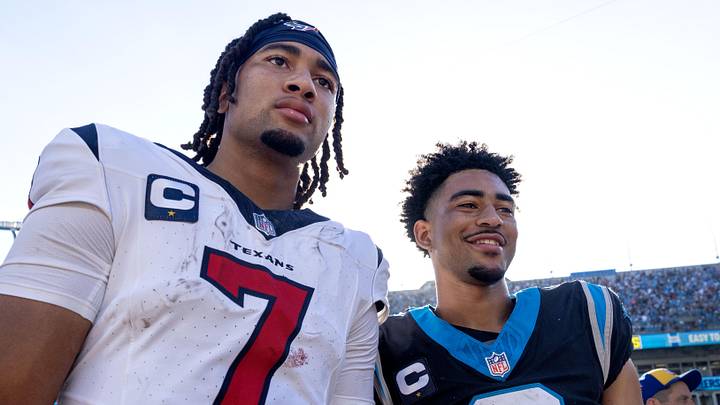
The first two picks in the 2023 NFL draft will forever be linked. The financial fortunes of Bryce Young and C.J. Stroud may have something in common as well.Russell Baxter|Oct 29, 2023; Charlotte, North Carolina, USA; Houston Texans quarterback C.J. Stroud (7) and Carolina Panthers quarterback Bryce Young (9) after the game at Bank of America Stadium. Mandatory Credit: Bob Donnan-Imagn Images | Bob Donnan-Imagn Images
They were the first two selections in the 2023 NFL draft. The Carolina Panthers gave up plenty to move up to the top spot (owned by the Chicago Bears) to grab University of Alabama signal-caller and 2021 Heisman Trophy winner Bryce Young. Minutes later, the Houston Texans opted for Ohio State quarterback C.J. Stroud.
Panthers’ QB Bryce Young had a forgettable rookie season
USA TODAY Network via Reuters Connect
The beginning of their pro careers couldn’t be more opposite. Young started all but one game for a team that finished 2-15. He completed 59.8 percent of his passes for 2,877 yards, 11 touchdowns and 10 picks. He was sacked 62 times and lost six of his 11 fumbles.
On the other hand, Stroud was a sensation. In his 15 starts, he hit on 63.9 of his throws for 4,108 yards and more than four times as many TD passes (23) as interceptions (5). He ran for 167 yards and three scores, was sacked only 38 times and lost just 4-of-8 fumbles. The Texans won the AFC South and Stroud was named the NFL Offensive Rookie of the Year and earned a Pro Bowl invitation.
Bryce Young and C.J. Stroud may be joined at the financial hip
Throwback to when Bryce Young got fired up when the Texans drafted CJ Stroud. pic.twitter.com/MHrFlnByzN
Young has made steady improvement these past two seasons, and led Carolina to the NFC South title in 2025. Stroud has had some ups and downs as of late, but the Texans have been a playoff team in each of his three seasons. Not surprisingly, both Carolina and Houston picked up the fifth-year options on their young field generals.
ESPN’s NFL Nation of writers took a look at each team and its most logical player in terms of a contract extension. It feels like it’s just a matter of time before new deals are done for Young and Stroud. Then again…
“The Panthers are open to the idea of an extension for Young,” said Dan Graziano, “and they continue to say they believe in him as their long-term franchise QB. But they aren't in a hurry to do a deal, and it's possible this doesn't happen until next offseason…”
The 2026 season is important to both Bryce Young and C.J. Stroud
“But with Houston seemingly in no hurry with Young's 2023 draftmate C.J. Stroud,” added Graziano, “there’s no rush to jump the market and do a Young deal without seeing more.”
Apparently, the Texans want to see more from Stroud as well. The three-year pro had a forgettable postseason. In the playoff split with the Steelers and Patriots, he hit on only 51.9 percent of his passes for 462 yards, two touchdowns and five interceptions (4 of those picks vs. New England). He was sacked three times in each contest, and at Pittsburgh fumbled five times—losing a pair of those drops.
“Stroud and the Texans aren't close to a deal as of late June,” explained ESPN’s DJ Bien-Aime. “Houston and its quarterback are in a tricky spot because last season did not end the way either would’ve preferred…With how negotiations are currently going,” stated Graziano’s colleague, “it's gearing up to be a prove-it season for Stroud.”
Obviously, the contract situations for both quarterbacks certainly bears watching. Just how long that watch will take place is a very different story.
Russell S. Baxter has been writing and researching the game of football for more than 40 years, and on numerous platforms. That includes television, as he spent more than two decades at ESPN, and was part of shows that garnered five Emmy Awards. He also spent the 2015 NFL season with Thursday Night Football on CBS/NFLN.
If you purchase an independently reviewed product or service through a link on our website, Robb Report may receive an affiliate commission.
Whiskey brands and distilleries make a lot of claims about how they taste, but sometimes it’s all about the power of suggestion. Did you really taste Christmas cake and treacle as you sipped that single malt? Do you even know what those things taste like? In the case of this new pair of whiskies from Fettercairn, however, the claims hold true—these two single malt scotches are bursting with tropical fruit notes, making them perfect summer sippers.
Fettercairn, a Highland distillery that is owned by Whyte & Mackay along with the Dalmore and Jura, is relatively new in the U.S. The distillery has been around for about two centuries, but the whisky only became available here last year with the launch of 24 and 28-year-old whiskies, the latter of which we found to be exceptional. It’s less common for a whisky to launch with higher age-statement expressions like these, although certainly not unheard of, but at the time a rep for the brand said younger expressions would follow. Well, they have arrived in the form of 12 and 16-year-old single malts, both of which are full of bright, fruity notes that will appeal to both newbies and seasoned whisky vets.
The distillery attributes its whisky’s tropical fruit character to the way in which it is distilled and cooled. There is a copper cooling ring near the top of the still that Fettercairn says means only the lightest vapors rise to the top, and those are said to contain the particular flavors that define the new make spirit and carry over through many years of maturation. “That process gives us a beautifully light, tropical spirit to work with, and from there, it’s about shaping that character with care—preserving its freshness while building texture and complexity through maturation,” said distillery manager Stewart Walker in a statement.
WATCH
If these technical details are a bit beyond your pay grade, try the whisky for yourself to see what you taste. The 12-year-old is aged entirely in ex-bourbon barrels and bottled at 46 percent ABV with natural color and no chill filtration. Look for notes of pineapple, banana, mango, vanilla, citrus, and ginger on the palate. The 16-year-old, also naturally colored and without chill filtration, was also aged in ex-bourbon barrels and bottled at a slightly higher 46.4 percent ABV. There’s a bit more oak on the palate here, as you might expect, along with notes of papaya, ripe pear, green apple, custard, cinnamon, and milk chocolate.
Both the 12 (SRP $55) and the 16 (SRP $90) were released in late spring and are available to purchase now from retailers around the country and at websites like Total Wine. And you can still find the excellent (and expensive) 24 and 28-year-old whiskies at websites like ReserveBar.
Authors
Jonah Flicker
Flicker is currently Robb Report's whiskey critic, writing a weekly review of the most newsworthy releases around. He is a freelance writer covering the spirits industry whose work has appeared in…
14 House Republicans vote down procedural rule over 'SAVE America Act,' halting week's legislative calendar
(L) Rep. Anna Paulina Luna (R-FL) speak with members of the media in Washington, DC. (Photo by Heather Diehl/Getty Images) / (R) Rep. Chip Roy (R-TX) speaks to reporters on April 30, 2026 at the U.S. Capitol in Washington, DC. (Photo by Graeme Sloan/Getty Images)
OAN Staff Brooke Mallory 4:00 PM – Tuesday, June 30, 2026
A coalition of fourteen House Republicans paralyzed the legislative floor on Tuesday, tanking a procedural vote and forcing GOP leadership to abruptly scrap the week’s legislative calendar.
The coalition, led by Representatives Anna Paulina Luna (R-Fla.) and Chip Roy (R-Texas), choked off legislative business as conservative holdouts dug in on demands for stricter federal voting regulations — specifically targeting the passage of the SAVE America Act.
The full list of the 14 Republicans includes:
Anna Paulina Luna (R-Fla.) — Coalition co-leader
Chip Roy (R-Texas) — Coalition co-leader
Lauren Boebert (R-Colo.)
Tim Burchett (R-Tenn.)
Eric Burlison (R-Mo.)
Eli Crane (R-Ariz.)
Randy Fine (R-Fla.)
Andy Harris (R-Md. )
Thomas Massie (R-Ky.)
Max Miller (R-Ohio)
Keith Self (R-Texas)
Victoria Spartz (R-Ind.)
Mike Turner (R-Ohio)
Steve Scalise (R-La.) — Voted “no” strictly for procedural routing
The immediate casualty of the intraparty disagreement was a $1.15 trillion defense spending bill. House Speaker Mike Johnson (R-La.) had engineered a plan to merge the annual National Defense Authorization Act (NDAA) with the SAVE America Act, packaging the conservative voting priorities into a must-pass piece of legislation before sending it to the upper chamber.
However, the faction rebelled against this strategy, sinking the routine procedural rule vote 224–198.
Luna described the leadership’s legislative bundling as a “procedural head fake,” arguing that merging the bills would make it far too easy for the Senate to simply strip the election provisions out during conference negotiations.
Instead, Luna and like-minded House members demanded that the voting regulations — including mandatory photo ID and documentary proof of citizenship to register for federal elections — be written directly into the base text of the NDAA via amendment, thus making it legally harder to unravel.
Analysts say that the legislative standoff represents a massive bottleneck for the thin Republican majority, where Speaker Johnson can only afford to lose three votes on party-line measures.
Notably, this procedural loophole allows Republican leadership to bring the rule back to the floor for reconsideration at a later date without being forced to send the massive defense package back to the House Rules Committee.
Confronted by an unyielding wall of opposition, GOP leadership admitted defeat just hours after the failed vote, canceling all remaining legislative business for Wednesday and Thursday. Lawmakers were sent home for an early Fourth of July holiday recess, postponing any further action on the defense bill or pending appropriations measures until the House reconvenes on July 13th.
A visibly frustrated Speaker Johnson defended the derailed defense package, noting that it contained roughly 65 of the Trump administration’s core priorities and executive orders (EOs). Johnson lamented that a handful of his own members chose to halt very important progress because of their grievances with Senate Democrats.
Meanwhile, thee ultimate destination for the SAVE America Act remains highly contentious.
While the bill represents a core pillar of the Trump administration’s platform, it faces friction in the upper chamber. Even if the House successfully advances the measure, Senate Majority Leader John Thune (R-S.D.) has struggled to gather the necessary support to cross the 60-vote filibuster threshold, with several Senate Republicans joining Democrats to vote against the measure in a recent 48–50 vote.
As the House enters a multi-week cooling-off period, Johnson indicated he would use the recess to regroup and work on the holdouts, though hardliners have pledged to block all subsequent floor traffic until their strict voting integrity parameters are met.
Stay informed! Receive breaking news alerts directly to your inbox for free. Subscribe here. https://www.oann.com/alerts

RUSSELL BAXTER
 Fettercairn