The Best Rock Covers Of 2026 (So Far) - Grunge
The Best Rock Covers Of 2026 (So Far)
By Brian Boone June 30, 2026 8:37 pm EST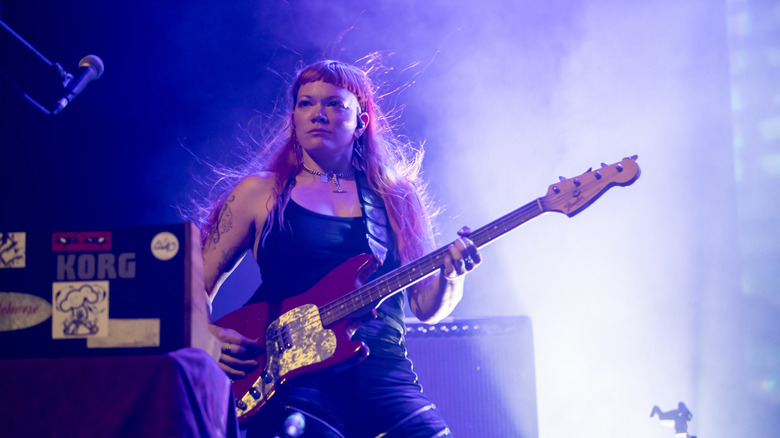 Miikka Skaffari/Getty Images
Some of the best songs of 2026 are not from 2026 at all — they're covers of beloved and popular rock standards of the 1960s, '70s, '80s, and '90s. What turns any hit song into a standard? Covers. If a tune endures over the years to the point that future generations of bands want to make it their own, then that's a pretty good indication that the song is a treasure and that it ought to be covered even more. Underneath all of the stylistic choices employed by the original artist or the studio tricks used in the sonically specific decades of the past, a great track can handle interpretation and changes. That results in imaginative and interesting covers, making older, well-known tunes into brand-new potential hits that both praise the original and show off the substantial talents of the influenced, contemporary musicians.
It's an enduring phenomenon in rock music, and 2026 in particular witnessed a groundswell of groundbreaking and eminently listenable covers from major-label and independent artists alike. Here are the ones we found to be the most astonishing, transformative, and rocking.
Paint It, Black — Los Dedos
The hard-charging, frenetic, and just barely restrained "Paint It, Black" is among the Rolling Stones' darkest songs and most progressive in that it added traditionally Eastern musical elements to its blues-rock sound. In 2026, U.K. band Los Dedos reinvented that 1966 No. 1 hit with another stylistic phenomenon also happening in the mid-1960s: instrumental surf rock. It's a short leap from bongos to rapid-fire drums and from sitar to agile finger-plucking up and down the guitar fretboard. As such, Los Dedos transformed "Paint It, Black" into a captivating surf rock gem as well as a convincing '60s throwback.
Overnight Sensation (Hit Record) — They Might Be Giants
With "Go All the Way," the Raspberries nailed the sound of '70s power pop, and they kept the movement going with 1974's "Overnight Sensation (Hit Record)." Ironically, They Might Be Giants celebrated the 40th anniversary of their self-titled album by covering this slightly tongue-in-cheek song about the dreams and base desires of a young band. The legendary, idiosyncratic band turns out a faithful version of the Raspberries' song and gives it more power than pop, loading up the heavy guitar, emphasizing the hooks and singalong chorus, and adding a big dose of that signature quirky They Might Be Giants humor.
Never Tear Us Apart — Matthew Ryan Jacobs
INXS's anthemic "Never Tear Us Apart" was a massive hit in 1988, but in retrospect, the song suffers under the weight of now dated '80s production techniques and a corny saxophone solo. Canada-based indie musician Matthew Ryan Jacobs stripped away all the unnecessary epic histrionics and flashy affectations to find the simple, beautiful, and haunting love song beneath. It's a cover song that's better than the original version, as Jacobs' pleading, earnest vocals and low-key electric accompaniment makes "Never Tear Us Apart" not just his own but the moving ballad it was always supposed to be.
I Ran (So Far Away) — The Beaches
Among the best cover songs that sound nothing like the original comes indie pop collective the Beaches' take on A Flock of Seagulls' 1982 new wave classic "I Ran (So Far Away)." What was formerly a robotic song played on the somewhat soulless synthesizers of the day is reborn in 2026 as a gorgeous, enveloping slice of indie pop. Drenched in evocative electronic instrumentation, "I Ran (So Far Away)" is all at once an agitated and alienated song about alienation made sad, sensual, and lush.
Making Time — The Damned
The Damned were among the initial run of U.K. punk bands in the late 1970s, but they evolved over the decades and showed off the scope of their influences. They paid tribute to their favorite bands on the 2026 covers LP "Not Like Everybody Else," and among versions of songs by Pink Floyd, the Kinks, and the Rolling Stones sits "Making Time." A 1966 single by the Creation, it's probably best known in the U.S. for its use in Wes Anderson's 1998 movie "Rushmore." Cool and crunchy, "Making Time" became fully unrestrained and rollicking when the Damned got ahold of it and made it into a gritty party song.
Kiss Off — The Dandy Warhols
The Dandy Warhols, a pop rock band with a run of popularity in the late 1990s and early 2000s, released the rarities LP "Pin Ups" in 2026 and included a cover of "Kiss Off," which originated in 1983 by acoustic alt-rock band the Violent Femmes. Keyboardist Zia McCabe takes over lead vocals, providing the exact disaffected and over-it tone the song's lyrics may suggest. Yet they contrast with the overabundant drums and a wall of sound, making it a far different rejection song than the sparse original.
Wicked Game — Social Distortion
Chris Isaak brought retro crooner and old-school rock 'n' roll vibes to the mainstream with the sultry and twangy "Wicked Game," his breakthrough 1989 single. Futilely pleading with a lover to not make him fall for her, "Wicked Game" suggested that romance could be ugly and destructive, and classic punk band Social Distortion tapped into that on its raucous, chaotic 2026 cover. Keeping Isaak's recognizable riff but speeding up everything else and making it raw and dirty, Social Distortion fulfilled the anti-love love song's destiny of becoming one of self-righteous anger, well-suited to Mike Ness' gravelly vocals.
Harvest Moon – Dale Crover
Dale Crover is the drummer and later bassist for influential punk band the Melvins, and his 2026 cover of Neil Young's sweet, romantic, and pleasantly haunting 1992 folk rocker "Harvest Moon" represents a full-circle moment. Back when the Young song was originally released, Crover portrayed a younger Young in the accompanying music video. His cover shows off his versatility he's as adept at lilting acoustic rock as he as is at punk. Fittingly, the second part of the "Harvest Moon" single is a new take on "The Bit," a Melvins song.
How Norway’s Viking Row has captured the American imagination
How Norway’s Viking Row has captured the American imagination

The Viking row has become a popular ritual for players and fans alike Lars Baron/Getty Images
By Patrick IversenJune 30, 2026 10:28 pm EDT UpdatedARLINGTON, Texas — The drum descended the stands like a sanctified relic, passed hand over hand through sections of fans who wouldn’t let it touch the ground.
By the time its journey began from the fans gathered in the third deck to the pitch at Dallas Stadium, Norway had already done the hard part: a 2-1 win over Ivory Coast, sealed by Erling Haaland’s 86th-minute winner — the country’s first knockout-round win in its World Cup history.
Captain Martin Ødegaard took the drum from the stands, placed it on the grass with his teammates sat behind him, and raised the stick high.
What happened next has become familiar to anyone who has followed Norway’s run through this tournament. The crowd above (red and blue, with Viking helmets scattered throughout) needed no instruction. They sat down in their seats, in the aisles. They reached forward, pulled back, and shouted “RO!” in time with the drum, the chant building speed as the beat quickened, arms moving in unison through a stadium full of many people who, a month ago, had no real reason to know what any of this meant.
The ritual is called the Viking Row, and it works the same way every time, whether it’s happening on a pitch in Arlington or a subway platform in Queens. Fans sit down in a line, one behind the other, lean back and pull their arms toward their chests in unison, as if hauling an oar through water, while a leader keeps time on a drum and the group chants “ro” — Norwegian for “row” — faster as the beat speeds up.
 Fans doing the viking row during the sixth inning of a game between the New York Mets and the Chicago Cubs (Ishika Samant/Getty Images)
It has done what its creators hoped, giving a country without a World Cup appearance in nearly three decades something simple to rally around. But it has also done something they didn’t fully anticipate: it has become one of the defining images of the North American World Cup, performed by people with no connection to Norway at all.
The gesture went viral in the U.S. after a video of Norwegian fans rowing up a Boston escalator gained millions of views. Since then, it’s been done on the floor of a New York City subway car, in the middle of Times Square, and by a section of fans at a Mets game who probably needed a distraction from their team.
Norway fans are doing a “Viking Row” up the escalator at Boston’s South Station before heading to the World Cup
Adding this to the list of things I’ve never seen before and probably never will again pic.twitter.com/j8NvltOvfk
— Jeremy Siegel (@jersiegel) June 16, 2026
The trend now attracts participants regardless of soccer ties; in Arlington on Tuesday, free agent NFL quarterback Jameis Winston taught Dallas Mavericks star Cooper Flagg how to row. As Norway’s plane landed at Dallas-Fort Worth Airport on Sunday, officers from the Dallas police department and the airport police were seated on the tarmac, doing their own version of the row just outside the aircraft.
“My buddy showed me a video of it like two weeks ago, and I was like, ‘That’s kind of awesome’, and now I’m doing it here with people I met today,” said Brett Couch, 37, of Fort Worth, outside the stadium post-game. Behind him, a family of four Norwegian fans sat on the grass doing the row as a foreign correspondent urged them on with a camera.
“Whoever invented the rowing has patented it, I hope,” head coach Stale Solbakken said on Monday.
The chant is older than it looks, dating back more than a year to Norway’s qualifying win over Italy. But the Viking framing was deliberate: a musician and a member of the team’s fan club, who dreamed up the chant together, built it around the image of Vikings “returning” to a continent they’d reached long before Columbus. It was a hook that turned out to travel much farther than anyone in Norway expected.
After Norway’s 3-2 win over Senegal in East Rutherford, New Jersey, which clinched their knockout-stage spot, Ødegaard banged the drum, and the team rowed with their fans on the field. With the team’s full adoption of the ritual, a post-game tradition appears to have taken hold. And the players, the sight of it spreading beyond their own fans hasn’t gone unnoticed.
 Erling Haaland, front right, and the rest of the Norway team have embraced the row (Lars Baron/Getty Images)
“They mean so much to us. It’s amazing to see so many Norwegians coming over, and everyone’s getting involved in the rows as well. So it’s brilliant,” midfielder Kristian Thorstvedt said. Asked how much the team looks forward to doing it themselves, as they did Tuesday, he didn’t hesitate. “It’s something we look forward to, and of course, this has to be a thing now. We have to keep doing it.”
Defender Torbjørn Heggem said the setting in the Dallas Cowboys’ home stadium gave it an extra charge. “It’s actually really fun. The first time was great, and now with this stadium and the acoustics and everything, it was unbelievable.”
“It’s like the wave, but better, because you get to yell,” said Valerie Brackett, 27, of Dallas.
That’s more or less the point fans and organizers keep making about why it has traveled so well. It doesn’t require knowing the words to a song or the history behind a banner. It requires sitting down, moving your arms and bellowing when someone tells you to.
A high-angle view of the Norway fan Viking row 🤯 pic.twitter.com/CJIda5U7ed
— Interesting things (@awkwardgoogle) June 24, 2026
It’s traveling in the other direction, too. “Back home, my mom is doing this in the kitchen, my whole family group chat is just rowing videos now, it’s out of control,” said Erik Stensrud, 31, from Norway, who flew over for the knockout rounds.
He is not exaggerating. Back in Norway, the row has spread well past stadiums and living rooms. A kindergarten class outside Oslo lined up shoulder to shoulder and rowed together in a video that Haaland himself shared. At a nursing home in the country’s north, residents set their alarms for the middle of the night to catch a match, then pulled on Viking hats and rowed before kickoff. Members of Norway’s Parliament have done it too, with the prime minister joining in.
 Members of the Norwegian parliament doing the row (Håkon Mosvold Larsen / NTB / AFP via Getty Images) / Norway OUT
So why has it spread in the U.S., too? Part of the explanation is timing: this is the first U.S.-hosted World Cup since 1994, arriving in a country where soccer fandom has spent three decades borrowing chants and rituals rather than inheriting them, and American sports culture already runs on simple, teachable group gestures like the wave.
The Viking Row fits that mold exactly — no chant, no language beyond a single syllable. Anyone can join in (and some Ivory Coast fans did on Tuesday) and get it right within four beats. It also travels well on social media, resolving into one clean, sweeping motion built for a tournament, followed in short clips by people who couldn’t afford a ticket.
Of course, anything viral will attract some pushback. One journalist labeled it an “introvert’s nightmare” due to social pressure. During the Senegal match, a Norway fan who refused to join was singled out online; he later dismissed the gesture as a copy of Iceland’s Euro 2016 “Thunderclap”. While the physical movements differ (overhead claps versus seated rowing), shared Viking heritage from some fanbases has led to some friction.
Swedish defender Gustaf Lagerbielke admitted to reporters last last week, after Norway’s first win, that Swedish players “just sigh” when the row gets shown on TV.
“But whatever floats your boat,” he added with a shrug.
None of it seems to have slowed the row’s momentum down in the United States, though.
What You Should Read Next Erling Haaland, a striker so good he doesn’t even need to touch the ball
Norway's talisman was kept quiet for long spells by Ivory Coast but exploded into life when it mattered
Erling Haaland, a striker so good he doesn’t even need to touch the ball
Norway's talisman was kept quiet for long spells by Ivory Coast but exploded into life when it mattered
Even Norway’s manager seems bemused by how far past the team it has spread. “I think that’s a question for culture journalists and people who follow trends,” he said when asked why the United States seems so enamored with the ritual. “Every woman and man from 100 years old to two years old is rowing in Norway now. And when we arrive in airports around the states, they are rowing there as well. It’s fun for togetherness.”
Whether the Viking Row outlives this tournament is a separate question, and many stadium traditions don’t survive the run that made them famous. But for one afternoon in Texas, with Haaland’s goal still fresh and Norway’s captain’s arm raised over that well-traveled drum, that wasn’t the point. Everybody knew what to do next.
Jul 1, 2026Connections: Sports Edition
Spot the pattern. Connect the terms
Find the hidden link between sports terms
Tagged To: CultureFIFA Men's World CupSoccerNorway