Bobby Bonilla Day: MLB's most misunderstood holiday arrives with another $1.2 million payment from Mets

 Jack BaerStaff writerWed, July 1, 2026 at 12:03 PM UTC·7 min read
Wednesday marks the arrival of one of MLB's most beloved unofficial holidays: Bobby Bonilla Day.
Every July 1, the New York Mets deliver a payment of $1.193 million to Bobby Bonilla, a former outfielder who has not played for the club since 1999. The payments are an obligation the Mets took on when they got Bonilla to agree to forego a $5.9 million salary for the 2000 season, with that seven-figure sum due once per year from 2011 to 2035.
AdvertisementAdvertisementIt's a deal that has come to define the Mets, a team that has made itself very easy to mock in the past few decades. This year figures to be no different, with the Mets foundering in last place at 36-50 and having recently fired manager Carlos Mendoza. Every year, the jokes arrive on social media. The explainers. The "lolMets" of it all.
After all, what's more short-sighted than agreeing to give a guy $29.83 million in the future just so you don't have to give him $5.9 million immediately?
Well, here's the thing. The Bobby Bonilla deal is perfectly fine from the Mets' side. And that's not even an "of course an organization with a $365 million payroll isn't going to sweat a $1.19 million payment each year" rationalization. The simple fact is that turning $5.9 million in 2000 into $29.83 million between 2011 and 2035 barely registers as a major gain in the world of finance. If anything, it's analogous to what happens in your average (and soberly maintained) 401(k).
There's a reason why the deal became regarded as a disaster for the Mets, but it is hardly anything inside the deal itself. Let's get into it.
AdvertisementAdvertisementMatching Bobby Bonilla's gains hasn't been that hard
We'll repeat the numbers one last time.
$5.9 million in 2000.
$29.83 million between 2011 and 2035.
When the Mets and Bonilla's people sat down to figure out a fair compensation, they landed on a deferred payment schedule that gave Bonilla an annual compound interest of 8%. That's a decent gain over time, acceptable for many retirement accounts. However, that is a rate of return roughly equivalent to what you historically get just by parking your money in the U.S. stock market.
Let's take that $5.9 million payment in January 2000 and put it in the most basic place you can put it: the S&P 500. Using a calculator based on historical data, investing that $5.9 million with dividends reinvested and not adjusting for inflation or taxes, you get a current value of … $49 million.
AdvertisementAdvertisementLet's say you don't want the full volatility of the U.S. stock market and instead invest 60% into stocks and 40% into bonds. Using a different calculator, that strategy works out to $35.2 million.
Even taking stock market gains and bonds out of the equation, the inflation alone is significant, with $5.9 million in 2000 being worth $11.7 million in 2026.
We're not saying Bonilla shouldn't have taken that deal. It just really needs to be said: No one with a legitimate financial background thinks such a return is that wild.
There's actually a great comparison to this, in which firms around the country try to get people to agree to a deal similar to what Bonilla got: the lottery.
AdvertisementAdvertisementIf you've read about lottery winnings before, you might have heard how you should probably take the lump sum over the offered annuity, even if the annuity winds up paying far more over time. There was a winner earlier this year who took a $4.56 million lump sum after withholdings over a "$1,000 A Day For Life" prize, which had a guaranteed minimum payout of $7 million.
Do you think the lotteries are doing that out of kindness? Or could they be well aware of what's possible when the winner doesn't take that money up front?
The Mets cut Bobby Bonilla's salary, then reached the World Series
Here's another fact that sometimes gets lost in the Bonilla of it all with the Mets.
AdvertisementAdvertisementThe Mets wanted to cut Bonilla and his 2000 salary so they could turn their team into a contender. The same offseason, they traded for starting pitcher Mike Hampton, who had a similar salary and proceeded to post a 3.14 ERA in 217 2/3 innings in 2000.
Hampton helped lead the Mets to the 2000 World Series. We should not have to explain to you that reaching the World Series comes with direct and indirect financial benefits, from the seat sales to the increased credibility with fans going forward. Do those benefits add up to $5.9 million in 2000? There's no way to know, but this ain't nothing.
Oh, and Hampton left after the 2000 season for an eight-year, $121 million contract with the Colorado Rockies. That sounds unfortunate for the Mets, until you learn they got a compensation pick for that departed free agency, the 38th overall pick in the 2001 MLB Draft.
Let's just say the player they drafted, David Wright, worked out.
AdvertisementAdvertisementBernie Madoff is what went wrong for Mets ownership
So why is the Bonilla deal so often presented as a reason for the Mets being a laughingstock? The answer for that lies in the friendship between the Wilpon family, who ran the Mets for much of the 21st century, and Bernie Madoff, perhaps the most infamous white-collar criminal of the 21st century.
We mentioned an 8% return for Bonilla in his deal. At the time, Madoff was offering his investors a promise of double-digit returns. The theoretical math for the Wilpons was simple: any money saved now can be turned into vastly more money in the future.
Obviously, that didn't work out. It definitely didn't work out for Madoff, who was sentenced to 150 years in prison and died in 2021. It also wound up being brutal for the Wilpons.
AdvertisementAdvertisementThe aftermath of the Madoff scandal saw trustee Irving Picard sue several people for profiting off Madoff in some way, even if their investments had gone up in smoke. Basically, a line was drawn between "benefactor" and "victim," and the Wilpons were found to be on the "benefactor" side.
Patriarch Fred Wilpon denied any knowledge of the scheme, but he wound up having to pay $162 million to settle Picard's lawsuit in 2012. That's when the Mets' money dried up until their sale in 2020 to the much richer Steve Cohen, to whom the Bonilla deal is basically a combination joke/rounding error.
So, with the Mets having to cut payroll significantly after 2011, right when the Bonilla payments started, you can see where the jokes began.
Taxes are what went right for Bobby Bonilla
Let's also be clear, no one here is saying Bonilla is a fool for taking that deal.
He might have underperformed the S&P 500, but there is value in knowing a similar payment is awaiting you in your golden years, in addition to your MLB pension. Bonilla probably felt pretty good about his choices during the Great Recession, and ultimately people are going to prioritize stability more than firms with far more resources.
There is also definitely something to be said about the fact that Bonilla went from the majority of his income being exposed to New York state taxes, to now cashing his checks in Florida, where there is no state income tax.
One more fun note is that the Mets aren't even the only team sending Bonilla checks on July 1. He worked out a similar deal with the Baltimore Orioles, who are paying him $500,000 each year from 2004 to 2028.
So that's the Bobby Bonilla deal, which is hardly a disaster for the Mets. Investing with Madoff certainly was, but pushing back a player's salary at a significant but manageable interest rate and using those immediate savings to bring in a player that helps you reach the World Series, and later draft Wright, honestly belongs among the Mets' better deals over the past three decades.
Is France the Best Team at This World Cup or Is It Yet to Be Properly Tested?
Is France the Best Team at This World Cup or Is It Yet to Be Properly Tested?
France has blown opponents away at this tournament, becoming the first team to score three or more goals in five straight World Cup matches.Conor Orr|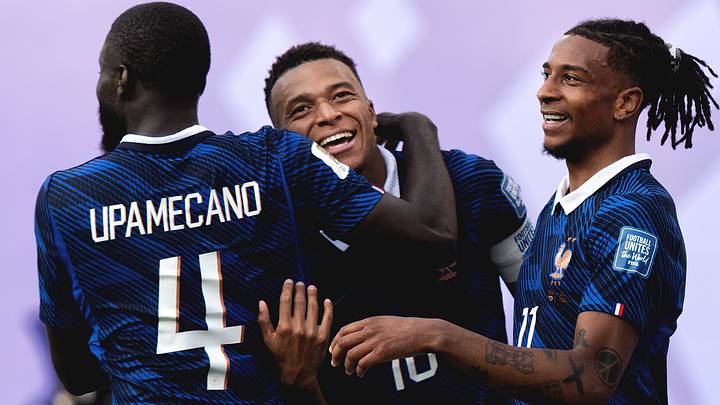
EAST RUTHERFORD, N.J. — Truly the stuff of fever dreams over here in section 225 along the stadium’s north side. Pass the man in the tight striped shirt wearing a red beret and holding a fake plastic baguette and you turn the corner to find a pair of men dressed as mimes. They are waving a French flag to fan a young supporter of Les Bleus who has overheated and is slumped down in a chair as security forms a wall around him to cool down.
Around the corner comes Max, an athletically built male of about 5’10” who is dripping sweat beneath what looks like a heavy, non-breathable blonde wig decorated in a kind of braided pigtail. He’s wearing a traditional Swedish dress for Midsommar atop shin guards, soccer socks and tennis shoes. Follow him through the concourse and onto the patio, and you’ve arrived at Camp Sweden.
The fan section of Swedish football—which also cleverly featured fans wearing yellow shirts with the word IKEA written on them—was paltry in size to the overwhelming number of French supporters here among the 83,000 attendants in New Jersey, but for the first 40 minutes, the chants of ‘Allez, Allez, Allez’ (‘Onward Sweden’) did not relent.
Max said Swedish fans took pride in their FIFA ranking for kindness, but when informed that France were heavy favorites, his eyes narrowed and he assumed a joking fighter’s posture. When asked if he believed, as Sweden seemed to escape one piercing attempt on goal after another (including a 19th-minute goal by Kylian Mbappe that was called back upon review) by the blistering French attack over the course of the first 40 minutes, he smiled.
“Of course I do,” he says. “I f—- flew here.”
France and Kylian Mbappé Take Charge

Of course, in rapid succession just before halftime, just after halftime and a third time at the 73rd minute, France eventually honed its eye for the goal and obliterated any chance of a stunning upset. Gone were the scattershot follows, the moments where Les Bleus’ incredible strikers were slapping their heads in frustration.
Kylian Mbappé sliced between two defenders and pounded the ball in the far side of the net. Bradley Barcola slipped between a pair of Swedish defenders, took a quick touch and scored again. Then Mbappé, one last time, punched the ball to the far corner of the net, just off the outstretched hand of Sweden's keeper, Jacob Widell Zetterström. After the last one Mbappé found an open swath of space and skied into the air, a bit like a toddler pretending he was a rocket ship blasting off to the moon.
Outside of the confidence that momentarily reverberated from Camp Sweden, though, the eventual 3-0 result was heavily expected. France became the first team in World Cup history to score three or more goals in five straight matches, though those matches were against some of the Cup’s lowliest opponents: A lukewarm Senegal, Iraq and a second-string Norway, none of which are in the FIFA top 15 World Rankings (Iraq hovers in the mid 60s). Sweden was in organizational tatters leading into the World Cup as well.
WIN FIFA WORLD CUP 2026™ FINAL TICKETS & OTHER PRIZES

Just How Good is This France Team?

It brings up the important question, as France advances to play Paraguay (another team outside of the Top 30 in FIFA World Rankings, though riding high after a stunning upset over Germany in the opening round) in the second stage of the knockout tournament: Are we responsible for believing what our eyes tell us to believe? Or, is it merely another victory over a small, bright-eyed, understaffed army like we saw in Camp Sweden?
“We knew we had to be perfect,” Graham Potter, Sweden’s manager said afterward, noting that, even if Sweden was perfect, it may not have been enough. “We needed a couple of miracles.”
When asked if he thought any team could beat France, he said: “Of course, it’s football, anything is possible, but I haven’t personally seen a better team.”
As Mbappé was subbed off in the 86th minute, France manager Didier Deschamps stretched out his arms and bowed several times, welcoming the 27-year-old star to the bench. Mbappé has now played in 18 World Cup games and has scored 18 goals. He is now the lone record holder, passing Ronaldo and Leonidas, for the most goals ever scored in the knockout stage of the World Cup (10).
What France Does to Opponents

French soccer, at this very moment, is the picture of versatility, with an amoebic attack that is grounded in a concept that is simple theoretically but almost impossible to achieve in real time: Make yourselves fluid enough to empower your goalscorers. France has dominated by mastering width, drawing double teams at both ends of the pitch and thinning out defenses that still cannot manage to bracket the team’s fleet of strikers. Even with quarterly hydration breaks, the tiring effect this has on defenders is debilitating.
They are also appropriately dominant. Before Mbappé’s first goal, he made a backward no-look pass to Ousmane Dembélé that looked more like a dance step (the pair have more mutual assists for one another than any tandem dating back more than 50 years). Every part of his facial expression suggested that he planned for the moment to go viral. France possessed the ball more than 60% of the game and had a shot advantage of 12-3.
Les Bleus appear comfortable enough, then, to sidestep the question of opponent quality. Deschamps admitted that “for us, it wasn’t that difficult” to reach the round of 16 but cautioned a reporter who mentioned the cementing confidence among French fans and journalists.
“Slow down, please,” he said. “There are issues, there’s always room for improvement.”
READ THE LATEST WORLD CUP NEWS, ANALYSIS AND INSIGHT FROM SI FC
Published 2 hours ago | Modified 17 minutes ago
 CONOR ORR
Conor Orr is a Senior Writer for Sports Illustrated with more than 15 years of experience covering the NFL. His work has been cited in Best American Sportswriting and has won a PFWAA award. Prior to Sports Illustrated, he covered both the Giants and Jets for The Star-Ledger. Conor lives in New Jersey with his amazing wife and three children.
Home/Soccer