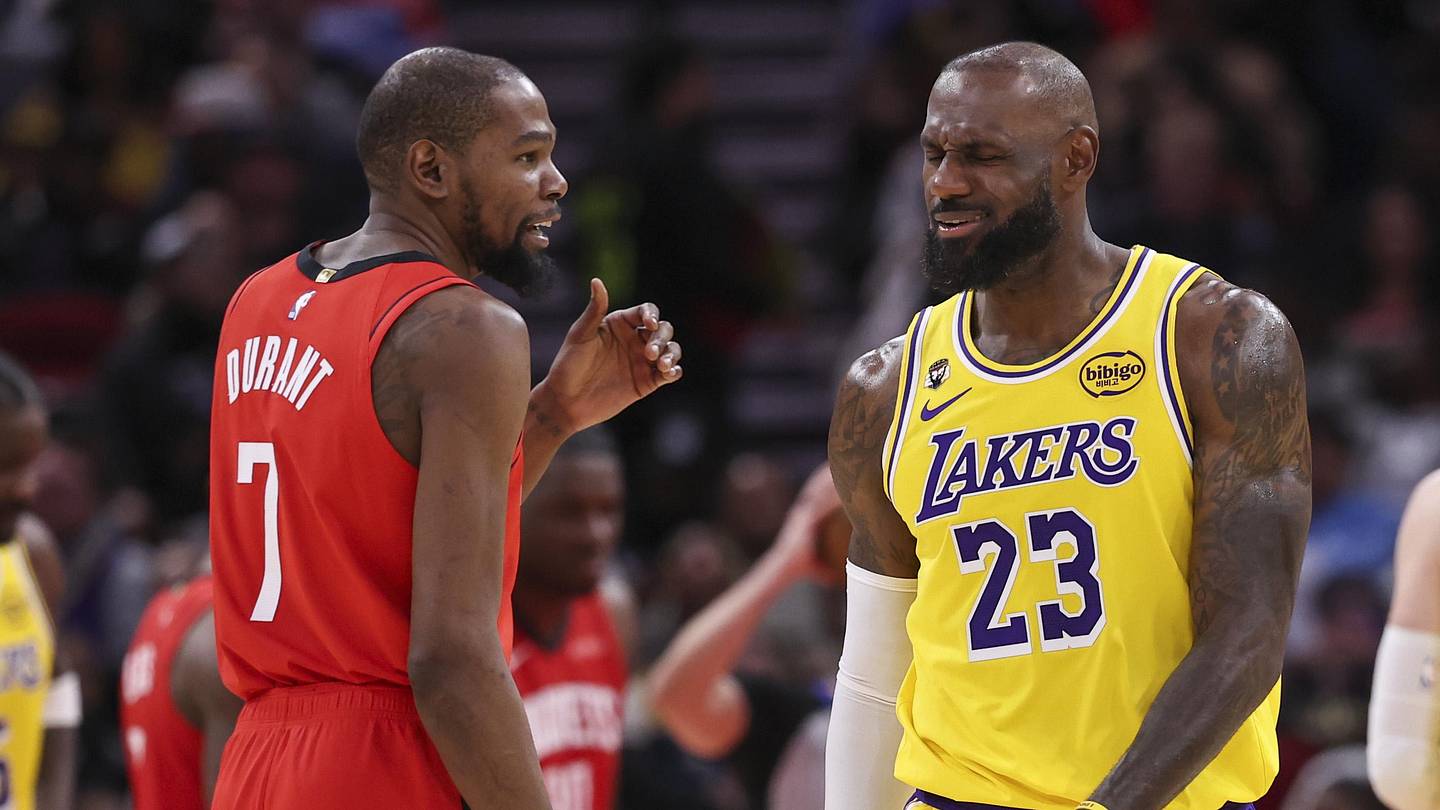
Rockets Deemed Most Likely to Land Lakers Guard in NBA Free Agency
Rockets Deemed Most Likely to Land Lakers Guard in NBA Free Agency
Houston could steal a veteran from Los Angeles for the second offseason in a row.Jed Katz|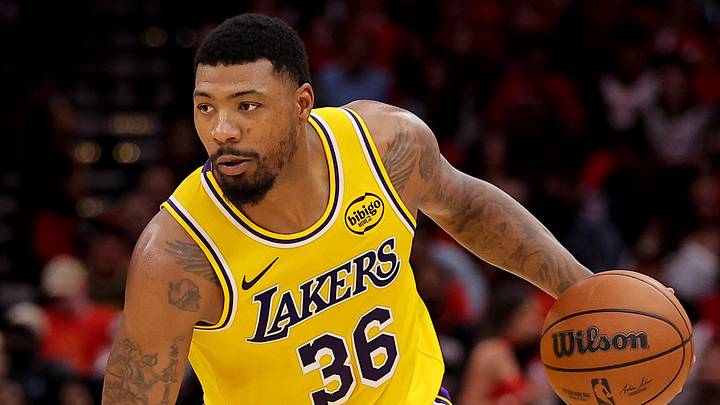
In this story:
Houston RocketsAhead of NBA free agency, starting today at 5 p.m. CT, headlines are starting to heat up for the Houston Rockets. They already have most of their rotation set to return for the 2026-27 season, but one familiar foe could end up with the organization by the end of the summer.
Hours after it was reported that Fred VanVleet picked up his $25 million player option, Marcus Smart opted to decline his own $5.4 million player option with the Los Angeles Lakers. He will enter unrestricted free agency with the opportunity to sign a much larger and longer contract.
Here's where Houston comes into play.
According to Dan Woike of The Athletic, the Rockets are not just in play to sign Smart, but a favorite to land the former Defensive Player of the Year. He noted that Smart and Udoka have a relationship from their time with the Boston Celtics.
"Strangely enough, according to team and league sources, the belief is that the Rockets will be the team most likely to land Smart once free agency opens on June 30 thanks to a multi-year deal," Woike wrote. "Smart played for Rockets coach Ime Udoka in Boston...
"Marc Stein and Jake Fischer linked Smart to the Rockets Saturday as a possible destination."
Smart would be a major addition to Houston as both a top perimeter defender and solid offensive contributor. He averaged 9.3 points, 2.8 rebounds, three assists and 1.4 steals per game with the Lakers this past season as a 3&D guard.
The 32-year-old could be a legitimate starter next to VanVleet, Kevin Durant and the Rockets' young core. If signed, Jabari Smith Jr. or Amen Thompson would likely be moved to the bench as a sixth man, but four of the five starters would almost certainly be VanVleet, Smart, Durant and Alperen Sengun.
When the Lakers paired Smart with an offensive specialist, they were elite on both ends of the floor. According to databallr, Los Angeles posted a net rating of +8.8 with a 122.0 offensive rating when he and Luka Doncic played in medium-and-high-leverage possessions (1070 minutes). When Smart was next to LeBron James, the number was still high at +5.0 (net).
There are other teams expected to be in the mix for Smart, as he could certainly return to the Lakers. However, they also have to worry about other free agents in James, Rui Hachimura and Luke Kennard.
Published 30 minutes ago
 JED KATZ
Jed is a student at the University of Wisconsin-Madison majoring in journalism. He also contributes at several other basketball outlets, including has his own basketball blog and podcast — The Sixth Man Report.
Home/Free Agency
A 'Digestion' Phase: Goldman Partner Sees Signs Of Broadening, Rotation, & 'Structurally Higher Vol'


 Premium
A 'Digestion' Phase: Goldman Partner Sees Signs Of Broadening, Rotation, & 'Structurally Higher Vol'
Authored by Bobby Molavi, Goldman Sachs Partner and macro trader,
Digestion
A market up over 50% since liberation day....a market that is narrow and concentrated….a market that now sees semis account for 19% of US market cap…..a market increasingly correlated to one factor (momentum)….a market with a growing reliance on one theme (Ai)….and within that theme, a growing dependence on a traditionally cyclical memory cycle. But this time might be different……
Can you spot the AI-generated faces? Take the test to find out
Can you tell the difference between a real person and an image generated by artificial intelligence (AI)?
According to a new study, it might be a lot harder than you think.
Researchers from Australian National University (ANU) warn that the average person is no worse off guessing at random when it comes to spotting AI-generated faces.
However, the experts say you can train yourself to spot the imposters by honing your natural intuitions.
The researchers found that people can be taught to focus on six key characteristics which can help separate real humans from digital doppelgangers.
Those are: Facial distinctiveness, memorability, proportionality, symmetry, attractiveness, and expressiveness.
But lead author Amy Dawel, associate professor of psychology at ANU, says just knowing what to look for isn't enough - you have to learn by practising.
So, how many of these AI-generated faces can you distinguish from real people? Take the quiz below to find out.
In a new paper, published in the journal PNAS, Dr Dawel and her co-authors warn that AI-generated faces are getting much harder to spot.
Today some programs are able to create faces that are all-but indistinguishable from the real thing.
This is driving a boom in AI-powered fraud, which is projected to lead to losses totalling $40 billion (£30.2 bn) in the United States alone by 2027.
One of the big issues is that AI's ability to generate deepfakes has accelerated much faster than our ability to spot them, as once-reliable advice becomes outdated.
For example, telling people to look for 'AI artefacts' like sixth fingers, misaligned teeth, or wonky ears simply no longer works.
Studies have shown that this advice doesn't improve people's ability to spot deepfakes, and real-life fraudsters can easily edit out or avoid these errors.
Instead, the researchers have developed a new training method that teaches people to pick up on 'global impressions' rather than specific features.
Dr Dawel says: 'Our training approach has a deliberate twist: we do not tell participants what to look for.

Researchers found that you can learn to spot AI-generated faces more reliably by rating each of these labelled examples from zero to seven according to six criteria: Facial distinctiveness, memorability, proportionality, symmetry, attractiveness, and expressiveness
'Instead, we expose them to AI-generated and genuine human faces while directing their attention to the qualities that distinguish the two.
'Over repeated exposure, participants build an intuitive sense for spotting AI faces, in the same way that expertise often develops through experience rather than explicit rules.'
In their study, participants were shown pictures correctly labelled either as AI-generated or human and asked to rank them on the six key characteristics.
This wasn't so that the participants could learn specific rules, such as 'high attractiveness is a sign of being an AI', but to help them hone their intuition.
What was so striking is just how much this short, online intervention improved people's ability to distinguish real and fake pictures.
Before training, people were able to find the AI imposter hidden alongside two real humans just 41 per cent of the time.
Likewise, people correctly identified a single human face as real in only 52 per cent of cases and correctly labelled an AI-generated face with 47 per cent accuracy.
But after practising on the labelled examples, the average accuracy doubled after a brief online training session, with some 'high performers' achieving near-perfect results.

Rating labelled examples on these criteria helps you develop an intuitive ability to distinguish real and AI-generated faces

Scientists found that a short online training session using this method doubled the average accuracy with which participants spotted AI fakes
Remarkably, these test results were then replicated by a team led by Professor Jim Tanaka and Dr Eric Mah at the University of Victoria, Canada.
Dr Mah says: 'The replication shows that the findings weren’t a fluke – when we trained a new set of people in a different country, we saw them improve just as much.
'Online training was effective, so our training program could easily be implemented at scale for little cost.'
The researchers say this works because facial impressions are formed rapidly and intuitively, and are very sensitive to the sorts of systemic biases inherent in AI algorithms.
Read More
What would happen if AI took over: Simulation reveals how bots could destroy society in four days

That sense of when a face looks right is something we all have, but people generally fail to leverage those impressions without training.
Directing people to pay attention to the broader, global characteristics trains them to hone their intuitive knack for spotting real faces.
While algorithms for detecting deep fakes do exist, these tend to be incredibly opaque 'black boxes' with potential hidden flaws.
Instead, the researchers argue that we 'urgently' need to improve our own AI-detection abilities to fight back against deepfake scams.