Ocean surface temperatures hit record high as world enters ‘uncharted territory,’ scientists warn
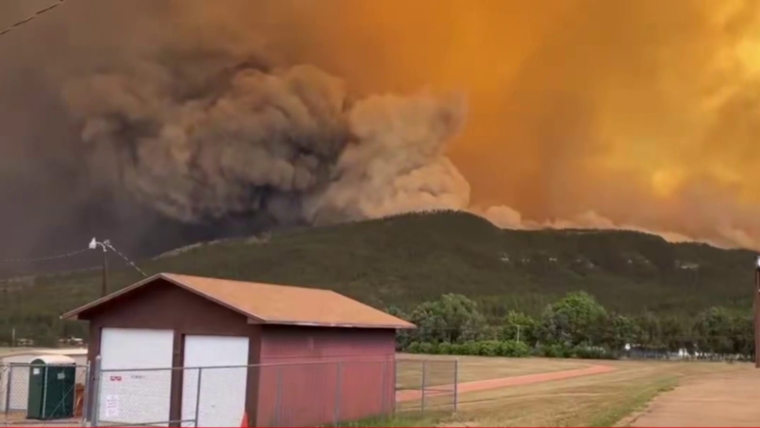 173 million people under extreme heat alerts as fires rage out west01:49July 1, 2026, 7:01 AM EDT / Updated July 1, 2026, 7:36 AM EDTBy Chantal Da Silva
Temperatures on the ocean surface hit a record high in June, European scientists warned Wednesday, fueling fears of more dangerous heat waves this summer and fanning concerns over the escalating global climate crisis.
Two separate services under the European Union’s Copernicus earth observation program — the Copernicus Climate Change Service and the Copernicus Marine Service — announced they had both independently confirmed the record temperatures.
Carlo Buontempo, director of the Copernicus Copernicus Climate Change Service, warned that the rising temperatures could mark the “beginning of a new phase.”
“With ocean temperatures at these levels and El Niño on the horizon, we are likely to see more temperature records fall in the coming months,” Buontempo said in a statement Wednesday. El Niño is a naturally occurring climate cycle that sees the central and eastern tropical Pacific Ocean become warmer than usual for months at a time.
The world could be heading into “uncharted territory,” Buontempo warned.

According to Copernicus Climate Change Service and the Copernicus Marine Service, global ocean temperatures outside the polar regions hit record levels on June 21, surpassing levels for the time of the year observed in both 2023 and 2024.
The Copernicus Climate Change Service said temperatures reached 20.86 degrees Celsius, or 69.54 degrees Fahrenheit, that day, climbing above the 20.83 degrees Celsius, or 69.49 degrees Fahrenheit observed in 2023 and 2024.
The Copernicus Marine Service meanwhile recorded temperatures at 21 degrees Celsius, or 69.8 Fahrenheit, beating previous records from 2023 and 2024 by 0.1 degree Celsius.
“It’s consistent with what we’ve known for a long time — that the planet is warming because we’re emitting vast quantities of greenhouse gasses, primarily from fossil fuel burning, into the atmosphere and that’s stifling the ability of the planet to lose its heat to space,” Richard Allan, a professor of climate science at the University of Reading in the U.K., said in a phone interview.

Oceans absorb more than around 90% of the excess energy on earth, which is primarily caused by the burning of fossil fuels like oil, coal and gas, with rising temperatures painting a concerning picture of the impacts of climate change, with the “emerging influence of El Niño” also a factor, Allan said.
It is important to continue using the tools available to monitor rising ocean surface temperatures and to “adapt” in parallel and “reduce our green gas emissions,” oceanographer Pierre-Yves Le Traon said.
“It’s really worrying to see this trend,” said Le Traon, the scientific director of Mercator Ocean International, a research institute based in Toulouse, France, which operates the Copernicus Marine Service.
The announcements came as a dangerous heat wave looked set to scorch parts of the United States ahead of the upcoming July Fourth weekend. More than 46 million people across the country are under extreme heat alerts as of Wednesday, according to the National Weather Service.
The weather service warned of “dangerous heat” set to build across the central and eastern U.S., with highs expected to reach the mid-to-upper 90s and some locations exceeding 100 degrees.
Areas across the Ohio Valley, the Mid-Atlantic and into the Northeast were expected to see record-breaking high temperatures through Thursday, it warned, with parts of northern neighbor Canada also facing extreme heat.

Meanwhile, heat records were broken across Europe last week, with WHO chief Tedros Adhanom Ghebreyesus Tedros Adhanom Ghebreyesus warning that more than 1,300 excess deaths had been recorded since June 21 “linked to high temperatures in Europe.”
France’s national health ministry said on Sunday there had been around 1,000 more deaths in the week before than expected in the country amid its record-smashing heat wave.
“Driven by climate change and global warming, the phenomenon of the ‘once-in-a-generation’ heat wave is now occurring nearly annual,” Tedros said in a post on X on Sunday. Europe, he noted, is the “fastest-warming continent on the Earth, heating at twice the global average,” with European homes, workplaces and schools “not built for these temperatures.”
Add NBC News to Google Chantal Da Silva
Chantal Da Silva reports on world news for NBC News Digital and is based in London.
Badenoch blasts 'moaning' female Labour MPs over Burnham jobs 'quota'
Kemi Badenoch has told Labour women to earn a job in Andy Burnham's Cabinet instead of demanding they are handed jobs because of their gender.
The Tory leader lashed out today amid reports that female MPs are demanding the de-facto new prime minister introduce a 50:50 gender split 'quota' in his government.
Amid reports that former foreign secretary David Miliband is being lined up to return to the role, possibly with his brother Ed as Chancellor, one female minister also complained that Burnham could not have 'more Milibands than women' in the top posts.
But in a scathing article in the Times today Mrs Badenoch told them to 'stop moaning' and get chosen on merit instead of retreating into 'more of the failed identity politics that is holding back our country'.
'There are many, many reasons why you shouldn't have any Milibands in the cabinet,' she said.
'But complaining that the boys haven't given them the right jobs or that the boys are taking all the jobs, just shows that Labour's women still don't get it.'
The idea of quotas was also attacked by Baroness Jacqui Smith, Labour's Skills Minister.
Asked by Times Radio if Mr Burnham should reserve jobs for women, she said: 'No, I think what Andy Burnham should be doing is building the very best team around him to change this country.'

A letter written by the Women's Parliamentary Labour Party has called on Mr Burnham to ensure a 50:50 split between men and women in government jobs

Amid reports that former foreign secretary David Miliband (above, right, in 2010) is being lined up to return to the role, possibly with his brother Ed as Chancellor, one female minister complained that Burnham could not have 'more Milibands than women' in the top posts

But Mrs Badenoch told them to pipe down and get chosen on merit instead of retreating into 'more of the failed identity politics that is holding back our country'
A letter written by the Women's Parliamentary Labour Party and seen by the BBC has called on Mr Burnham to ensure a 50:50 split between men and women in government jobs after he succeeds Sir Keir Starmer.
'We are asking you to demonstrate this change from day one and address the toxicity and misogyny within our own party and government,' it said.
Labour has never had a female leader, while the Conservatives have had three, and Mrs Badenoch urged the government to follow its meritocratic example.
'If you run a meritocracy, then you do not have to worry about jobs for the boys,' she wrote.
'Every woman who is a Conservative MP, every woman who has ever won the leadership, has had to fight to get where she is.
'By contrast, Labour women are demanding guarantees from Burnham. But the truth is he doesn't have to give any guarantees.
'If none of Labour's women are prepared to get their hands dirty and challenge him for the leadership, their demands are toothless.'
'In fact, it's quite revealing that the women's parliamentary Labour Party has written to Burnham asking him to commit himself to at least 50 per cent female ministers.
'This has nothing to do with meritocracy. It is yet more of the failed identity politics that is holding back our country.'
Venezuela Fury and Noah Price subsidising their life by livestreaming
Venezuela Fury and her husband Noah Price look to be making their own way in the world by raking it in from their lucrative social media accounts.
The influencer daughter of Tyson and Paris Fury, 16, has become an internet sensation after tying the knot with her husband Noah, 19, earlier this year.
Since getting married and moving in together the couple have been earning thousands of pounds a month, livestreaming their life as newlyweds in their static caravan in the East Riding of Yorkshire.
And fans can't get enough of their regular life updates on TikTok and Kick, which have proved to be very profitable for the pair.
They look to be supporting themselves after Noah denied that he was given £5million by Venezuela's family as a wedding gift.
Despite his wife's huge family wealth, an estimated combined £160 million, Noah recently told his Kick followers that he 'pays for everything' for the couple.
Making light of the claims about Venezuela's millionaire financial status, Noah said: 'I actually pay for everything unfortunately. You'd expect the millionaire to pay for it wouldn't you.'

Venezuela Fury and Noah Price are earning thousands livestreaming their caravan life - after her new groom insisted he pays all the bills and denied he had £5m handout from her dad

The influencer daughter of Tyson and Paris Fury , 16, has become an internet sensation after tying the knot with her husband Noah, 19, earlier this year
Venezuela then asked their fans: 'Do you think I am a millionaire?'
Noah joked: 'She isn't a secret millionaire guys', before she broke into song and sang: 'But I live like a millionaire!'
But it seems according to estimated calculations from their social media work, Noah and Venezuela can more than afford to support themselves.
Noah has been livestreaming on platforms such as Kick and TikTok, where viewers can send paid gifts or donations.
He was previously encouraging viewers to send gifts on his honeymoon during livestreams, suggesting this is one revenue stream.
Both Noah and Venezuela have built substantial followings on Instagram and TikTok. They can potentially earn money through sponsored posts, brand collaborations, affiliate links and creator payouts.
Kick allows its creators to take home 95 per cent of the £4.99 subscription cost that fans pay.
Streamers keep 100 per cent of direct tips and donations, minus minor standard payment processing fees.
It is unclear how many subscribers Noah currently has because this information is hidden, but he does have 7,200 followers which is publicly viewable.
An industry insider has suggested Noah is making around £400 per video on TikTok, while Venezuela is likely to make £2,000 due to her following count of 1.3 million.

An industry insider has suggested Noah is making around £400 per video on TikTok, while Venezuela is likely to make £2,000 due to her following count of 1.3 million
In one video on their honeymoon, Noah asked his followers if they'd give them some more gifts now that they were married.
In a TikTok live viewed by 20,000 he said: 'Keep liking our videos people, keep sending gifts.'
After saying thank you to several of his followers he joked they should stick around on the livestream and 'watch Venezuela punch me in the mouth'.
The other half of the honeymooning couple said: 'I am, honestly!'
Noah previously confirmed that the pair don't share their finances after they were asked whether they have a shared bank account.
'She earns her money, I earn mine,' said Noah, as Venezuela joked: 'Yeah, what you gonna do about it.'
Noah went on to debunk the rumour that Tyson gave him £5million when he tied the knot with his daughter as he insisted: 'No Tyson did not give me £5million'.
Meanwhile Venezuela is being eyed up by executives for a fly on the wall TV series.

Noah went on to debunk the rumour that Tyson gave him £5million when he tied the knot with his daughter as he insisted: 'No Tyson did not give me £5million'
Boasting 1.3 million TikTok followers, Venezuela is already entertaining fans with her honest musings and candid moments, from cooking to kitting out her and Noah's static caravan home.
And following the success of the Netflix series At Home With The Furys, it is no wonder bosses are wanting to draw on the Fury popularity.
A TV insider said: 'The couple are not A-list celebrities but everyone has become obsessed with their love story.
'People are genuinely intrigued by them. Whether it’s the fact they have married so young, Venezuela’s famous family or their gypsy lifestyle, they have the ‘X factor'.
'Several TV executives think a proper fly-on-the-wall series following their lives as newlyweds in the gypsy community would be fascinating,' they told The Sun.
It is thought Netflix would be likely to produce the series due to their already established relationship with the Furys.
Venezuela's representatives told The Daily Mail: 'We have many offers on the table regarding Venezuela which we are discussing.'