Ancient cave paintings can harbor human DNA for millennia, scientists find
Join Our Community of Science Lovers!
In a first, scientists recovered human DNA from ancient cave paintings, a breakthrough that could open new ways to investigate prehistoric human activity by enabling caves to act as “genetic archives” that could reveal more about the ancient people who painted them.
The new research focused on caves in Spain and Portugal, but the technique could be applied anywhere. “The samples with better DNA, which allowed us to look into their genetic ancestry—these could be up to 16,000 years old," says geneticist Alba Bossoms Mesa, a doctoral student at the Max Planck Institute for Evolutionary Anthropology in Leipzig, Germany.
The researchers took samples of pigments from both ancient cave paintings and the surfaces of nearby unpainted rocks inside 11 caves. The findings, which were recently published in Nature Communications, could help date paintings in Spain's Covarón Cave to the Upper Palaeolithic period, which spanned from 50,000 to 12,000 years ago.
On supporting science journalism
If you're enjoying this article, consider supporting our award-winning journalism by subscribing. By purchasing a subscription you are helping to ensure the future of impactful stories about the discoveries and ideas shaping our world today.
Bossoms Mesa, the study's first author, explains how the researchers took the samples while also preserving the paintings. In some cases, the scientists took tiny surface samples from areas that had already been damaged, while in others—such as in Spain’s famed Altamira Cave—water from above naturally flows over some of the ancient paintings, and that was collected for the research.
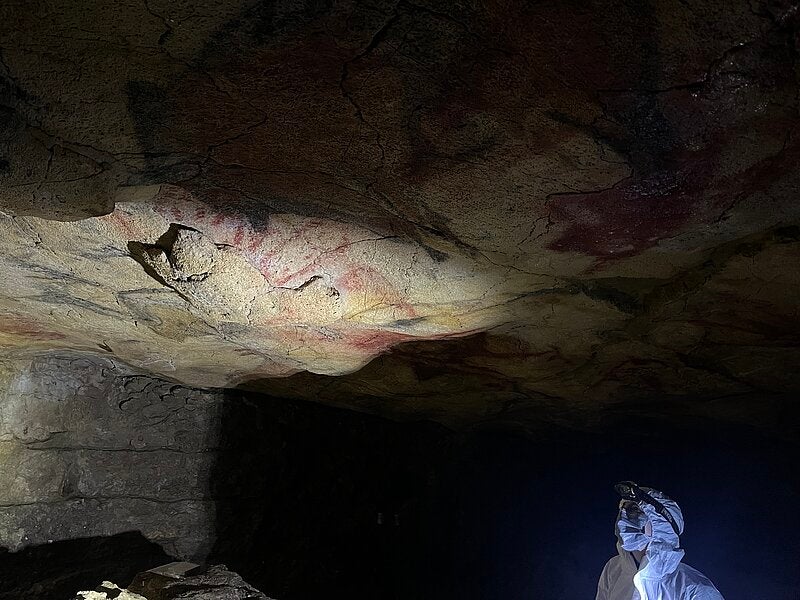
Polychrome ceiling of Altamira from which pigment samples were analyzed.
© Matthias Meyer
The researchers successfully recovered ancient human DNA in samples taken from five of the 11 caves. In most cases, it was mixed with ancient animal DNA—often from species such as bats and rodents. This mixed DNA was an important signal: The researchers believe it likely indicates that sediments from the cave floor were naturally transferred to the walls. By contrast, in Portugal's Escoural Cave the researchers found isolated human DNA that they believe came from the original artists—perhaps left by their touch, when they rested their body on the wall, or from saliva or sweat during the painting process.
At Spain’s Covarón Cave, most of the samples were mixed animal and human DNA, but they contained much more ancient DNA than elsewhere. As a result, the researchers were able to trace the genetic ancestry of the people who once lived there.
Their analysis indicates that the cave paintings were probably made by hunter-gatherers who lived in Western and Central Europe sometime between 16,700 and 5,200 years ago. Unmixed human DNA from this period was found only on unpainted cave walls, so it’s unclear if they were the artists.
Adam Brumm, an archaeologist at Australia's Griffith University who was not involved in the study, welcomes the results: "Several years ago we tried to extract ancient DNA from dated Late Pleistocene hand stencils in Sulawesi and Borneo," he says. "We had no success, so I’m glad to see the promising results obtained by this team."
Brumm was one of the scientists that found the world’s earliest-known cave art on Sulawesi, which is thought to be more than 67,800 years old.
“The demonstration that human DNA can persist on cave walls for thousands of years is encouraging,” he says. If successful, extracting ancient human DNA from rock art “will be a game-changer that will revolutionise our understanding of early human culture.”
It’s Time to Stand Up for Science
If you enjoyed this article, I’d like to ask for your support. Scientific American has served as an advocate for science and industry for 180 years, and right now may be the most critical moment in that two-century history.
I’ve been a Scientific American subscriber since I was 12 years old, and it helped shape the way I look at the world. SciAm always educates and delights me, and inspires a sense of awe for our vast, beautiful universe. I hope it does that for you, too.
If you subscribe to Scientific American, you help ensure that our coverage is centered on meaningful research and discovery; that we have the resources to report on the decisions that threaten labs across the U.S.; and that we support both budding and working scientists at a time when the value of science itself too often goes unrecognized.
In return, you get essential news, captivating podcasts, brilliant infographics, can't-miss newsletters, must-watch videos, challenging games, and the science world's best writing and reporting. You can even gift someone a subscription.
There has never been a more important time for us to stand up and show why science matters. I hope you’ll support us in that mission.

Thank you,
David M. Ewalt, Editor in Chief, Scientific American
SubscribeBadenoch blasts 'moaning' female Labour MPs over Burnham jobs 'quota'
Kemi Badenoch has told Labour women to earn a job in Andy Burnham's Cabinet instead of demanding they are handed jobs because of their gender.
The Tory leader lashed out today amid reports that female MPs are demanding the de-facto new prime minister introduce a 50:50 gender split 'quota' in his government.
Amid reports that former foreign secretary David Miliband is being lined up to return to the role, possibly with his brother Ed as Chancellor, one female minister also complained that Burnham could not have 'more Milibands than women' in the top posts.
But in a scathing article in the Times today Mrs Badenoch told them to 'stop moaning' and get chosen on merit instead of retreating into 'more of the failed identity politics that is holding back our country'.
'There are many, many reasons why you shouldn't have any Milibands in the cabinet,' she said.
'But complaining that the boys haven't given them the right jobs or that the boys are taking all the jobs, just shows that Labour's women still don't get it.'
The idea of quotas was also attacked by Baroness Jacqui Smith, Labour's Skills Minister.
Asked by Times Radio if Mr Burnham should reserve jobs for women, she said: 'No, I think what Andy Burnham should be doing is building the very best team around him to change this country.'

A letter written by the Women's Parliamentary Labour Party has called on Mr Burnham to ensure a 50:50 split between men and women in government jobs

Amid reports that former foreign secretary David Miliband (above, right, in 2010) is being lined up to return to the role, possibly with his brother Ed as Chancellor, one female minister complained that Burnham could not have 'more Milibands than women' in the top posts

But Mrs Badenoch told them to pipe down and get chosen on merit instead of retreating into 'more of the failed identity politics that is holding back our country'
A letter written by the Women's Parliamentary Labour Party and seen by the BBC has called on Mr Burnham to ensure a 50:50 split between men and women in government jobs after he succeeds Sir Keir Starmer.
'We are asking you to demonstrate this change from day one and address the toxicity and misogyny within our own party and government,' it said.
Labour has never had a female leader, while the Conservatives have had three, and Mrs Badenoch urged the government to follow its meritocratic example.
'If you run a meritocracy, then you do not have to worry about jobs for the boys,' she wrote.
'Every woman who is a Conservative MP, every woman who has ever won the leadership, has had to fight to get where she is.
'By contrast, Labour women are demanding guarantees from Burnham. But the truth is he doesn't have to give any guarantees.
'If none of Labour's women are prepared to get their hands dirty and challenge him for the leadership, their demands are toothless.'
'In fact, it's quite revealing that the women's parliamentary Labour Party has written to Burnham asking him to commit himself to at least 50 per cent female ministers.
'This has nothing to do with meritocracy. It is yet more of the failed identity politics that is holding back our country.'