Lawmakers press Eli Lilly for China drug trials tied to military-linked hospitals
Lawmakers press Eli Lilly for China drug trials tied to military-linked hospitals
Chairman Moolenaar cites more than 220 clinical studies in China since 2003, warning of biotechnology data risks and Uyghur informed consent concerns
 By
Morgan Phillips Fox News
Published
June 30, 2026 2:51pm EDT close
By
Morgan Phillips Fox News
Published
June 30, 2026 2:51pm EDT close  Video
Video Navy SEAL-turned-investor says Trump is bringing America's drone dominance back to beat China
Harpoon Ventures founder Larsen Jensen details the crucial need for strengthening U.S. tech leadership in defense. He emphasizes investment in AI, drone warfare, and space capabilities to counter China's growing dominance. Jensen reveals Harpoon Ventures' fourth fund and new Black Flag Investor List, aiming to boost industrial resilience and national security against adversaries.
NEWYou can now listen to Fox News articles!FIRST ON FOX: House Select Committee on the Chinese Communist Party Chairman John Moolenaar is launching an investigation into pharmaceutical giant Eli Lilly's clinical trial operations in China, demanding records related to research conducted at Chinese military-affiliated hospitals and facilities in Xinjiang.
In a Tuesday letter obtained by Fox News Digital, Moolenaar, R-Mich., demanded that Eli Lilly provide detailed information about its clinical trial operations in China, including how the company ensures ethical standards, protects sensitive biotechnology and intellectual property, and veterans research conducted at hospitals linked to the People's Liberation Army and in Xinjiang, where the Chinese government has been accused of widespread human rights abuses against Muslim Uyghurs and other ethnic minorities.
The committee says publicly available records indicate Lilly has sponsored or collaborated on more than 220 clinical studies in China since 2003, including at least 11 trials involving hospitals in Xinjiang, China, and at least 16 involving Chinese military medical centers. Several remain active today, the letter says.
The inquiry marks an escalation in congressional scrutiny of U.S. pharmaceutical companies' growing ties to China as lawmakers warn that clinical research conducted at Chinese military-affiliated hospitals and in Xinjiang, China, could pose national security, intellectual property and human rights risks. The committee is seeking records from Lilly as it expands its investments and research partnerships in China.
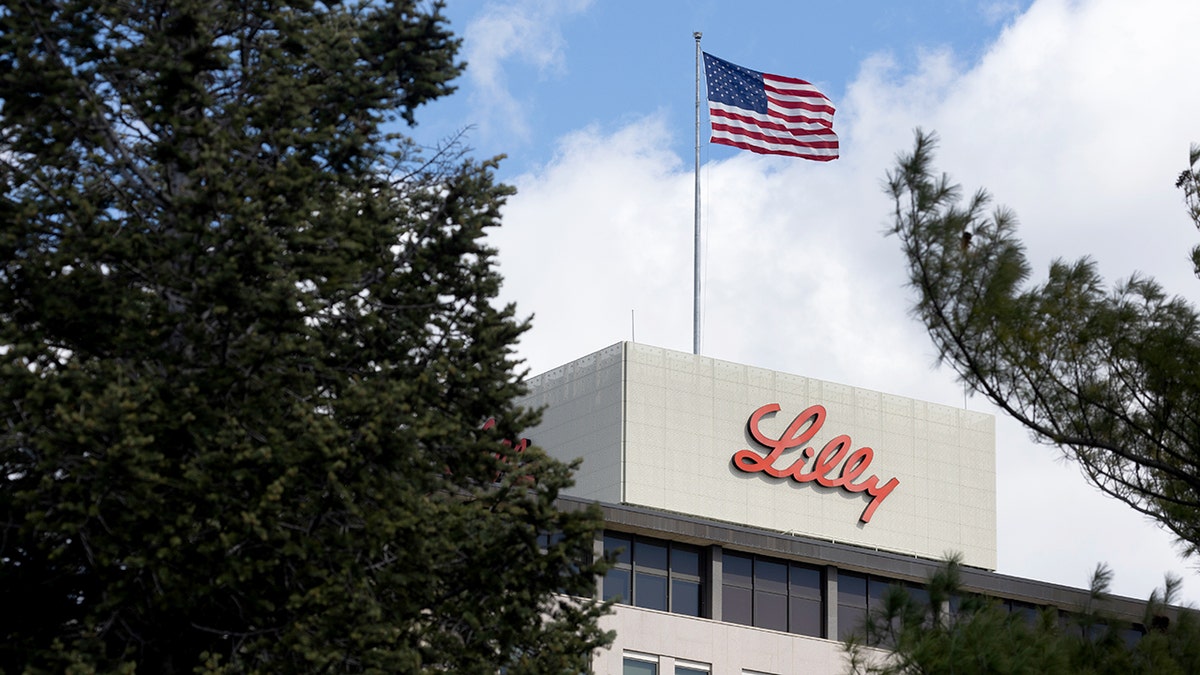
A flag flies above the headquarters campus of Eli Lilly and Company on March 17, 2024 in Indianapolis, Indiana. (Flag over Eli lilly)
Moolenaar stressed that the committee has "no evidence that Lilly has engaged in illegal activity or wrongdoing," but argued that conducting clinical trials in China — particularly in Xinjiang, China, and at military-affiliated hospitals, hospitals affiliated with China's People's Liberation Army (PLA), which the committee argues could gain access to valuable biotechnology research and clinical trial data generated through collaborations with U.S. companies.
CHINA’S GRIP ON RARE-EARTH MAGNETS COULD CRUSH US DRONE INDUSTRY BEFORE IT GROWS
"The United States is engaged in a fierce biotechnology competition with the People's Republic of China," Moolenaar wrote, arguing that biotechnology has become a strategic arena in U.S.-China competition with implications for national security, economic competitiveness and the protection of Americans' medical data.
He pointed to China's latest five-year plan, which identifies biotechnology as a national priority and calls for expanded use of artificial intelligence across the sector.
Moolenaar said China has transformed itself into one of the world's fastest and least expensive places to conduct early-stage human drug trials through regulatory reforms, state subsidies and rapid patient enrollment. The committee argues that speed has made China increasingly attractive for global drug development while also raising concerns about ethics, data security and intellectual property.

The committee says publicly available records indicate Lilly has sponsored or collaborated on more than 220 clinical studies in China since 2003, including at least 11 trials involving hospitals in Xinjiang and at least 16 involving Chinese military medical centers. (iStock)
GABBARD SAYS DECLASSIFIED BIOLAB RECORDS VALIDATE CONCERNS PREVIOUSLY DISMISSED AS MISINFORMATION
The inquiry comes as Lilly has continued expanding its presence in China.
Earlier in 2026, the company announced a roughly $3 billion investment to expand manufacturing and local supply in the country, bringing its total investment in China to nearly $6 billion.
Lilly also has deepened its research ties with Chinese biotechnology companies, announcing an up to $8.8 billion oncology and immunology collaboration with Innovent Biologics in February and an agreement worth up to about $3 billion with Haisco Pharmaceutical Group earlier ni June. Both partnerships are referenced in Moolenaar's letter as examples of the company's expanding relationships with Chinese drugmakers.
The chairman also questioned whether China's clinical trial system adequately protects participants' rights. He cited research suggesting many participants misunderstand the experimental nature of drug studies or mistakenly believe treatments have already been proven effective, raising concerns about whether informed consent is being properly obtained.
The letter separately raises concerns about trials conducted in Xinjiang, pointing to reports from the United Nations, the State Department and human rights organizations documenting allegations of forced medical testing, DNA collection and other abuses targeting Uyghurs. Moolenaar argued those conditions warrant heightened scrutiny over whether clinical trial participants in the region are volunteering freely.
The committee also argues that research conducted at hospitals affiliated with the People's Liberation Army raises questions about whether sensitive biotechnology research and proprietary data developed through clinical trials could ultimately benefit China's military biotechnology programs.
CLICK HERE TO DOWNLOAD THE FOX NEWS APP
Moolenaar gave Lilly until July 17 to provide documents detailing its due diligence procedures, inspections of clinical trial sites, agreements with Chinese companies, and safeguards for protecting sensitive data and intellectual property.
"Lilly has received the letter from the House Select Committee on China. We are reviewing the letter closely," a company spokesperson told Fox News Digital.
NHS maternity probes spark backlash by referring to 'birthing people'
Major investigations into NHS maternity failings have sparked a backlash by referring to ‘birthing people’ and ‘birthing population’ rather than simply ‘women’.
Campaigners said only women can get pregnant and give birth and ‘unscientific jargon’ that pretends otherwise adds ‘insult to injury’ for the families affected by care scandals.
The language used appears to have been ‘shoe-horned in’ to pander to the trans lobby, they add, and shows a ‘shameful disregard’ to the mums harmed.
The National Maternity and Neonatal Investigation, chaired by Baroness Valerie Amos, today found maternity units are ‘not fit for purpose’ with filthy and crumbling hospitals leaving mothers suffering unsafe and undignified care.
It found the NHS continues to inflict harm, ignore women and cover-up mistakes despite years of reviews, inquiries and hundreds of previous recommendations.
But it seemingly fails to notice the irony of highlighting the role of medical misogyny and the repeated failure to listen to women’s voices while using the phrase ‘birthing people’ throughout.
The report defends its wording in a breakout box before the foreword by saying it uses what it describes as ‘an additive approach to language’.
‘By this, we mean that the report seeks to centre the experiences of women and mothers, while also recognising that not everyone who is pregnant, gives birth or uses maternity and perinatal services identifies as a woman or mother,’ it adds.

Senior midwife Donna Ockenden (pictured) led the inquiry into Nottingham University Hospitals NHS Trust.
The report came less than a week after an inquiry into Nottingham University Hospitals NHS Trust, led by senior midwife Donna Ockenden, found more than 500 mothers and babies suffered avoidable harm or died due to ‘deeply embedded systemic failures’ at the ‘toxic’ hospital trust.
That report also used the phrases ‘birthing population’ and ‘birthing people’.
Fiona McAnena, director of campaigns at sex-based rights charity Sex Matters, told the Daily Mail: 'It’s a disgrace that Baroness Amos and Donna Ockenden refer to ‘mothers and birthing people’ in their investigations into NHS neonatal and maternity services.
'There have been so many heartbreaking stories of mothers and babies gravely let down by NHS trusts across the UK, but someone decided to shoe-horn "birthing people" into both the Amos and Ockenden reports, presumably so as not to offend the trans lobby.
'The pain and loss is felt by mothers and fathers, but only women can become pregnant and give birth. To pretend otherwise shows shameful disregard for women harmed by these systemic failures in the NHS.
'They are all mothers, not "birthing people".
'The priority in the NHS should be the treatment and care of pregnant women and their babies, not pandering to transactivists with this unscientific jargon, which adds insult to injury for families affected by these scandals.'
Writing on X, Independent MP Rosie Duffield also took aim at Lady Amos, saying ‘Got to say, it's incredibly irritating, and entirely unnecessary that every single time the word “women” is used in the report, it's immediately followed by “and birthing people”.

Baroness Valerie Amos (pictured) chaired the National Maternity and Neonatal Investigation.
‘A tiny handful of women, doing a physical thing that only our sex is capable of, identify otherwise.’
Claire Coutinho, the shadow equalities minister, told the Daily Mail: ‘This review should be a major turning point for maternity and neonatal services, exposing some of the awful failings that have seriously let women and their babies down.
‘Adopting activist language in a way that erases the role of mothers seriously undermines the importance of its findings.
‘The women at the heart of this issue deserve better than to written out of the story completely.
‘It is yet another example of how our public services have been captured by an obsession with equality and diversity.’
Families whose children were harmed or died due to NHS maternity failings said Lady Amos’s report is not sufficiently independent, as they renewed their calls for a statutory public inquiry.
The Maternity Safety Alliance said plans for a new national maternity commissioner in the format she proposed are ‘dangerous’, while there is not enough scrutiny of regulators such as the Care Quality Commission and General Medical Council.
Meanwhile, it has emerged that the chairman of inquiries into maternity scandals at Morecambe Bay and East Kent resigned from Lady Amos’s review in a dispute over ‘normal birth ideology’, which sees women pressured into having a vaginal birth even if they request a c-section.

Independent MP Rosie Duffield (pictured) said use of the phrase 'birthing people' was 'incredibly irritating'.
Dr Bill Kirkup stepped down from his position as expert adviser, with Health Service Journal reporting it was due to him wanting a stronger line on the patient safety consequences of a normal birth ideology than Lady Amos would agree to.
Lady Amos said in her review they ‘did not find that “normal birth ideology” was currently widespread in the maternity services we visited in England’.
Ms Ockenden also criticised the Amos report and threw doubt on whether she would accept the job of national maternity commissioner if offered it.
She told Times Radio: ‘I’ve looked at it overnight and I don’t see anything that we didn’t already know, that hasn’t already been spelled out very clearly.’
Asked if she would take on the role, Ms Ockenden said: ‘I wouldn’t want to be a failure because of lack of time or lack of focus or effort by others who should be doing more.’
Health secretary James Murray today told the Commons that maternity failures in the NHS are ‘on a scale that shames our society’.
And Wes Streeting pressed the Government to bring in the Hillsborough law before the summer to improve NHS maternity services.
The former health secretary said culture change will not happen without proper accountability and its duty of candour rules will help stop the NHS’s ‘cover-up culture’.