Watch artisans craft Nat Geo's enormous new handmade globe
 Video byDominic HowlettText byHalley BrownPublished June 22, 2026
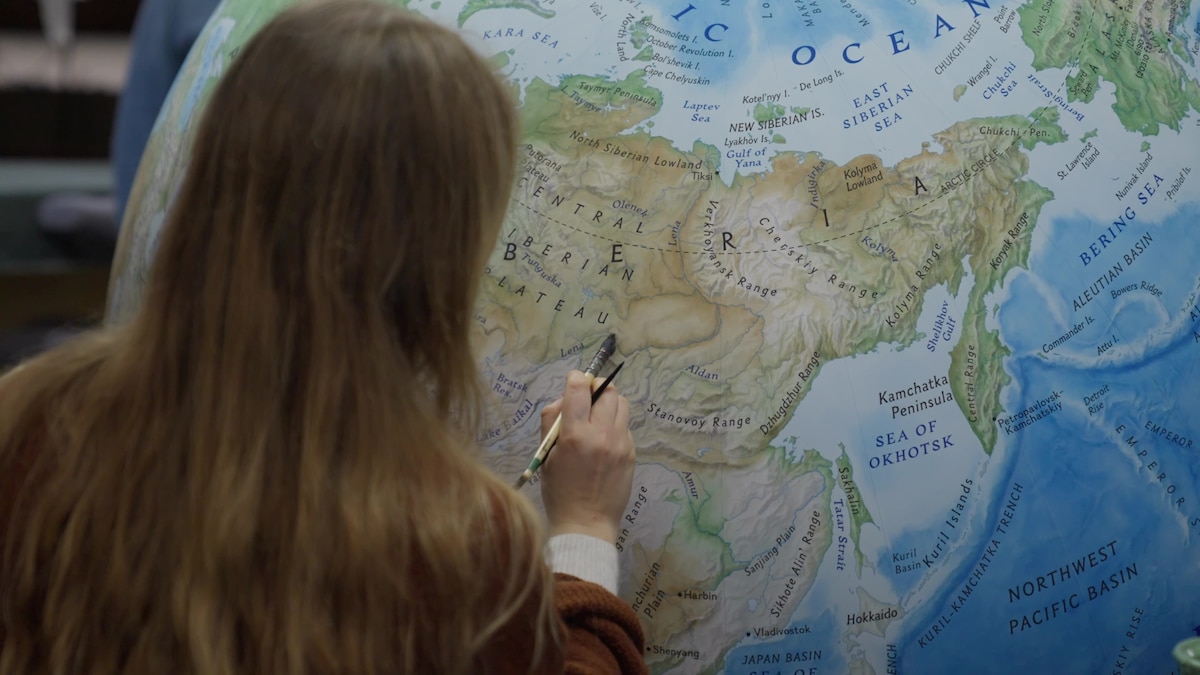
On a cloudy day in central London, artisans at Bellerby & Co, Globemakers are putting the finishing touches on the largest handcrafted globe they’ve ever made. Over the previous few months, every plateau, peninsula, island, and mountain ridge on Earth had been painstakingly hand-painted on the five foot diameter 100-pound sphere. Today, a final coat of watercolor paint is laid on, but then, a new challenge arises: how to get it out of the studio.
The completed globe is so large that it doesn’t fit through the front door. Instead, a crane plucks the globe, now placed in a shipment crate, from the studio’s roof and sets it in the quiet alleyway, where it starts a transatlantic journey to be installed at the new National Geographic Museum of Exploration, opening this week.
Much about traditional globe making hasn’t changed since the 16th century. But Bellerby & Co is a relative newcomer to the craft.
In 2008, owner Peter Bellerby was working in real estate when he went searching for a handcrafted globe for his father’s 80th birthday. His only options were either purchasing an expensive antique, so fragile it couldn’t be touched, or a mass-produced globe riddled with geographic errors. He couldn’t find a company making one-off bespoke globes.
He decided to make two globes on his own, immersing himself in the meticulous craft. Bellerby learned mostly by trial and error how to make plaster spheres, stretch wet paper across a a rounded surface, and design maps with exact measurements. He didn’t complete the globes in time for his father’s 80th birthday; the two 19.5-inch globes took two years to finish. But Bellerby was hooked.
The experience revealed a gap in the globemaking market, and Bellerby feared the traditional art had been lost. “So I thought I’d give it a go,” Bellerby said.
Since then, Bellerby has evolved his process, mixing traditional and modern globemaking techniques to craft custom pieces of art. Whereas the watercolor finishes are similar to what globemakers would put on their projects centuries ago, the metal elements on their bespoke bases are precision-designed by a Formula One fabricator.
In late 2025, the nonprofit National Geographic Society cold-called the studio with a request: Could the studio produce what would be its largest-ever handmade globe for the lobby of the Society's new museum? The globe had to highlight the world’s natural features and adhere to the strict standards of the Society’s cartography department. And it had to be completed in just nine months.
Smaller globes take around a year to make, but “the team was up for the challenge,” Bellerby said.
Here’s how Bellerby & Co pulled it off.
Wrapping a football
The first step in globemaking is manufacturing a sphere. Here, the company uses bespoke molds, casting two halves of the hollow sphere in glass-reinforced plastic. Then the surface is sanded so printed maps can be glued to the sphere.
Next comes the challenge of printing an incredibly detailed 2D map file that Bellerby’s painters will use as their guide. These maps include most geographic features on Earth, but details that align on a computer screen can misalign when wrapped around a sphere. So Bellerby & Co cartographers like Ollie Cameron check every detail for accuracy, from the labels to river width, ensuring they won’t get distorted when pasted onto the sphere.
Cutting the gores
Accurately wrapping a flat piece of paper around a sphere is nearly impossible. But globemakers have a geometric solution: The printed maps are hand-cut into slices called gores. Gores look like surfboards or orange peel slices—the shape allows globemakers to wrap paper around the surface with minimal distortion. Each "slice" contains a precise section of the world scaled to a specific shape and size to fit the sphere.
For the National Geographic project, globemakers used 24 gores spanning about eight feet of paper. The gores were lightly painted before they were applied to the sphere, with careful attention on the oceans, which require many shades of blue to reflect the oceanic ridges, trenches, and rises.
Applying the gores
Next, the gores were carefully stretched over the blank sphere. Stretching wet paper is a delicate process. One false move and the gores could tear or become misaligned. What’s more, factors like temperature and humidity can affect how the paper behaves. It took a coordinated effort by two globemakers to apply the gores without damaging the paper.
Painting the world
When the gores are dry, more layers of watercolor paint are applied. Painter Kasia Ostrowski painted every land mass and body of water, combining transparent watercolor and gouache paints to achieve the right color scheme. Place-names were printed on the 2D map file in the official National Geographic typeface, then painted over again during this step. When Ostrowski was nearly done, National Geographic Society cartographers visited Bellerby & Co to manually fact-check every hand-painted detail against their strict cartographic standards.
Mounting the globe
Finally, the globe was mounted on its base. Bellerby & Co uses a range of materials for bases, but the National Geographic globe required one that would support the weight of its 100 pound spinning sphere.
They chose an almost equally heavy 150 pound metal base produced by a Formula One fabricator that took six people to move into place. Then the globe was then lifted into the air and carefully positioned on the base.
Installing the final globe
From celestial globes to artistic interpretations of the moon, Bellerby & Co employs the modern and traditional techniques to create globes of all shapes and sizes. Many of the handcrafted pieces decorate private residences, having one on display for the world to enjoy was seen as a special opportunity for Bellerby & Co.
“This is unbelievable, fantastic,” Bellerby says, beaming at his team’s finished work.
You can see the globe handcrafted by Bellerby & Co, Globemakers at the Museum of Exploration in Washington, DC.
Opening in Washington, D.C., the Museum of Exploration will unlock your inner explorer. Discover immersive exhibits illuminating the wonders of our world, nearly 140 years of stunning photography, and inspiring stories from world-changing National Geographic Explorers. Find details on exhibitions and events at moe.nationalgeographic.org.Badenoch blasts 'moaning' female Labour MPs over Burnham jobs 'quota'

Kemi Badenoch has told Labour women to earn a job in Andy Burnham's Cabinet instead of demanding they are handed jobs because of their gender.
The Tory leader lashed out today amid reports that female MPs are demanding the de-facto new prime minister introduce a 50:50 gender split 'quota' in his government.
Amid reports that former foreign secretary David Miliband is being lined up to return to the role, possibly with his brother Ed as Chancellor, one female minister also complained that Burnham could not have 'more Milibands than women' in the top posts.
But in a scathing article in the Times today Mrs Badenoch told them to 'stop moaning' and get chosen on merit instead of retreating into 'more of the failed identity politics that is holding back our country'.
'There are many, many reasons why you shouldn't have any Milibands in the cabinet,' she said.
'But complaining that the boys haven't given them the right jobs or that the boys are taking all the jobs, just shows that Labour's women still don't get it.'
The idea of quotas was also attacked by Baroness Jacqui Smith, Labour's Skills Minister.
Asked by Times Radio if Mr Burnham should reserve jobs for women, she said: 'No, I think what Andy Burnham should be doing is building the very best team around him to change this country.'

A letter written by the Women's Parliamentary Labour Party has called on Mr Burnham to ensure a 50:50 split between men and women in government jobs

Amid reports that former foreign secretary David Miliband (above, right, in 2010) is being lined up to return to the role, possibly with his brother Ed as Chancellor, one female minister complained that Burnham could not have 'more Milibands than women' in the top posts

But Mrs Badenoch told them to pipe down and get chosen on merit instead of retreating into 'more of the failed identity politics that is holding back our country'
A letter written by the Women's Parliamentary Labour Party and seen by the BBC has called on Mr Burnham to ensure a 50:50 split between men and women in government jobs after he succeeds Sir Keir Starmer.
'We are asking you to demonstrate this change from day one and address the toxicity and misogyny within our own party and government,' it said.
Labour has never had a female leader, while the Conservatives have had three, and Mrs Badenoch urged the government to follow its meritocratic example.
'If you run a meritocracy, then you do not have to worry about jobs for the boys,' she wrote.
'Every woman who is a Conservative MP, every woman who has ever won the leadership, has had to fight to get where she is.
'By contrast, Labour women are demanding guarantees from Burnham. But the truth is he doesn't have to give any guarantees.
'If none of Labour's women are prepared to get their hands dirty and challenge him for the leadership, their demands are toothless.'
'In fact, it's quite revealing that the women's parliamentary Labour Party has written to Burnham asking him to commit himself to at least 50 per cent female ministers.
'This has nothing to do with meritocracy. It is yet more of the failed identity politics that is holding back our country.'
Venezuela Fury and Noah Price subsidising their life by livestreaming

Venezuela Fury and her husband Noah Price look to be making their own way in the world by raking it in from their lucrative social media accounts.
The influencer daughter of Tyson and Paris Fury, 16, has become an internet sensation after tying the knot with her husband Noah, 19, earlier this year.
Since getting married and moving in together the couple have been earning thousands of pounds a month, livestreaming their life as newlyweds in their static caravan in the East Riding of Yorkshire.
And fans can't get enough of their regular life updates on TikTok and Kick, which have proved to be very profitable for the pair.
They look to be supporting themselves after Noah denied that he was given £5million by Venezuela's family as a wedding gift.
Despite his wife's huge family wealth, an estimated combined £160 million, Noah recently told his Kick followers that he 'pays for everything' for the couple.
Making light of the claims about Venezuela's millionaire financial status, Noah said: 'I actually pay for everything unfortunately. You'd expect the millionaire to pay for it wouldn't you.'

Venezuela Fury and Noah Price are earning thousands livestreaming their caravan life - after her new groom insisted he pays all the bills and denied he had £5m handout from her dad

The influencer daughter of Tyson and Paris Fury , 16, has become an internet sensation after tying the knot with her husband Noah, 19, earlier this year
Venezuela then asked their fans: 'Do you think I am a millionaire?'
Noah joked: 'She isn't a secret millionaire guys', before she broke into song and sang: 'But I live like a millionaire!'
But it seems according to estimated calculations from their social media work, Noah and Venezuela can more than afford to support themselves.
Noah has been livestreaming on platforms such as Kick and TikTok, where viewers can send paid gifts or donations.
He was previously encouraging viewers to send gifts on his honeymoon during livestreams, suggesting this is one revenue stream.
Both Noah and Venezuela have built substantial followings on Instagram and TikTok. They can potentially earn money through sponsored posts, brand collaborations, affiliate links and creator payouts.
Kick allows its creators to take home 95 per cent of the £4.99 subscription cost that fans pay.
Streamers keep 100 per cent of direct tips and donations, minus minor standard payment processing fees.
It is unclear how many subscribers Noah currently has because this information is hidden, but he does have 7,200 followers which is publicly viewable.
An industry insider has suggested Noah is making around £400 per video on TikTok, while Venezuela is likely to make £2,000 due to her following count of 1.3 million.

An industry insider has suggested Noah is making around £400 per video on TikTok, while Venezuela is likely to make £2,000 due to her following count of 1.3 million
In one video on their honeymoon, Noah asked his followers if they'd give them some more gifts now that they were married.
In a TikTok live viewed by 20,000 he said: 'Keep liking our videos people, keep sending gifts.'
After saying thank you to several of his followers he joked they should stick around on the livestream and 'watch Venezuela punch me in the mouth'.
The other half of the honeymooning couple said: 'I am, honestly!'
Noah previously confirmed that the pair don't share their finances after they were asked whether they have a shared bank account.
'She earns her money, I earn mine,' said Noah, as Venezuela joked: 'Yeah, what you gonna do about it.'
Noah went on to debunk the rumour that Tyson gave him £5million when he tied the knot with his daughter as he insisted: 'No Tyson did not give me £5million'.
Meanwhile Venezuela is being eyed up by executives for a fly on the wall TV series.

Noah went on to debunk the rumour that Tyson gave him £5million when he tied the knot with his daughter as he insisted: 'No Tyson did not give me £5million'
Boasting 1.3 million TikTok followers, Venezuela is already entertaining fans with her honest musings and candid moments, from cooking to kitting out her and Noah's static caravan home.
And following the success of the Netflix series At Home With The Furys, it is no wonder bosses are wanting to draw on the Fury popularity.
A TV insider said: 'The couple are not A-list celebrities but everyone has become obsessed with their love story.
'People are genuinely intrigued by them. Whether it’s the fact they have married so young, Venezuela’s famous family or their gypsy lifestyle, they have the ‘X factor'.
'Several TV executives think a proper fly-on-the-wall series following their lives as newlyweds in the gypsy community would be fascinating,' they told The Sun.
It is thought Netflix would be likely to produce the series due to their already established relationship with the Furys.
Venezuela's representatives told The Daily Mail: 'We have many offers on the table regarding Venezuela which we are discussing.'