U.N. Nuclear Body Chief Celebrates U.S.-Iran Deal: 'Now the Technical Work Starts'
U.N. Nuclear Body Chief Celebrates U.S.-Iran Deal: ‘Now the Technical Work Starts’
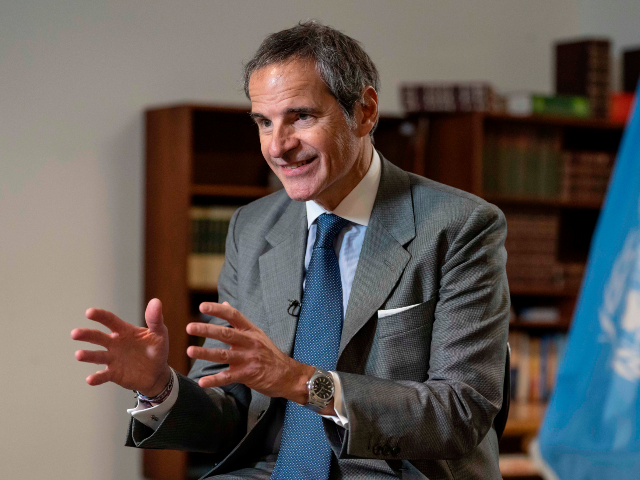

The head of the International Atomic Energy Agency (IAEA), Rafael Grossi, cheered the signing of a memorandum of understanding between America and Iran that allows for the end of active hostilities, especially appreciating that it carved out an oversight role for his agency.
President Donald Trump announced this weekend that, after months of negotiations, the Iranian terror regime had agreed to a temporary deal to extend a ceasefire that had paused “Operation Epic Fury” in April. Prior to the pause, the U.S. military had engaged in widespread bombing of Iranian military targets and, alongside the Israel Defense Forces (IDF), eliminated dozens of senior Iranian officials, among them dictator Ali Khamenei. Among several reasons for the American attack, which began in February, was Iran’s insistence on engaging in illicit nuclear development, particularly the enrichment of uranium at rates that are not compatible with any known civilian use. President Trump has repeatedly stated that he would not allow Iran to possess a nuclear weapon given the regime’s regular threats to destroy the nation of Israel and Iran’s heavy and consistent investment in a network of terror organizations including Hamas, Hezbollah, Palestinian Islamic Jihad, the Houthis of Yemeni, and a host of Iraqi Shiite paramilitaries.
The IAEA has for years expressed frustration with the Iranian regime, as it is a signatory to the nuclear Non-Proliferation Treaty (NPT) and has international legal obligations to allow the agency to inspect its nuclear sites. Tehran has all but banned IAEA inspectors from the country, however, save for some minor operations and meetings with officials that did not allow them to have appropriate access to the information they need to enforce international law. In his comments on Thursday, Grossi emphasized the importance of having that access.
“The fact that the indispensable role of the IAEA is recognized is a sound point of departure, and now it’s for us to sit down with our American colleagues, our Iranian colleagues, and start formulating the concrete steps that will have to be taken,” he told reporters. “So I think it’s good that the memorandum is there. Now the technical work starts.”
Grossi insisted that he was proceeding in his work assuming “good faith” from both America and Iran.
“I think if they have signed it, if they have taken the step of signing this memorandum, this important document, it’s because everybody wants this to be a success,” he stated, adding in French, “We cannot allow ourselves to be frustrated by past failures. What has happened has happened. Now we have a chance and we need to seize it, and that is what we will try to do with all our force and conviction.”
The text of the memorandum of understanding between Iran and America, as verified by Breitbart News on Wednesday, requires the participation of the IAEA in two separate sections of its 14 points. In point 7, Washington agrees to help lift all sanctions on Iran if the Iranian government holds to the terms of the memorandum and of the “final deal” expected to specify terms around the Iranian nuclear program after 60 days of negotiations. IAEA sanctions are specifically identified on the list of those to be lifted.
As part of Iran’s commitment that it will never build nuclear weapons, the agreement states the country has “agreed to resolve the disposition of stockpiled enriched material pursuant to a mechanism that will be mutually agreed upon, in accordance with the schedule mentioned in paragraph 7, with the minimum methodology to be down blending on-site, under the supervision of the IAEA.”
President Trump reportedly signed a copy of the memorandum of understanding at the Palace of Versailles in France on Wednesday. Iranian state media confirmed that President Masoud Pezeshkian, who is subordinate to missing “supreme leader” Mojtaba Khamenei, also signed the agreement on Wednesday, and that Pakistani Prime Minister Shahbaz Shariz has also agreed to be a signatory; Pakistan assumed the role of lead mediator in the negotiations that resulted in the memorandum.
As head of the IAEA, Grossi has repeatedly called for Iran to abide by international law and allow IAEA inspections. He has also criticized the prior nuclear agreement between Iran and the United States, the “Joint Comprehensive Plan of Action” (JCPOA) brokered by former President Barack Obama in 2015.
“Nobody applies it, nobody follows it. There have been attempts to revive it here in Vienna. But unfortunately, although they were relatively close to success, they failed for reasons unknown to me, because I was not involved in the process,” Grossi complained about the JCPOA in 2024.
As negotiations continued for a new agreement in April, Grossi insisted that a new agreement must have more robust protections than the JCPOA.
“Iran has a very ambitious, wide nuclear program, so all of that will require the presence of IAEA inspectors,” he said at the time. “Otherwise, you will not have an agreement. You will have an illusion of an agreement.”
According to reports this month, Grossi’s update to the IAEA Board of Inspectors in early June included an admission that, due to Iranian obstruction, the agency did not have information about the status or amount of enriched uranium the country possesses. In June 2025, President Trump approved airstrikes on Iran’s three largest enrichment sites in Fordow, Natanz, and Isfahan. According to Grossi, what happened to the enriched uranium there after the bombings remained a mystery as of early June.
“It is now almost one year that the Agency has had no access to any of the declared nuclear facilities affected by the military attacks of June 2025, therefore the Agency has lost continuity of knowledge of the previously declared nuclear material at those facilities,” Grossi reportedly explained. “This gives rise to a proliferation concern as this nuclear material includes 440 kg of highly enriched uranium, which the Agency has not been able to verify since June 2025.”
Follow Frances Martel on Facebook and Twitter.
Badenoch blasts 'moaning' female Labour MPs over Burnham jobs 'quota'

Kemi Badenoch has told Labour women to earn a job in Andy Burnham's Cabinet instead of demanding they are handed jobs because of their gender.
The Tory leader lashed out today amid reports that female MPs are demanding the de-facto new prime minister introduce a 50:50 gender split 'quota' in his government.
Amid reports that former foreign secretary David Miliband is being lined up to return to the role, possibly with his brother Ed as Chancellor, one female minister also complained that Burnham could not have 'more Milibands than women' in the top posts.
But in a scathing article in the Times today Mrs Badenoch told them to 'stop moaning' and get chosen on merit instead of retreating into 'more of the failed identity politics that is holding back our country'.
'There are many, many reasons why you shouldn't have any Milibands in the cabinet,' she said.
'But complaining that the boys haven't given them the right jobs or that the boys are taking all the jobs, just shows that Labour's women still don't get it.'
The idea of quotas was also attacked by Baroness Jacqui Smith, Labour's Skills Minister.
Asked by Times Radio if Mr Burnham should reserve jobs for women, she said: 'No, I think what Andy Burnham should be doing is building the very best team around him to change this country.'

A letter written by the Women's Parliamentary Labour Party has called on Mr Burnham to ensure a 50:50 split between men and women in government jobs

Amid reports that former foreign secretary David Miliband (above, right, in 2010) is being lined up to return to the role, possibly with his brother Ed as Chancellor, one female minister complained that Burnham could not have 'more Milibands than women' in the top posts

But Mrs Badenoch told them to pipe down and get chosen on merit instead of retreating into 'more of the failed identity politics that is holding back our country'
A letter written by the Women's Parliamentary Labour Party and seen by the BBC has called on Mr Burnham to ensure a 50:50 split between men and women in government jobs after he succeeds Sir Keir Starmer.
'We are asking you to demonstrate this change from day one and address the toxicity and misogyny within our own party and government,' it said.
Labour has never had a female leader, while the Conservatives have had three, and Mrs Badenoch urged the government to follow its meritocratic example.
'If you run a meritocracy, then you do not have to worry about jobs for the boys,' she wrote.
'Every woman who is a Conservative MP, every woman who has ever won the leadership, has had to fight to get where she is.
'By contrast, Labour women are demanding guarantees from Burnham. But the truth is he doesn't have to give any guarantees.
'If none of Labour's women are prepared to get their hands dirty and challenge him for the leadership, their demands are toothless.'
'In fact, it's quite revealing that the women's parliamentary Labour Party has written to Burnham asking him to commit himself to at least 50 per cent female ministers.
'This has nothing to do with meritocracy. It is yet more of the failed identity politics that is holding back our country.'
Venezuela Fury and Noah Price subsidising their life by livestreaming

Venezuela Fury and her husband Noah Price look to be making their own way in the world by raking it in from their lucrative social media accounts.
The influencer daughter of Tyson and Paris Fury, 16, has become an internet sensation after tying the knot with her husband Noah, 19, earlier this year.
Since getting married and moving in together the couple have been earning thousands of pounds a month, livestreaming their life as newlyweds in their static caravan in the East Riding of Yorkshire.
And fans can't get enough of their regular life updates on TikTok and Kick, which have proved to be very profitable for the pair.
They look to be supporting themselves after Noah denied that he was given £5million by Venezuela's family as a wedding gift.
Despite his wife's huge family wealth, an estimated combined £160 million, Noah recently told his Kick followers that he 'pays for everything' for the couple.
Making light of the claims about Venezuela's millionaire financial status, Noah said: 'I actually pay for everything unfortunately. You'd expect the millionaire to pay for it wouldn't you.'

Venezuela Fury and Noah Price are earning thousands livestreaming their caravan life - after her new groom insisted he pays all the bills and denied he had £5m handout from her dad

The influencer daughter of Tyson and Paris Fury , 16, has become an internet sensation after tying the knot with her husband Noah, 19, earlier this year
Venezuela then asked their fans: 'Do you think I am a millionaire?'
Noah joked: 'She isn't a secret millionaire guys', before she broke into song and sang: 'But I live like a millionaire!'
But it seems according to estimated calculations from their social media work, Noah and Venezuela can more than afford to support themselves.
Noah has been livestreaming on platforms such as Kick and TikTok, where viewers can send paid gifts or donations.
He was previously encouraging viewers to send gifts on his honeymoon during livestreams, suggesting this is one revenue stream.
Both Noah and Venezuela have built substantial followings on Instagram and TikTok. They can potentially earn money through sponsored posts, brand collaborations, affiliate links and creator payouts.
Kick allows its creators to take home 95 per cent of the £4.99 subscription cost that fans pay.
Streamers keep 100 per cent of direct tips and donations, minus minor standard payment processing fees.
It is unclear how many subscribers Noah currently has because this information is hidden, but he does have 7,200 followers which is publicly viewable.
An industry insider has suggested Noah is making around £400 per video on TikTok, while Venezuela is likely to make £2,000 due to her following count of 1.3 million.

An industry insider has suggested Noah is making around £400 per video on TikTok, while Venezuela is likely to make £2,000 due to her following count of 1.3 million
In one video on their honeymoon, Noah asked his followers if they'd give them some more gifts now that they were married.
In a TikTok live viewed by 20,000 he said: 'Keep liking our videos people, keep sending gifts.'
After saying thank you to several of his followers he joked they should stick around on the livestream and 'watch Venezuela punch me in the mouth'.
The other half of the honeymooning couple said: 'I am, honestly!'
Noah previously confirmed that the pair don't share their finances after they were asked whether they have a shared bank account.
'She earns her money, I earn mine,' said Noah, as Venezuela joked: 'Yeah, what you gonna do about it.'
Noah went on to debunk the rumour that Tyson gave him £5million when he tied the knot with his daughter as he insisted: 'No Tyson did not give me £5million'.
Meanwhile Venezuela is being eyed up by executives for a fly on the wall TV series.

Noah went on to debunk the rumour that Tyson gave him £5million when he tied the knot with his daughter as he insisted: 'No Tyson did not give me £5million'
Boasting 1.3 million TikTok followers, Venezuela is already entertaining fans with her honest musings and candid moments, from cooking to kitting out her and Noah's static caravan home.
And following the success of the Netflix series At Home With The Furys, it is no wonder bosses are wanting to draw on the Fury popularity.
A TV insider said: 'The couple are not A-list celebrities but everyone has become obsessed with their love story.
'People are genuinely intrigued by them. Whether it’s the fact they have married so young, Venezuela’s famous family or their gypsy lifestyle, they have the ‘X factor'.
'Several TV executives think a proper fly-on-the-wall series following their lives as newlyweds in the gypsy community would be fascinating,' they told The Sun.
It is thought Netflix would be likely to produce the series due to their already established relationship with the Furys.
Venezuela's representatives told The Daily Mail: 'We have many offers on the table regarding Venezuela which we are discussing.'