Trump upends Senate GOP's plans once again with demands over nominations
 Politics
Trump upends Senate GOP's plans once again with demands over nominations
By Kaia Hubbard Politics Reporter Kaia Hubbard is a politics reporter for CBS News Digital, based in Washington, D.C. Read Full Bio Kaia HubbardJune 18, 2026 / 9:46 AM EDT / CBS News
Add CBS News on GoogleWashington — Senate Republicans were poised to pull off a complex maneuver this week to confirm President Trump's newest pick for director of national intelligence, a move that would have resolved an impasse over a lapsed warrantless surveillance program.
Then, the president himself threw a wrench in the plans. In an early morning Truth Social post from Europe, he said Jay Clayton's confirmation should not move forward until the Senate approves a replacement for his current role as the top federal prosecutor in Manhattan. He also made additional demands for the reauthorization of Section 702 of FISA, which grants intelligence agencies broad authority to spy on overseas targets. Senators canceled Clayton's confirmation hearing once it became clear he wouldn't appear.
Why did the president do it?
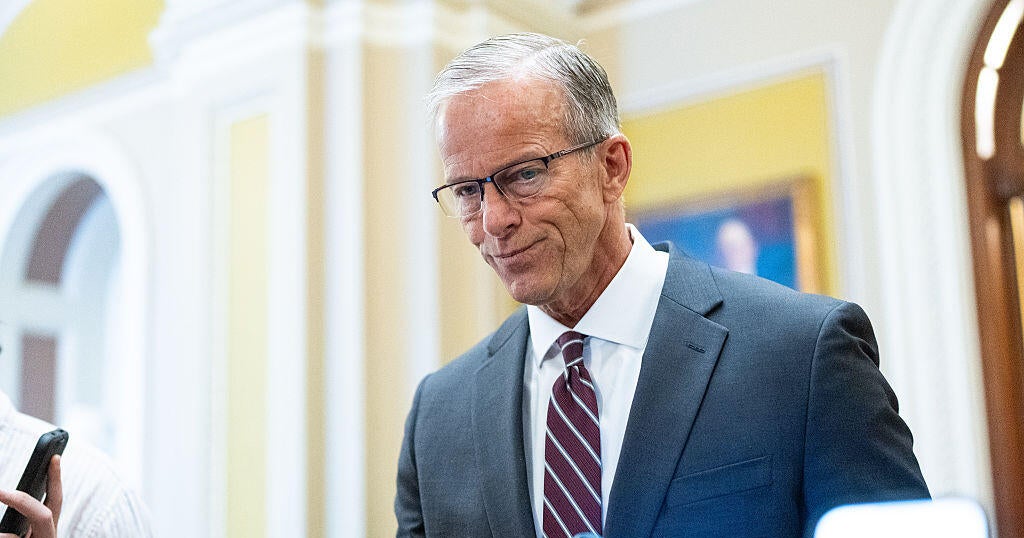
"Good question," Senate Majority Leader John Thune told reporters Wednesday.
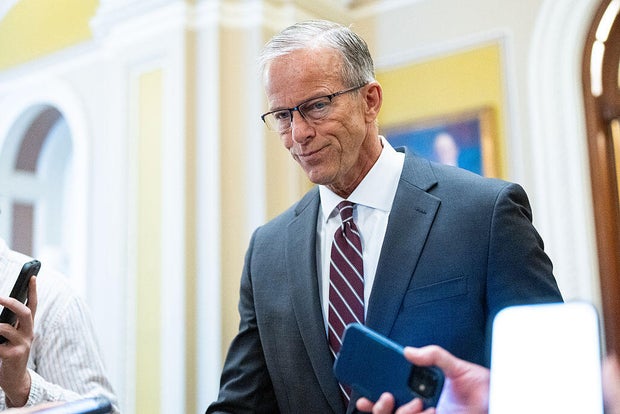
The breakdown represents the latest misalignment between the executive branch and Senate Republicans. A number of poorly timed announcements from the other end of Pennsylvania Avenue have forced Thune and his conference to squander carefully laid plans, exposing a widening rift within the party heading into the midterm elections.
The dispute over Clayton's nomination has its origins in another decision by the president: his announcement of Bill Pulte as acting director of national intelligence earlier this month. That move single-handedly foiled an emerging deal to reauthorize Section 702, with Democrats saying they would not support doing so if Pulte was set to take over.
And last month, the Justice Department's announcement of an "anti-weaponization" fund blew up Senate GOP plans to approve long-sought funding for immigration enforcement agencies, forcing them to delay votes. That same funding package had to be reworked days earlier to remove funds for security tied to Mr. Trump's massive White House ballroom project.
GOP senators' frustrations have been exacerbated by the president effectively ousting two of their own. He endorsed the primary opponents of Sens. Bill Cassidy of Louisiana and John Cornyn of Texas, leading to stinging primary defeats. Both have been more willing to criticize the administration in the weeks since.
"It's hard to divorce anything that happens here from what's happening in the political atmosphere around us," Thune told reporters last month.
Senate Republicans have also been clamoring for more details this week on the U.S.-Iran agreement that was announced Sunday. GOP leaders called for a briefing, but appeared to be left largely in the dark.
The miscommunications have once again put the majority leader in a difficult position, raising questions about why the president seems intent on making his life more difficult.
"I know the president pretty well, and I think he really likes Sen. Thune," GOP Sen. John Kennedy of Louisiana told reporters Wednesday. "I mean, who doesn't like John Thune? If you don't like John Thune, you don't like golden retrievers."
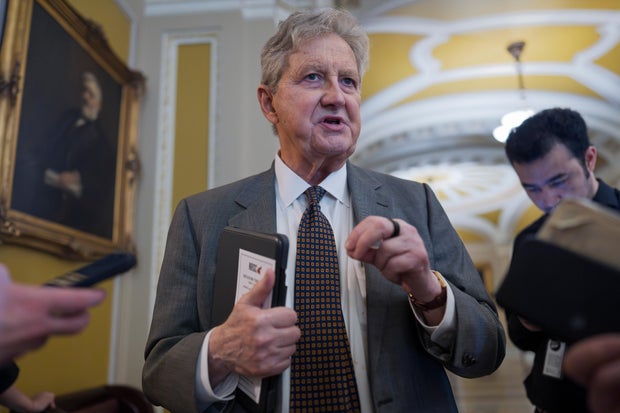
Kennedy argued that the president simply has "two speeds: uninterested and the speed of light."
"And on the things that are important to him, he moves at the speed of light," Kennedy said.
The president has repeatedly been at odds with Senate GOP leadership over one issue in particular — an elections bill known as the SAVE America Act, which would impose strict new rules for registering to vote and casting ballots. Thune has repeatedly explained that the bill, which Democrats and a handful of Republicans oppose, does not have the votes to pass in the Senate. But the president has encouraged Thune to find a way to get it done, including by changing the Senate's rules if needed.
"He wants the SAVE Act and he wants Bill Pulte, that's clear," Kennedy said of the president. "But that's not the way this place works. I mean, I want a Porsche for my birthday. I'm not going to get it."
The election legislation was part of Mr. Trump's demands on Wednesday, when he torpedoed the Senate's plans to move ahead with Clayton's confirmation. "[T]o add a slight bit of intrigue but, for the Good of the Nation, and the People of our Country, I will not approve FISA without THE SAVE AMERICA ACT going along with it," the president wrote.
Before the 11th-hour intervention, Clayton was expected to sail to confirmation as soon as Thursday, in what would have been a significant victory for Senate Republicans, who moved at a rapid clip to fast-track his nomination. Doing so would have precluded the need for Pulte to take the reins of the intelligence community, clearing the way for Democrats to support reauthorizing Section 702.
The White House did not immediately respond to a request for comment.
With the president's latest turn, and the realities of the dynamics in the upper chamber, Senate Republicans were left unclear about how to proceed. Asked Wednesday afternoon about the path forward, Thune said, "I'm not sure I know the answer to that just yet." He told reporters that he hadn't spoken to the president in a few days.
"This is his nominee, and so obviously he made a decision not to move forward at the moment," Thune said. "And we'll see what comes next."
But for a majority leader who was uncharacteristically tight-lipped, with an agenda once again at the whims of the president, "one day at a time" was his most consistent refrain.
Badenoch blasts 'moaning' female Labour MPs over Burnham jobs 'quota'

Kemi Badenoch has told Labour women to earn a job in Andy Burnham's Cabinet instead of demanding they are handed jobs because of their gender.
The Tory leader lashed out today amid reports that female MPs are demanding the de-facto new prime minister introduce a 50:50 gender split 'quota' in his government.
Amid reports that former foreign secretary David Miliband is being lined up to return to the role, possibly with his brother Ed as Chancellor, one female minister also complained that Burnham could not have 'more Milibands than women' in the top posts.
But in a scathing article in the Times today Mrs Badenoch told them to 'stop moaning' and get chosen on merit instead of retreating into 'more of the failed identity politics that is holding back our country'.
'There are many, many reasons why you shouldn't have any Milibands in the cabinet,' she said.
'But complaining that the boys haven't given them the right jobs or that the boys are taking all the jobs, just shows that Labour's women still don't get it.'
The idea of quotas was also attacked by Baroness Jacqui Smith, Labour's Skills Minister.
Asked by Times Radio if Mr Burnham should reserve jobs for women, she said: 'No, I think what Andy Burnham should be doing is building the very best team around him to change this country.'

A letter written by the Women's Parliamentary Labour Party has called on Mr Burnham to ensure a 50:50 split between men and women in government jobs

Amid reports that former foreign secretary David Miliband (above, right, in 2010) is being lined up to return to the role, possibly with his brother Ed as Chancellor, one female minister complained that Burnham could not have 'more Milibands than women' in the top posts

But Mrs Badenoch told them to pipe down and get chosen on merit instead of retreating into 'more of the failed identity politics that is holding back our country'
A letter written by the Women's Parliamentary Labour Party and seen by the BBC has called on Mr Burnham to ensure a 50:50 split between men and women in government jobs after he succeeds Sir Keir Starmer.
'We are asking you to demonstrate this change from day one and address the toxicity and misogyny within our own party and government,' it said.
Labour has never had a female leader, while the Conservatives have had three, and Mrs Badenoch urged the government to follow its meritocratic example.
'If you run a meritocracy, then you do not have to worry about jobs for the boys,' she wrote.
'Every woman who is a Conservative MP, every woman who has ever won the leadership, has had to fight to get where she is.
'By contrast, Labour women are demanding guarantees from Burnham. But the truth is he doesn't have to give any guarantees.
'If none of Labour's women are prepared to get their hands dirty and challenge him for the leadership, their demands are toothless.'
'In fact, it's quite revealing that the women's parliamentary Labour Party has written to Burnham asking him to commit himself to at least 50 per cent female ministers.
'This has nothing to do with meritocracy. It is yet more of the failed identity politics that is holding back our country.'