Treasury scraps numeracy tests 'in a bid to attract diverse graduates'
The Treasury has ditched its numeracy test for graduate hires in a bid to attract more diverse candidates.
In a move branded 'ideological nonsense', it was revealed on Tuesday that Whitehall's economics department had scrapped its mathematical reasoning exam after finding it was having an 'adverse impact'.
The test had typically demanded that graduates prove they could perform calculations and use data to solve problems when applying for jobs in the Treasury, which controls Britain's purse strings.
It also expected candidates to complete a verbal reasoning assessment as part of their application process.
But the department explained that it ditched the maths test in 2019 due to it harming the chances of candidates coming from a wider mix of backgrounds.
In board minutes seen by The Spectator magazine, the Treasury said it binned the exam as it wanted 'more diverse ethnicity at assessment centres'.
It added: 'Having two tests creates an additional 'hurdle' for candidates to jump over and another opportunity for candidates to be sifted out of the process.'
And it went on to claim, in response to a Freedom of Information request, that 'subsequently, the levels of adverse impact decreased in the 2020 campaign'.

Whitehall, HM Treasury Building at the Corner of Parliament Square and Parliament Street
Read More
Whitehall attendance slumps despite Labour's pledge to limit civil servants working from home

The Treasury then removed its verbal reasoning test in 2024 after being advised by an ethnic diversity recruitment specialist that their candidates 'tend to struggle'.
The replacement 'Civil Service Strengths Test' instead asked graduates whether they agree with statements such as: 'I prefer not to have to concentrate on one thing for too long' or 'it is important for me to exceed expectations when I am given a task to do'.
Both the Tories and Reform last night railed against the Treasury's 'ideological' pursuit of boosting diversity.
The Conservatives laid the blame at the door of the Equality Act's duty for public bodies to consider how their decisions impact those with so-called 'protected characteristics'.
Tory MP Jack Rankin said: 'Kemi Badenoch has fought against this kind of ideological nonsense for years.
'Under her leadership, the Conservatives will scrap the Public Sector Equality Duty and restore genuine meritocracy.'
And Tory peer Lord Frost said the revelations would 'surprise absolutely nobody involved with the Civil Service in recent years'.
He added: 'Most departments did some version of this. Many Civil Service leaders publicly revelled in the results.'
Reform's economics spokesman Robert Jenrick, meanwhile, said: 'If people can't add up, they shouldn't be in the Treasury.'
A Treasury spokesman said: 'It is complete nonsense to suggest that we have lowered our hiring standards for the sake of diversity.'
Brendan Sorsby’s Settlement With the NFL Sets a Clear Timeline for His Pro Career
Brendan Sorsby’s Settlement With the NFL Sets a Clear Timeline for His Pro Career
Sorsby released a statement after deciding not to take legal action against the NFL. Eva Geitheim|
In this story:
Texas Tech Red RaidersA week after the NFL announced it would not be holding a supplemental draft for Brendan Sorsby, the league has confirmed that the former Texas Tech and Cincinnati quarterback will not be taking legal action.
When the NFL first shared its decision to not hold a supplemental draft for Sorsby after he was ruled ineligible from the NCAA after gambling on college football, Sorsby’s lawyer, Jeffrey Kessler, indicated they would fight the league’s choice. Kessler wrote in a statement last week, “This is an unlawful action by the NFL in violation of the CBA. We will be taking this matter to the NFLPA.”
Related: Brendan Sorsby: A Complete Timeline of the Saga That Has Rocked College Football
Since, the CFL has also announced that they will not Sorsby will play in its league this season. Sorsby and his team have now officially decided against taking legal action, which the NFL shared in a memo to all 32 teams obtained by Sports Illustrated’s Albert Breer.
The memo read, “We have confirmed with the NFLPA and Brendan Sorsby that there will be no further litigation regarding his entry into the NFL—and that instead, Mr. Sorsby will focus on his preparation for entry into the League via the 2027 NFL Draft. For purposes of league and CBA rules, Mr. Sorsby will considered a “draft-eligible” player for the 2027 NFL Draft. Mr. Sorsby will not be eligible to sign an NFL player contract until the completion of the 2027 NFL Draft.”
Sorsby himself also released a statement sharing the following:
“There has been a lot of news about me out there and I want to share this statement to make sure things are clear. I accept 100% responsibility for my actions. I did not have control of my gambling problem and it took getting caught for me to realize that, but it was truly the best thing that could’ve happened to me. Because of this, I have been able to get the help I need and fully focus on my recovery.
“The news about the supplemental draft changes nothing about my recovery journey—I will continue to take it one day at a time. Focusing on making myself better throughout this process and making sure to share what I have learned and will continue to learn with others going forward. I am fully committed to being the best version of myself that I can be while getting ready for the 2027 draft. God makes no mistakes and I look forward to seeing the good that is to come from this.”
The NFL sent a memo to all 32 teams on Brendan Sorsby, who'll now shift his focus to preparing for the 2027 NFL Draft after the league denied him entry into the supplemental draft.
— Albert Breer (@AlbertBreer) June 30, 2026
Here is that memo, and Sorsby's statement. pic.twitter.com/TEXnIHfXIv
In its letter announcing there would be no supplemental draft, the league took aim at Sorsby for lacking accountability. Sorsby notably holds himself accountable in this letter, and will not receive further discipline from the league as he officially turns his focus to entering the NFL next year.
So ... what’s next for Brendan Sorsby?
With Sorsby unable to play in the NCAA, NFL or CFL in 2026, he will instead look to prepare for the 2027 NFL draft. Per Tom Pelissero of NFL Network, Sorsby will accordingly be allowed to participate in non-league events in the lead-up to the draft, such as the Senior Bowl, pro day and visits with teams.
The biggest disadvantage for Sorsby will of course be that he cannot play in games and further his experience in that regard—which is key for a player to boost their draft stock. Sorsby was a player that had potential to become a first-round pick next year, but it’s harder to see him reaching that point without getting to showcase his development on the field in game settings.
On the more optimistic side, Sorsby will still be able to train. There are more resources, private quarterback coaches and technology than ever to help quarterbacks develop and succeed, and while that by no means can compare to in-game experience, it’s a decent silver lining for a player that put himself in a really tough spot. Sorsby will also have the opportunity to meet with teams and showcase his physical tools ahead of the draft—which have made him an enticing prospect. A number of quarterbacks have improved their draft stock as much or more through the pre-draft process than during their play on the field, and Sorsby has the opportunity to do the same.
More NFL from Sports Illustrated
Published 1 hour ago | Modified 1 hour ago
 EVA GEITHEIM
Eva Geitheim is an NFL writer at Sports Illustrated. Prior to joining SI in December 2024, she wrote for Newsweek, Gymnastics Now and Dodgers Nation. A Bay Area native, she has a bachelor’s in communications from UCLA. When not writing, she can be found baking or rewatching Gilmore Girls.
Home/NFL
Serena Williams Didn’t Win in Wimbledon Return. But She Didn’t Lose Either
Serena Williams Didn’t Win in Wimbledon Return. But She Didn’t Lose Either
The 44-year-old fell to 20-year-old Maya Joint in a respectable showing after nearly four years away from major competition. Jon Wertheim|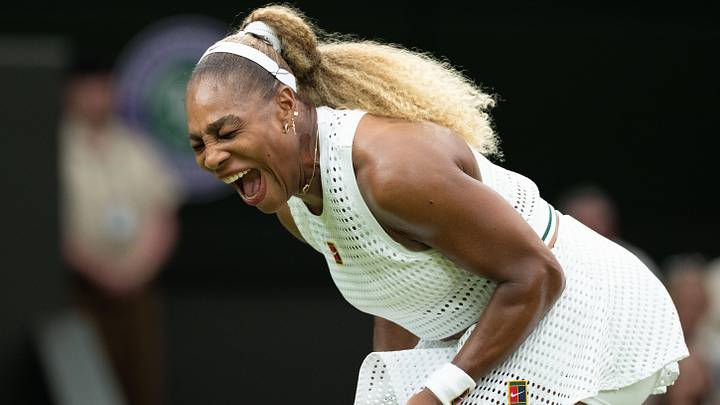
For all its hidebound traditions, Wimbledon decided to do something different this year. The tournament turned back the clock on Tuesday at the All England Club. There on Centre Court (in, symbolically, diminishing evening light), was the familiar sight of Serena Williams, ankles taped, clad in Nike, brandishing a Wilson racket, crowding the baseline, serving in excess of 120 mph, fixing her eyes on targets and rocking her arms as she prepared to return serve.
The nostalgia and throwback only went so far. Serena played more than respectably—surely one of the world’s all-time best players north of 40 years old. She served well, moved respectively, and, at times, did a convincing Serena impersonation. But in the end, the mighty Serena Williams lost to Maya Joint, a game 20-year-old from Australia, 6–3, 6–7, 6–3. And with that, considerable amounts of air left this tournament.
Ever since she announced her comeback, Serena has been the talk of Wimbledon, the biggest source of star wattage and the reason ESPN’s ratings may be higher for this first-round match than for the finals 10 days from now. This is a familiar story of a generational athlete returning, braided with themes of motherhood, self-agency and even the power of GLP-1s.
But, viewed objectively, this match was more about the opponent than the headliner. A former star at Texas, Joint turned pro as a teenager and cracked the top 30 in the WTA rankings. This year, at 20, she’s struggled mightily, having lost 12 of the past 13 matches she’s played. But tonight, in the strangest and most pressure-stuffed match of her career, she was the player who imposed herself, who protected her second serve, won the majority of the long rallies and handled the occasion with poise to burn.
Four years ago at Wimbledon, Serena lost to France’s Harmony Tan, moving sluggishly, making scads of errors and playing at a level unworthy of a GOAT. On Tuesday, she would have beaten that player handily. Against a player half her age, she hung in rallies, clubbed seven aces and showed flashes of brilliance. She also suffered from the lack of match play, made a series of questionable decisions, played too many balls to the middle of the court and missed too many second-serve returns. “Respectable” was a word scribbled in my notes more than once. Not dazzling. Not embarrassing. Respectable.
Where does Serena go from here? The first answer is the Wimbledon doubles draw, where she will pair with her sister, Venus, their combined age being 90. The bigger question: Was this a fun detour and experiment, a chance for a player to test herself and play in front of her kids when they could appreciate Mom’s aura? Or will this fail to slake her thirst for competition, and she’ll start training for the U.S. hard-court season?
Speculating about anything Serena-related is a fool’s errand. Always has been. But if she continues this comeback, she’ll need more match play, a bit more movement and better returning.
This we can say with certitude: Serena didn’t lose on Tuesday. Not in the big picture. But she didn’t win either. Her career singles record coming in was 858–156. It is now 858–157.
Meanwhile, the doubles team of time and biology remains, of course, unbeaten.
More Tennis from Sports Illustrated
Published 9 minutes ago | Modified 9 minutes ago
 JON WERTHEIM
Jon Wertheim is a senior writer for Sports Illustrated and has been part of the full-time SI writing staff since 1997, largely focusing on the tennis beat, sports business and social issues, and enterprise journalism. In addition to his work at SI, he is a correspondent for “60 Minutes” and a commentator for The Tennis Channel. He has authored 11 books and has been honored with two Emmys, numerous writing and investigative journalism awards, and the Eugene Scott Award from the International Tennis Hall of Fame. Wertheim is a longtime member of the New York Bar Association (retired), the International Tennis Writers Association and the Writers Guild of America. He has a bachelor’s in history from Yale University and received a law degree from the University of Pennsylvania. He resides in New York City and Paris with his wife, who is a divorce mediator and adjunct law professor. They have two children.
Home/Tennis