The U.S.-Iran negotiations have been chaotic. But the confusion has only grown since the agreement was signed.
WASHINGTON — The effort by the U.S. and Iran to negotiate an end to the war has been defined by dramatic fits and starts and punctuated by missile strikes and naval blockades. Yet since a memorandum of understanding was brokered last weekend, the confusion has only grown.
The White House said the agreement had been signed on Sunday by Vice President JD Vance but then announced there would be another signing — this time with a ceremony — on Friday. Also on Sunday, President Donald Trump said he would “fully authorize” the reopening of the Strait of Hormuz in what he described as a “complete” deal. But an hour later, the president said the critical waterway would open once the deal was signed on Friday.
Trump administration officials offered conflicting messages on Monday about when the text of the memorandum would be released, with some saying within the next 24 to 48 hours and others saying not until Friday.
At one point, Trump said while in France for the Group of Seven summit that he might just read the text of the MOU aloud during a news conference. Instead, U.S. officials read the text on a call with reporters during Trump’s news conference.
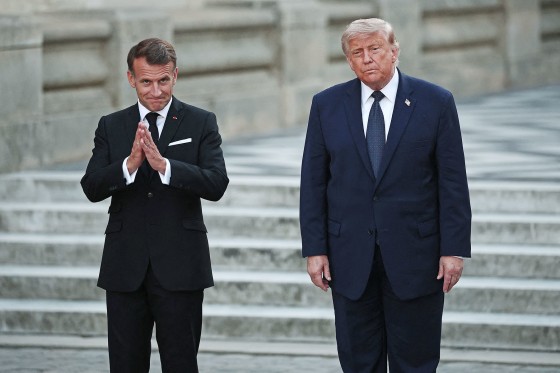
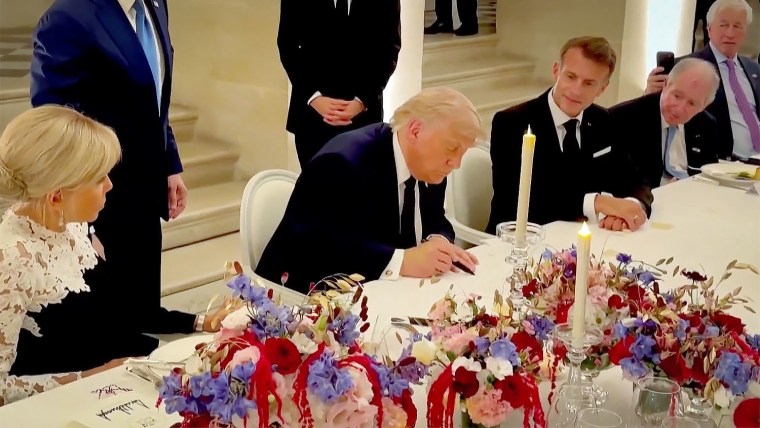
Then, Trump and Iranian President Masoud Pezeshkian suddenly re-signed the agreement, the U.S. leader doing so during a dinner at Versailles with French President Emmanuel Macron looking on. And now it’s unclear whether there will be a signing ceremony, or further talks, at all.
The lack of clarity over the proposed peace deal is only the latest murky point in the conflict since the U.S. and Israel launched attacks on Iran in February. Trump has offered shifting reasons for going to war with Iran and given different answers on what he hoped to get out of it. Both Iran and the U.S. have continued to launch strikes, even as leaders say a temporary ceasefire brokered in early April remains in place. Even the MOU differs from what Trump said he wanted out of a deal with Iran.
It comes as Americans are increasingly down on Trump’s handling of the war, with elevated gas prices and November’s midterm elections drawing near. And even some Trump-supporting Republicans in Congress are raising concerns about the 14-point MOU as a road map to a comprehensive Iran deal.
Sen. Bill Cassidy, R-La., wrote on X on Wednesday that President Ronald “Reagan is rolling over in his grave” and labeled the MOU “the worst foreign policy blunder in decades.”
Asked if he’s confident Iran will give up its nuclear ambitions, Sen. John Kennedy, R-La., said on Tuesday, “Unless you were homeschooled by a day drinker, no one’s confident that Iran’s going to do anything.”
And Sen. Lindsey Graham, R-S.C., who has been skeptical of the U.S. negotiating with Iran, posted on X that he spoke with U.S. envoy Steve Witkoff and “it is my opinion that signing the MOU will be beneficial to the United States, in as much as the Strait of Hormuz will begin to open, and the hostilities with Iran will stop.”
Vance said Thursday that the 60-day clock for a long-term agreement had already started. But it took hours for the U.S. to say the critical Strait of Hormuz was open, a development that the MOU stipulates should have happened immediately, though the U.S. blockade of ships coming from or going to Iranian ports was lifted after the second MOU signing, according to U.S. Central Command.
“The traffic of commercial vessels will immediately start,” the MOU states.
The U.S. military does not have any reports of Iranian attacks against commercial ships in the strait on Friday, according to a U.S. official. U.S. forces would continue to operate in the area to support freedom of navigation, the official said, adding: “We’re not going to let commercial vessels get attacked.”
It also remains unclear whether the U.S. has issued sanctions waivers to allow Iran to sell its oil, which is also a provision in the MOU. “The United States of America undertakes that immediately upon the signing of this MOU, and until the termination of sanctions, U.S. Department of Treasury will issue waivers for the export of Iranian crude oil, petroleum products, and derivatives, and all associated services, including banking transactions, insurances, transportation, etc.,” it says.
The latest twist came on Thursday.
Officials from Tehran and Washington were set to meet in Switzerland on Friday to begin 60 days of negotiating a long-term deal designed to facilitate a lasting conclusion to the war. But new Israeli strikes in Lebanon cast doubt on the deal, and the White House abruptly announced that Vance had postponed plans to travel to Switzerland for the talks.
Iran asked for guarantees that hostilities in Lebanon would end, as outlined in the MOU, and mediators were working to resolve the issue, a regional diplomat told NBC News.
American spy agencies believe Israel will likely continue to launch attacks on Hezbollah forces in Lebanon, potentially jeopardizing the tentative peace deal between the U.S. and Iran, according to a source with knowledge of the intelligence assessments. And Israeli Prime Minister Benjamin Netanyahu and officials in his government have criticized the MOU.
Trump, meanwhile, has publicly sought to convey optimism about the MOU and the prospect of a long-term deal.
“We have our deal done with Iran,” he said Tuesday during a meeting with the emir of Qatar while in France. “It goes to a second stage, which I think will be actually easier.”
Add NBC News to GoogleMegan ShannonMegan Shannon is an Associate Producer for the White House Unit.
 Monica Alba
Monica Alba is a White House correspondent for NBC News.
 Dan De Luce
Dan De Luce is a reporter for the NBC News Investigative Unit.
 Courtney Kube
Courtney Kube is a correspondent covering national security and the military for the NBC News Investigative Unit.
Justin Goldman contributed.Badenoch blasts 'moaning' female Labour MPs over Burnham jobs 'quota'

Kemi Badenoch has told Labour women to earn a job in Andy Burnham's Cabinet instead of demanding they are handed jobs because of their gender.
The Tory leader lashed out today amid reports that female MPs are demanding the de-facto new prime minister introduce a 50:50 gender split 'quota' in his government.
Amid reports that former foreign secretary David Miliband is being lined up to return to the role, possibly with his brother Ed as Chancellor, one female minister also complained that Burnham could not have 'more Milibands than women' in the top posts.
But in a scathing article in the Times today Mrs Badenoch told them to 'stop moaning' and get chosen on merit instead of retreating into 'more of the failed identity politics that is holding back our country'.
'There are many, many reasons why you shouldn't have any Milibands in the cabinet,' she said.
'But complaining that the boys haven't given them the right jobs or that the boys are taking all the jobs, just shows that Labour's women still don't get it.'
The idea of quotas was also attacked by Baroness Jacqui Smith, Labour's Skills Minister.
Asked by Times Radio if Mr Burnham should reserve jobs for women, she said: 'No, I think what Andy Burnham should be doing is building the very best team around him to change this country.'

A letter written by the Women's Parliamentary Labour Party has called on Mr Burnham to ensure a 50:50 split between men and women in government jobs

Amid reports that former foreign secretary David Miliband (above, right, in 2010) is being lined up to return to the role, possibly with his brother Ed as Chancellor, one female minister complained that Burnham could not have 'more Milibands than women' in the top posts

But Mrs Badenoch told them to pipe down and get chosen on merit instead of retreating into 'more of the failed identity politics that is holding back our country'
A letter written by the Women's Parliamentary Labour Party and seen by the BBC has called on Mr Burnham to ensure a 50:50 split between men and women in government jobs after he succeeds Sir Keir Starmer.
'We are asking you to demonstrate this change from day one and address the toxicity and misogyny within our own party and government,' it said.
Labour has never had a female leader, while the Conservatives have had three, and Mrs Badenoch urged the government to follow its meritocratic example.
'If you run a meritocracy, then you do not have to worry about jobs for the boys,' she wrote.
'Every woman who is a Conservative MP, every woman who has ever won the leadership, has had to fight to get where she is.
'By contrast, Labour women are demanding guarantees from Burnham. But the truth is he doesn't have to give any guarantees.
'If none of Labour's women are prepared to get their hands dirty and challenge him for the leadership, their demands are toothless.'
'In fact, it's quite revealing that the women's parliamentary Labour Party has written to Burnham asking him to commit himself to at least 50 per cent female ministers.
'This has nothing to do with meritocracy. It is yet more of the failed identity politics that is holding back our country.'