The great Labour brain drain
The great Labour brain drain The party has lost its intellectuals
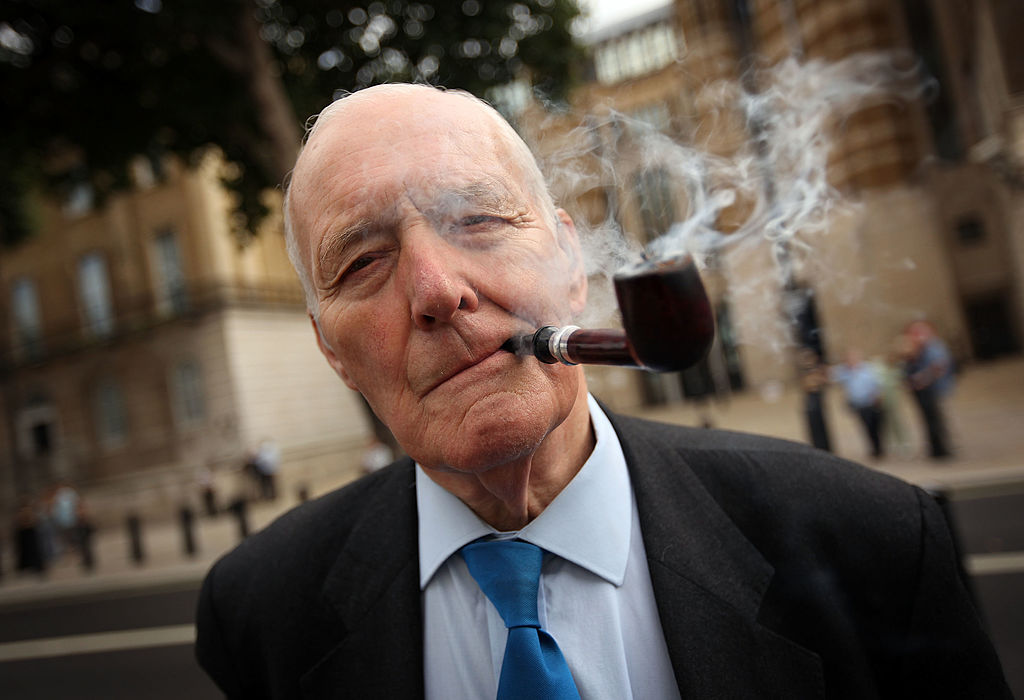
Nobody could accuse Tony Benn of thinking small. (Dan Kitwood/Getty)
Nobody could accuse Tony Benn of thinking small. (Dan Kitwood/Getty)
Andy BurnhamGordon BrownLabour PartyPoliticsSocialismtony bennTony BlairUK



 Pratinav Anil
Jun 24 2026 - 12:01am 8 mins
Pratinav Anil
Jun 24 2026 - 12:01am 8 mins
How awkward is it that the last great hope of the Labour Left should have the NHS’s first hospital privatization tucked away in his curriculum vitae? Long before he became the patron saint of bus franchising and the scourge of centralization, Andy Burnham found himself grappling with the institutional collapse of Hinchingbrooke Hospital in Cambridgeshire. The solution eventually chosen, under a procurement process initiated on his watch and completed by the Coalition, was not public oversight or any of the old socialist remedies, but outsourcing management to Circle Health, a private company. Why storm the commanding heights when you can outsource their management? The irony was not lost on Nick Clegg, who could quip in 2014 that Burnham was “the only man in England who has ever privatized an NHS hospital”.
Time was when the Labour Left did ambition. Whatever one thinks of Tony Benn, and opinions divide sharply, nobody could accuse him of thinking small. His 1975 Alternative Economic Strategy, a patriotic blueprint for autarky, envisaged public ownership on a colossal scale, capital controls, industrial planning, tariffs to protect domestic manufacturing, and a self-respecting state capable of directing investment towards national priorities. At one point, he floated the nationalization of Britain’s 25 largest companies. The aim was not merely to regulate capitalism but to grab it by the lapels and reorder it through state action. To Benn, the struggle against capitalism and the struggle for national sovereignty were inseparable. His socialism amounted to a species of Anglo-Gaullism. The objective was to ensure that Parliament, rather than plutocrats or Eurocrats, ruled Britain.
That patriotism informed Benn’s hostility to the European Economic Community — Euroskepticism was then still an honorable, even intellectually formidable, tradition on the Labour Left. Benn regarded the EEC not as a post-national panacea but as a constitutional straitjacket designed to frustrate democratic control over the economy. If Westminster could not direct investment, subsidize industry, regulate capital flows or protect strategic sectors without running afoul of Brussels, then the entire project of socialist transformation became an elaborate exercise in make-believe. Compared with today’s notionally Left-wing Europhilia — which often amounts to little more than a Pavlovian urge to applaud whatever annoys the Tories and, latterly, Reform — Bennite Euroskepticism at least rested on a clutch of thoughtful and well-articulated premises.
Benn, moreover, was not some lonely crank muttering socialist incantations and shouting from the backbenches. By the late Seventies and early Eighties, much of the Labour Left shared his conviction that Britain’s economic malaise demanded structural remedies rather than desultory managerial tinkering. Michael Foot, now remembered chiefly as a disheveled romantic in a donkey jacket, led a party committed to an astonishing program of economic intervention. The 1983 manifesto promised new public enterprises in electronics, pharmaceuticals, and high tech; proposed renationalizing key assets; advocated extensive industrial planning; and sought to extend democratic control over economic life. To modern ears, accustomed to politicians boasting about breakfast clubs and advising men to whisper “maaaate” at misogynists, the sheer scale of the ambition feels almost foreign.
Yet there was a minor snag. Bennism never came remotely close to persuading the proletariat. The 1983 manifesto may today read like the last serious attempt by the British Left to think systematically about power, but it also delivered Labour’s worst post-war result. For an electorate still haunted by inflation and strikes, nationalization and withdrawal from the EEC looked less like a program for renewal than a recipe for further turmoil. Nor was the electorate the only obstacle. The Labour Left spent almost as much time arguing with itself as it did with its opponents. Benn and Foot did not exactly belong to a single political tendency. Foot’s subsequent reputation as a wild-eyed Bennite firebrand was always somewhat exaggerated. An old-fashioned parliamentary socialist, he romanticized the Commons in a way Benn never did. He also regarded some of Benn’s more ambitious proposals with skepticism, describing the idea of nationalizing Britain’s 25 largest companies as “crazy”. Where Benn sought to remake Labour, Foot often sought to hold it together, preserving a heteroclite coalition that still stretched from Tribune socialists to elements on the Labour Right.
For all their differences, both men possessed something now largely absent from Labour politics: a theory of power. They believed that Britain’s problems stemmed from the structure of ownership: a state in hock to a rentier class that preferred inflating house prices to financing factories; a financial system that found speculation and offshoring more profitable than domestic production, and democratic institutions hollowed out by budget cuts and Brussels. The central question, as Benn saw it, was not simply how wealth was distributed but who possessed power, and whether democratic institutions retained the capacity to challenge it. Reflecting on his years in government, he wrote in one of his voluminous diaries: “As a minister, I experienced the power of industrialists and bankers to get their way by use of the crudest form of economic pressure, even blackmail, against a Labour government.”
More from this author How hipsters ruined saunasBurnham’s politics, by contrast, start from the tacit assumption that the argument has already been settled and lost. Finance will remain dominant. Capital will remain mobile. The ownership of the economy is no longer a political question but a fact of nature, somewhere between gravity and the weather. As one former colleague put it, Burnham’s beliefs are “not ideological” but rooted in “people’s daily experiences”. Benn began with a theory and worked downwards to policy; Burnham begins with a conversation in Morrisons and works upwards towards a philosophy. The commanding heights have disappeared into the mist; the task now is to ensure that the buses arrive roughly on schedule. Benn wanted to socialize the economy. Burnham is content with contactless ticketing.
The retreat began long before Burnham. Neil Kinnock’s achievement as party leader from 1983 onwards was not to construct a new theory of power, but to dismantle the old one in the shadow of Thatcherism. After the electoral catastrophes of the early Eighties, Labour’s idée fixe became electability rather than transformation. It accordingly spent 40 years sanding down its ambitions in pursuit of intermittent office, trapped in a vicious circle whereby each electoral victory was achieved by abandoning the very ideas that might have justified it. Public ownership was quietly downgraded, trade-union power curbed, Euroscepticism abandoned, and socialism itself pushed into the loft conversion alongside conference samizdat. Yet Kinnock never quite replaced what he had discarded. Labour shed policy after policy without offering much in the way of a positive alternative. By the time he left office in 1992, the party had become more respectable but intellectually thinner, more adept at winning the confidence of ordinary Brits before elections than improving their lives afterwards. The ambition to stem decline had given way to the more modest goal of reassuring Middle England that Labour’s bark was worse than its bite.
John Smith represented a further step down the mountain. An insufferably moralizing chap, he looked less like a tribune of the working class than a Scottish bank manager who had wandered into the wrong conference. Smith grasped that Labour needed constitutional reform, decentralization and a more liberal conception of politics, but he lacked both the temperament and the time for anything more audacious, preoccupied as he was with the battle over One Member One Vote. Where Labour once dreamed of reindustrialization and redistribution, it now devoted its energies to redesigning the method by which delegates selected the shadow cabinet.
With Blair and Brown, the comedown became complete. New Labour in power accepted not merely the institutions of Thatcherism but many of its underlying assumptions. The task was no longer to challenge the dominance of finance but to manage it more effectively; not to reverse globalization but to adapt to it; not to democratize economic power but to skim enough tax revenue from the City to finance a few public services. By the end of the Blair-Brown years, finance accounted for a larger share of the economy than ever, manufacturing had shrunk further, and vast swathes of public expenditure were being funneled through private contractors. The party had moved from promising to assume the commanding heights to Cool Britannia.
If New Labour represented the abandonment of Labour’s old ambitions, Ed Miliband represented their uncertain rediscovery. The timing ought to have been propitious. The Conservatives were imposing the most severe fiscal retrenchment in a generation. Real wages were stagnant, public services under pressure, and the financial crash had discredited the hubris of many a Hayekian. Yet Miliband proved strangely unable to convert this conjuncture into a compelling alternative. Though he flirted with a critique of “predatory capitalism” and occasionally hinted that his marxisant father Ralph might have been right all along, he never developed these instincts into a coherent political project. The whole unhappy experiment culminated, appropriately enough, in the EdStone. Unveiled in a Hastings car park during the 2015 election campaign, the two-tonne limestone monolith bore a handful of pledges so anodyne — “a strong economic foundation”, “higher living standards”, “an NHS with the time to care” — as to be quite meaningless. The stone was intended for Downing Street’s rose garden; instead, it became a monument to Labour’s inability to explain why it deserved power. Faced with a choice between austerity and tax-and-spend, the British electorate displayed a touching preference for someone else’s suffering. Miliband’s defeat duly followed.
“Burnham’s politics start from the tacit assumption that the argument has already been settled and lost. Finance will remain dominant. Capital will remain mobile.”In the aftermath, Labour briefly returned to something resembling Bennism in the form of Corbynism. The program amounted to moderately higher public spending — raising the state’s share of GDP from roughly 40 to 45%, bringing Britain closer to its continental peers — alongside the renationalization of selected utilities and a modest industrial revival: hardly the storming of the Winter Palace. A surprising number of voters appeared to recognize as much in the snap election of 2017. Yet his leadership was undone two years later by fifth columnists and a cackhanded commitment to two referendums — Brexit and, potentially, Scotland — at precisely the moment when the public wanted none. The Labour Left thus contrived to squander what may have been its last once-in-a-generation opportunity.
Now, with Starmer’s purges having culminated in the discovery that even the purger can one day become the purgee, we are witnessing the extraordinary recrudescence of the Labour Left. Starmer survived the paid-for clothes and Mandelson’s penchant for removing his own but not Burnham’s by-election victory. The irony is that the Labour Left’s great returning hope arrives not bearing a new economic settlement but a municipal case study, albeit a successful one.
Yet the more remarkable fact is that Burnham may now inherit the Labour leadership, and with it the premiership, without ever being forced to explain what, precisely, he believes. His supporters treat his coronation as a foregone conclusion. That is curious. For a party supposedly rediscovering its radical tradition, there has been remarkably little appetite to subject its newest savior to public scrutiny. The Conservatives spent much of the past decade airdropping prime ministers into Downing Street and presenting the electorate with a fait accompli. Unlike them, though, our future prime minister is an empty signifier.
Burnham’s backers speak reverently of “Manchesterism”, but it is not entirely clear what the term means beyond competent local government. The flagship achievement of his mayoralty has been fixing Greater Manchester’s bus network. The policy has been successful enough: usage in the first franchised areas rose by around 8%, punctuality improved, and the city’s now-iconic yellow buses have become a visible symbol of municipal renewal. Yet there is an undeniable mismatch between the scale of the achievement and the scale of the claims made for it. Britain’s productivity growth has averaged barely 0.5% annually since the financial crisis. Business investment remains among the lowest in the G7. Housing construction consistently falls short of demand. The country’s capital stock is aging, its infrastructure creaks, and regional inequalities remain among the highest in the developed world. Against this backdrop, Burnham’s prime ministerial pitch appears to amount largely to better buses.
What is missing is the very thing that animated Benn, Foot, and even, in his own coy fashion, Corbyn: an explanation of how the economy works. Burnham can tell you who broke Britain — “the four horsemen of Britain’s apocalypse are deregulation, privatization, austerity, and Brexit” — but he has remarkably little to say about what should replace the existing model. His cri de coeur is “business-friendly socialism”, whatever that focus-grouped inanity might mean. Perhaps this accounts for his popularity. A Labourist Zelig elevated by the party machine, he has built a career on being all things to all people. Whether this party trick will work in power as it has in party intrigue remains to be seen.
Pratinav Anil is the author of two bleak assessments of 20th-century Indian history. He teaches at St Edmund Hall, Oxford.
 pratinavanil
Join the discussion

Join like minded readers that support our journalism by becoming a paid subscriber
Subscribe to comment
To join the discussion in the comments, become a paid subscriber.
Join like minded readers that support our journalism, read unlimited articles and enjoy other subscriber-only benefits.
Subscribe Subscribe 37 Comments Most Voted Newest Oldest Inline Feedbacks View all comments Report this commentBadenoch blasts 'moaning' female Labour MPs over Burnham jobs 'quota'

Kemi Badenoch has told Labour women to earn a job in Andy Burnham's Cabinet instead of demanding they are handed jobs because of their gender.
The Tory leader lashed out today amid reports that female MPs are demanding the de-facto new prime minister introduce a 50:50 gender split 'quota' in his government.
Amid reports that former foreign secretary David Miliband is being lined up to return to the role, possibly with his brother Ed as Chancellor, one female minister also complained that Burnham could not have 'more Milibands than women' in the top posts.
But in a scathing article in the Times today Mrs Badenoch told them to 'stop moaning' and get chosen on merit instead of retreating into 'more of the failed identity politics that is holding back our country'.
'There are many, many reasons why you shouldn't have any Milibands in the cabinet,' she said.
'But complaining that the boys haven't given them the right jobs or that the boys are taking all the jobs, just shows that Labour's women still don't get it.'
The idea of quotas was also attacked by Baroness Jacqui Smith, Labour's Skills Minister.
Asked by Times Radio if Mr Burnham should reserve jobs for women, she said: 'No, I think what Andy Burnham should be doing is building the very best team around him to change this country.'

A letter written by the Women's Parliamentary Labour Party has called on Mr Burnham to ensure a 50:50 split between men and women in government jobs

Amid reports that former foreign secretary David Miliband (above, right, in 2010) is being lined up to return to the role, possibly with his brother Ed as Chancellor, one female minister complained that Burnham could not have 'more Milibands than women' in the top posts

But Mrs Badenoch told them to pipe down and get chosen on merit instead of retreating into 'more of the failed identity politics that is holding back our country'
A letter written by the Women's Parliamentary Labour Party and seen by the BBC has called on Mr Burnham to ensure a 50:50 split between men and women in government jobs after he succeeds Sir Keir Starmer.
'We are asking you to demonstrate this change from day one and address the toxicity and misogyny within our own party and government,' it said.
Labour has never had a female leader, while the Conservatives have had three, and Mrs Badenoch urged the government to follow its meritocratic example.
'If you run a meritocracy, then you do not have to worry about jobs for the boys,' she wrote.
'Every woman who is a Conservative MP, every woman who has ever won the leadership, has had to fight to get where she is.
'By contrast, Labour women are demanding guarantees from Burnham. But the truth is he doesn't have to give any guarantees.
'If none of Labour's women are prepared to get their hands dirty and challenge him for the leadership, their demands are toothless.'
'In fact, it's quite revealing that the women's parliamentary Labour Party has written to Burnham asking him to commit himself to at least 50 per cent female ministers.
'This has nothing to do with meritocracy. It is yet more of the failed identity politics that is holding back our country.'