‘The decision is sickening’: MAHA leaders feel betrayed by Supreme Court ruling on Roundup weed killer
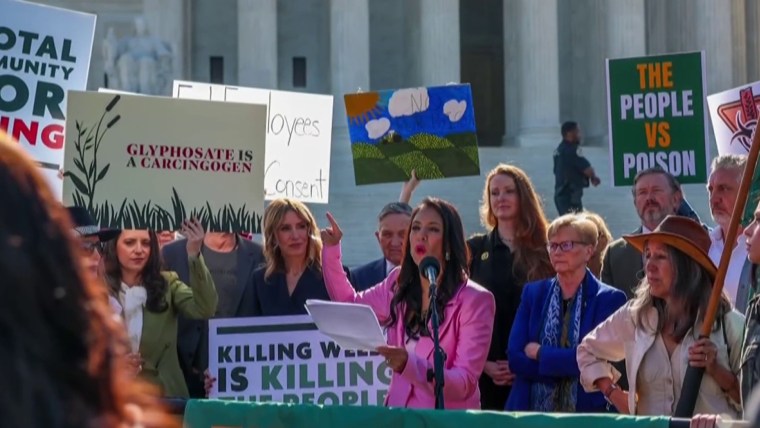 Some in MAHA movement express frustration over Supreme Court ruling on Roundup weed killer03:09June 25, 2026, 7:49 PM EDTBy Aria Bendix and Julie Tsirkin
Many prominent figures in the “Make America Healthy Again” movement said they felt betrayed Thursday after the Supreme Court ruled that Bayer, the manufacturer of Roundup, did not need to warn consumers of a potential cancer risk associated with its weed killer.
The ruling is likely to prevent thousands of lawsuits from arguing in state courts that Roundup should come with a cancer warning.
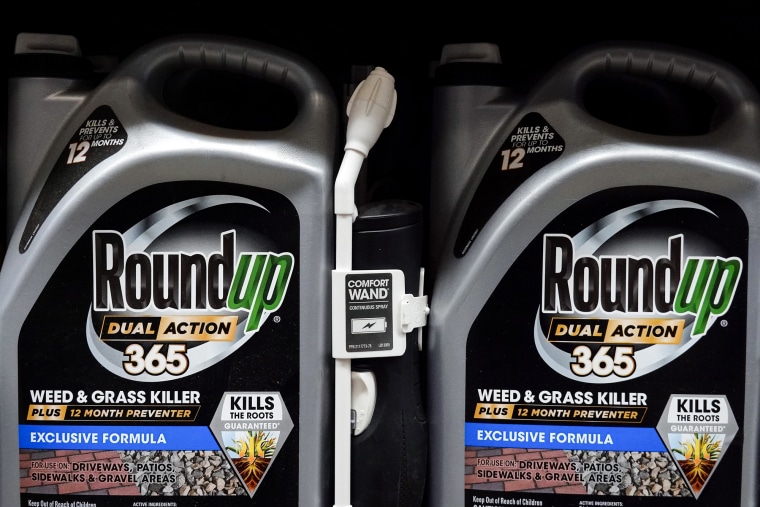
A growing body of scientific evidence suggests that glyphosate, the active ingredient in Roundup, is linked to cancer. That has long alarmed a subset of Health Secretary Robert F. Kennedy Jr.’s followers, known as “MAHA moms,” who want to eliminate chemicals from the food supply. The group rallied in front of the Supreme Court during oral arguments in April, and a smaller cohort expressed their concerns about underregulation of pesticides directly to Kennedy and President Donald Trump at a White House meeting that month.
Thursday’s ruling gave new fuel to worries within the movement that the Trump administration has prioritized the interests of the agrochemical industry.
“The decision is sickening and would have never happened had the administration not given Bayer Monsanto a favor,” Vani Hari, a high-profile MAHA voice who goes by the moniker “Food Babe,” said in a text message. Bayer bought Monsanto, the original manufacturer of Roundup, in 2018.
“Congress must act to remediate this,” Hari added.
The White House did not address NBC News’ questions about the Supreme Court’s decision. The Health and Human Services Department did not respond to a request for comment.
The plaintiff — a Missouri man named John Durnell — sued Monsanto in 2019, alleging that two decades of Roundup use had caused his non-Hodgkin lymphoma, a type of blood cancer. A jury sided with him in 2023, awarding him $1.25 million, but the Supreme Court took up the case on appeal. The Trump administration backed Bayer’s petition. The Biden administration had taken the opposite stance in a previous Roundup-related case against Bayer, urging the Supreme Court to reject its appeal.
In a 7-2 ruling Thursday, the court said Bayer cannot be sued in state courts because federal regulations have found that a cancer link to Roundup is unlikely and does not require a warning label.
 Supreme Court hands Trump administration two major immigration victories12:16
The Environmental Protection Agency determined in 2020, during the first Trump administration, that glyphosate is unlikely to be a human carcinogen. Environmental groups sued, and a federal appeals court ruled that the EPA had not adequately explained its analysis. The EPA agreed to update its evaluation, though it has not published a new version yet.
The International Agency for Research on Cancer, part of the World Health Organization, classified glyphosate in 2015 as “probably carcinogenic to humans.”
Kelly Ryerson, a prominent MAHA activist known as “Glyphosate Girl,” said the Supreme Court ruling had cost the Trump administration some MAHA movement loyalty.
“Never in history has an administration so blatantly and willingly sold out our fertility, vitality, and health to corporate interests,” she wrote on X. “It is unforgivable. We will make sure all voters know exactly how this domestic chemical attack happened.”
MAHA has found itself at odds with the Trump administration on several recent occasions.
In February, Trump angered some of the movement’s leaders when he signed an executive order invoking the Defense Production Act to boost the supply of glyphosate. Kennedy backed the move, saying it was a way to increase domestic agricultural production, but he called pesticides “toxic by design.” Kennedy told senators at a hearing in April that he believes glyphosate causes cancer. Before he joined the federal government, Kennedy sued Monsanto as a lawyer representing plaintiffs who alleged that Roundup had caused their non-Hodgkin lymphoma.
Some prominent MAHA figures were also critical of Food and Drug Administration regulatory changes in May that expanded access to fruit-flavored e-cigarettes. Before that, they disapproved of the EPA’s rollback of mercury emissions standards and its move to rescind drinking water limits for certain PFAS, also known as “forever chemicals.”
“MAHA moms are not as motivated to vote at this point because we’re not getting what we expected,” Michaela Bardossas, a nutritionist who works with a MAHA advocacy group called Moms Across America, told NBC News in April.
“If these Republicans want to stay in power, then they need to step up and they need to show their support for the people that voted them in,” she said, adding, “The pesticide issue has been a huge slap in the face.”
The two dissenting Supreme Court justices were Ketanji Brown Jackson and Neil Gorsuch. Jackson wrote that the majority’s decision “unjustifiably closes the courthouse doors” to plaintiffs like Durnell.
In a statement Thursday, Bayer said the ruling “is good for science, farmers, and industries that depend on regulatory clarity for innovation.”
As MAHA activists turn their focus to Congress, Rep. Anna Paulina Luna, R-Fla., said Thursday that she intends to introduce legislation to strip pesticide companies of liability protections.
“These companies purposefully omit labeling information knowing their products cause cancer and other health problems. It is time they are held accountable,” she wrote on X.
Luna led a push this year to defeat a provision initially included in the farm bill that would have protected Bayer from allegations that its herbicide includes a potentially cancer-causing ingredient.
Scientists who study the health risks of glyphosate said the EPA’s 2020 analysis was not based on the most robust evidence. At a symposium in Seattle in March, dozens of international scientists concluded that glyphosate can cause cancer, adding that the strongest evidence points to an increased risk of non-Hodgkin lymphoma.
Some researchers have also pointed to differences between the studies used for the International Agency for Research on Cancer’s analysis and for the EPA’s. The IARC, they say, relied mostly on peer-reviewed research, while the EPA drew from unpublished studies funded by the pesticide industry.
“IARC got it right, and the evidence since the IARC review that happened in 2015 has only gotten stronger,” said Lianne Sheppard, a professor at the University of Washington environmental and occupational health sciences department.
Add NBC News to Google Aria Bendix
Aria Bendix is the breaking health reporter for NBC News Digital.
 Julie Tsirkin
Julie Tsirkin is a correspondent covering Capitol Hill and the White House.
Badenoch blasts 'moaning' female Labour MPs over Burnham jobs 'quota'

Kemi Badenoch has told Labour women to earn a job in Andy Burnham's Cabinet instead of demanding they are handed jobs because of their gender.
The Tory leader lashed out today amid reports that female MPs are demanding the de-facto new prime minister introduce a 50:50 gender split 'quota' in his government.
Amid reports that former foreign secretary David Miliband is being lined up to return to the role, possibly with his brother Ed as Chancellor, one female minister also complained that Burnham could not have 'more Milibands than women' in the top posts.
But in a scathing article in the Times today Mrs Badenoch told them to 'stop moaning' and get chosen on merit instead of retreating into 'more of the failed identity politics that is holding back our country'.
'There are many, many reasons why you shouldn't have any Milibands in the cabinet,' she said.
'But complaining that the boys haven't given them the right jobs or that the boys are taking all the jobs, just shows that Labour's women still don't get it.'
The idea of quotas was also attacked by Baroness Jacqui Smith, Labour's Skills Minister.
Asked by Times Radio if Mr Burnham should reserve jobs for women, she said: 'No, I think what Andy Burnham should be doing is building the very best team around him to change this country.'

A letter written by the Women's Parliamentary Labour Party has called on Mr Burnham to ensure a 50:50 split between men and women in government jobs

Amid reports that former foreign secretary David Miliband (above, right, in 2010) is being lined up to return to the role, possibly with his brother Ed as Chancellor, one female minister complained that Burnham could not have 'more Milibands than women' in the top posts

But Mrs Badenoch told them to pipe down and get chosen on merit instead of retreating into 'more of the failed identity politics that is holding back our country'
A letter written by the Women's Parliamentary Labour Party and seen by the BBC has called on Mr Burnham to ensure a 50:50 split between men and women in government jobs after he succeeds Sir Keir Starmer.
'We are asking you to demonstrate this change from day one and address the toxicity and misogyny within our own party and government,' it said.
Labour has never had a female leader, while the Conservatives have had three, and Mrs Badenoch urged the government to follow its meritocratic example.
'If you run a meritocracy, then you do not have to worry about jobs for the boys,' she wrote.
'Every woman who is a Conservative MP, every woman who has ever won the leadership, has had to fight to get where she is.
'By contrast, Labour women are demanding guarantees from Burnham. But the truth is he doesn't have to give any guarantees.
'If none of Labour's women are prepared to get their hands dirty and challenge him for the leadership, their demands are toothless.'
'In fact, it's quite revealing that the women's parliamentary Labour Party has written to Burnham asking him to commit himself to at least 50 per cent female ministers.
'This has nothing to do with meritocracy. It is yet more of the failed identity politics that is holding back our country.'