The 24-hour hotline helping save the world’s biggest freshwater fish
The 24-hour hotline helping save the world’s biggest freshwater fish
The ‘megafish’ living in southeast Asia’s Mekong River once faced extinction. A new rapid response system is helping reverse their dire outlook.
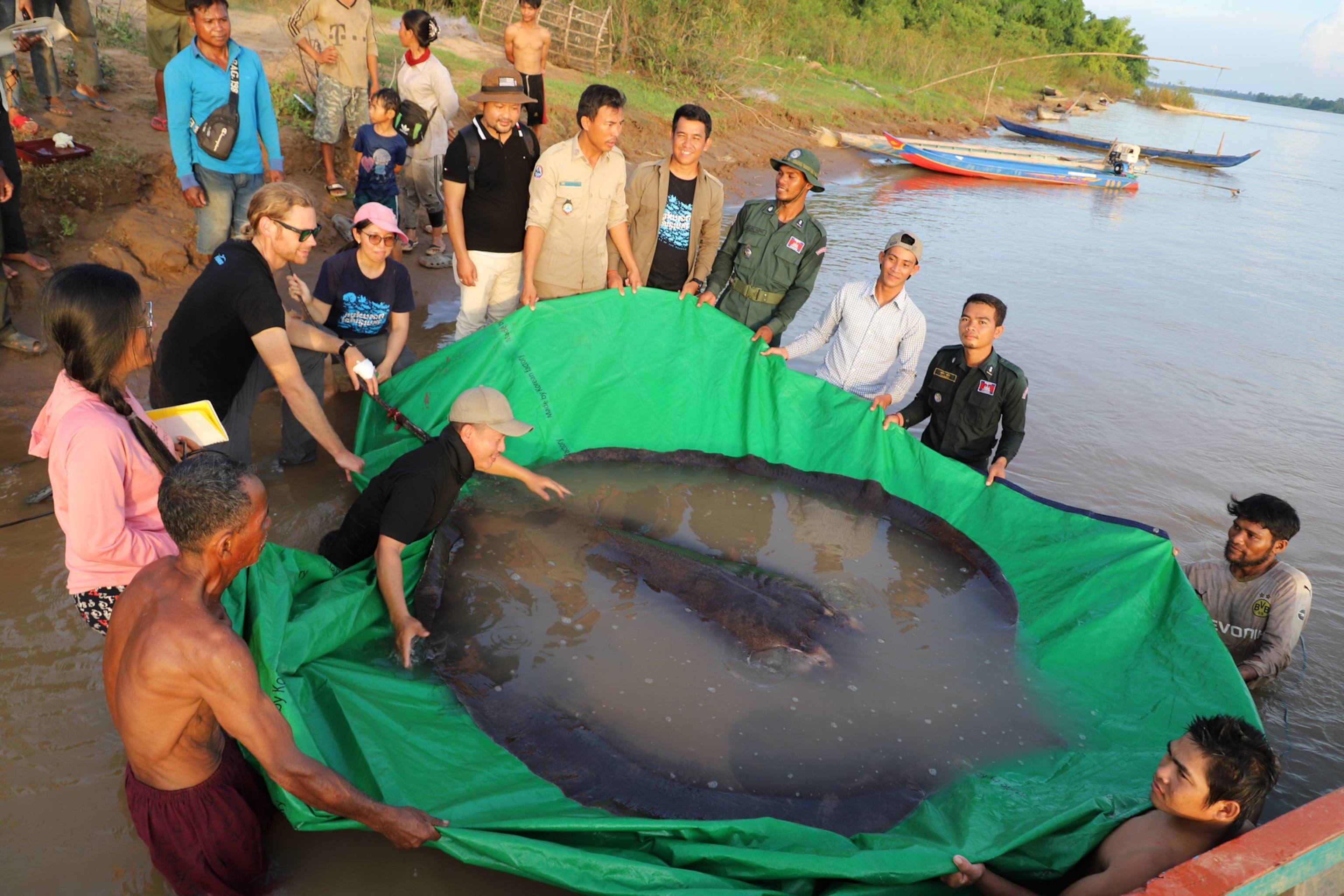
Kampong Cham, Cambodia — In early January, at the peak of Cambodia’s fishing season, Chea Seila was driving north along the Mekong River when her phone began to buzz. The call came from another part of the river’s vast watershed, hours away. A fisherman had just hauled in a 209-pound Mekong giant catfish.
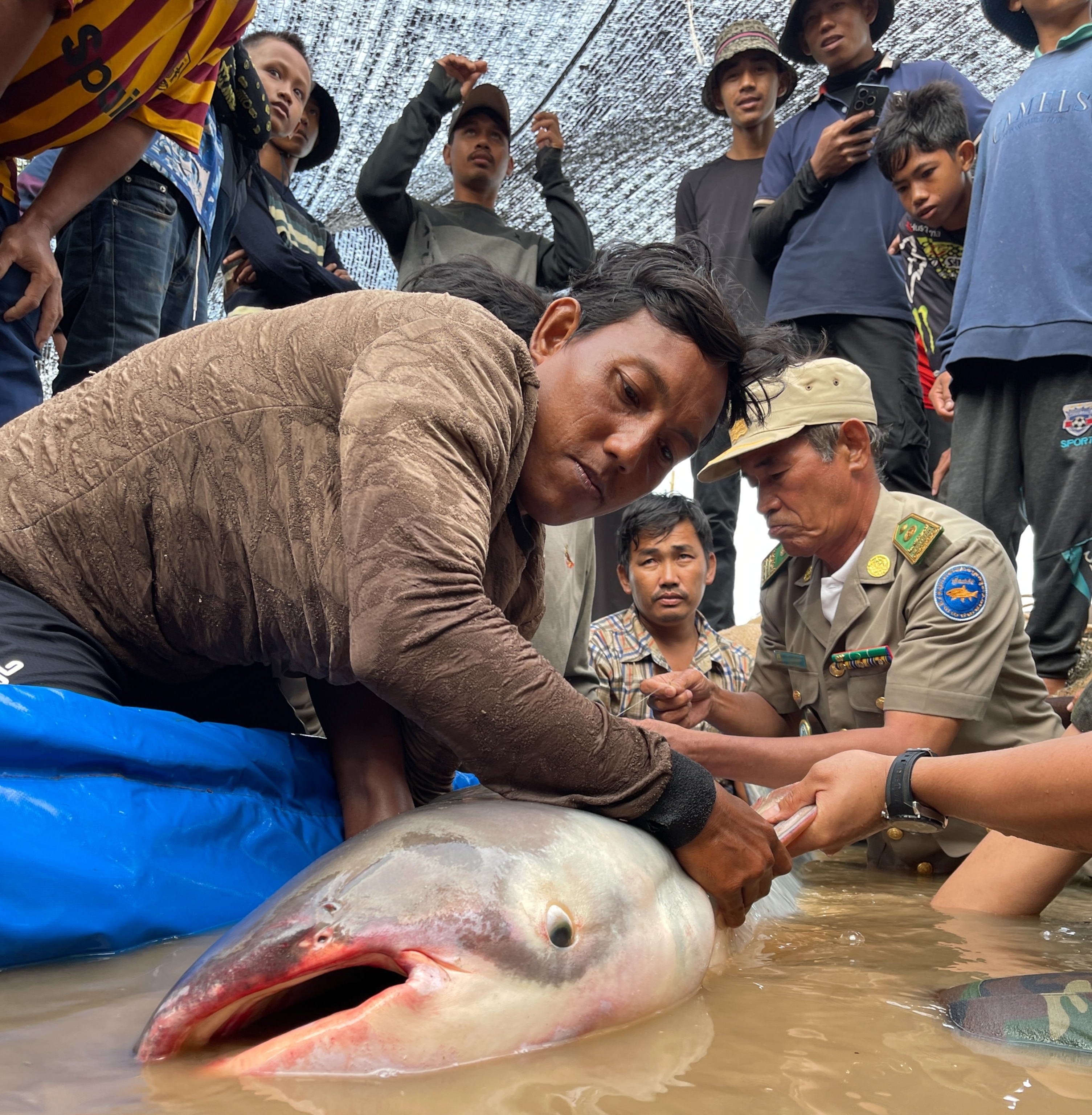
Seila, a member of a national rapid-response team formed to rescue imperiled megafish, turned her car around. Within hours, she and her colleagues were on site—measuring, tagging, and eventually releasing the critically endangered fish back into the water. Then her phone rang again.
This time the call came from near Phnom Penh, where fishers had accidentally caught a 172-pound giant barb, known as Cambodia’s “King of Fish,” also critically endangered. Once again, the rapid-response team mobilized, and before long this giant, too, was back in the river. “There were seasons when we didn’t hear about a single giant fish,” Seila said. “Now the calls keep coming.”
For species long thought to be disappearing, the surge is striking. Once abundant across the Mekong basin, giant fish were killed by overfishing, dams, and disruption to the regular rise and fall of water levels along the river. The Mekong, spanning six countries and supporting the world’s largest inland fishery, holds more megafish species than any river on Earth, some of which can grow over 600 pounds.
In recent decades, their numbers have collapsed.
But in Cambodia, conservationists have persisted, working closely with fishing communities and local government officials strengthening cooperation along the river. In late 2025, a national hotline; a Mekong Fish App; and a dedicated rapid-response team transformed scattered rescues into a coordinated national effort. From mid-November to early February, the team returned 92 large fish that had been unintentionally caught—24 Mekong giant catfish, 23 giant barb, 32 seven-striped barb, and 13 striped catfish—back into the waters, alive.
To Zeb Hogan, a fish biologist at the University of Nevada, Reno, and a National Geographic Explorer who has studied Mekong fish for three decades, the season was a stunning shift. “After years of watching these species edge toward extinction, seeing numbers rise instead of fall feels almost unimaginable. But it's happening, and it's exciting,” he says.
Why megafish started to disappear
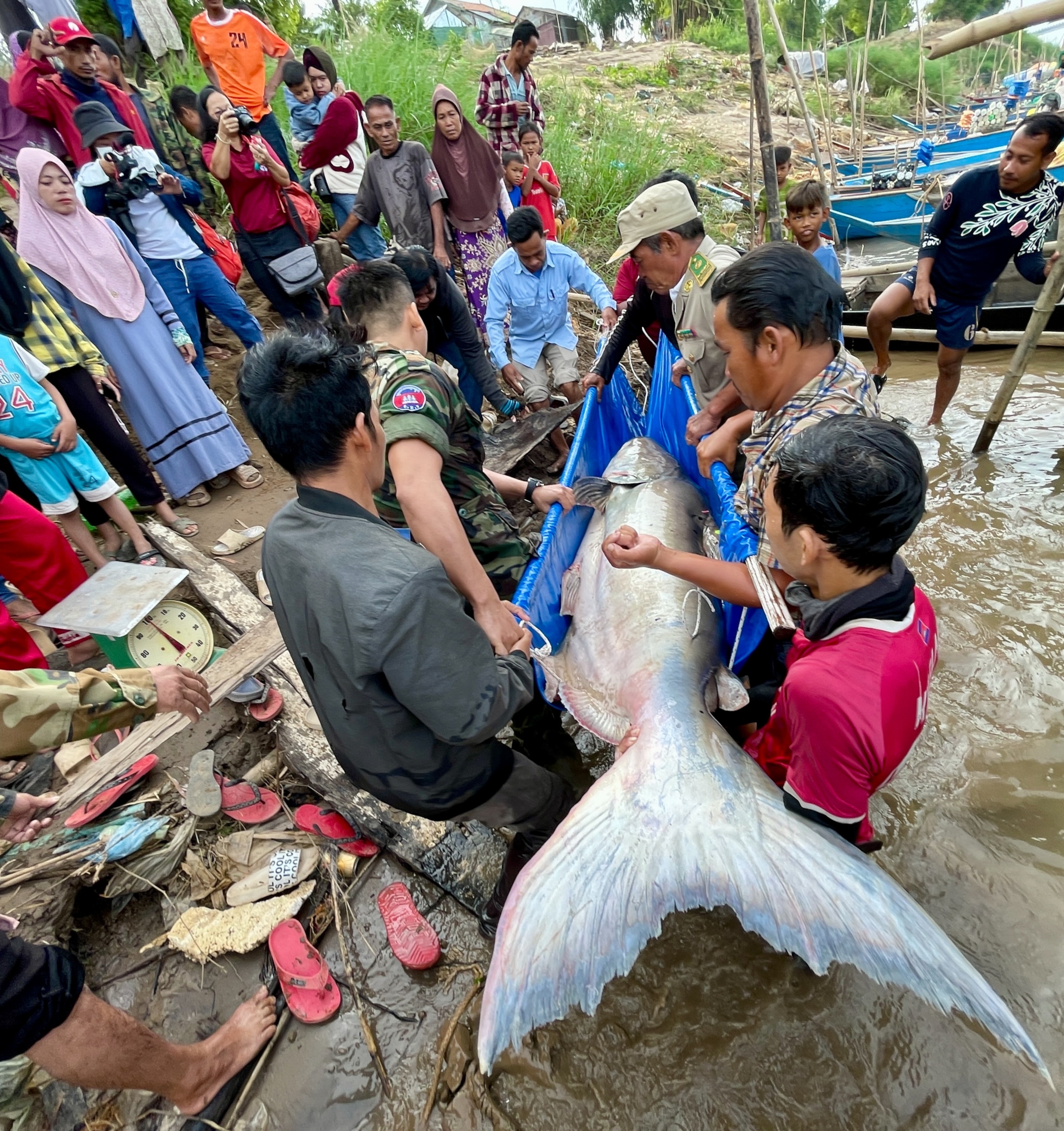
Giant freshwater fish are among the most threatened animals on Earth. In some regions, populations of freshwater megafish—which Hogan defines as species that can grow to at least 200 pounds or six feet in length—have declined by more than 95 percent since 1970. One such leviathan, the Chinese paddlefish, which could exceed 20 feet, was declared to have gone extinct in the early 2000s.
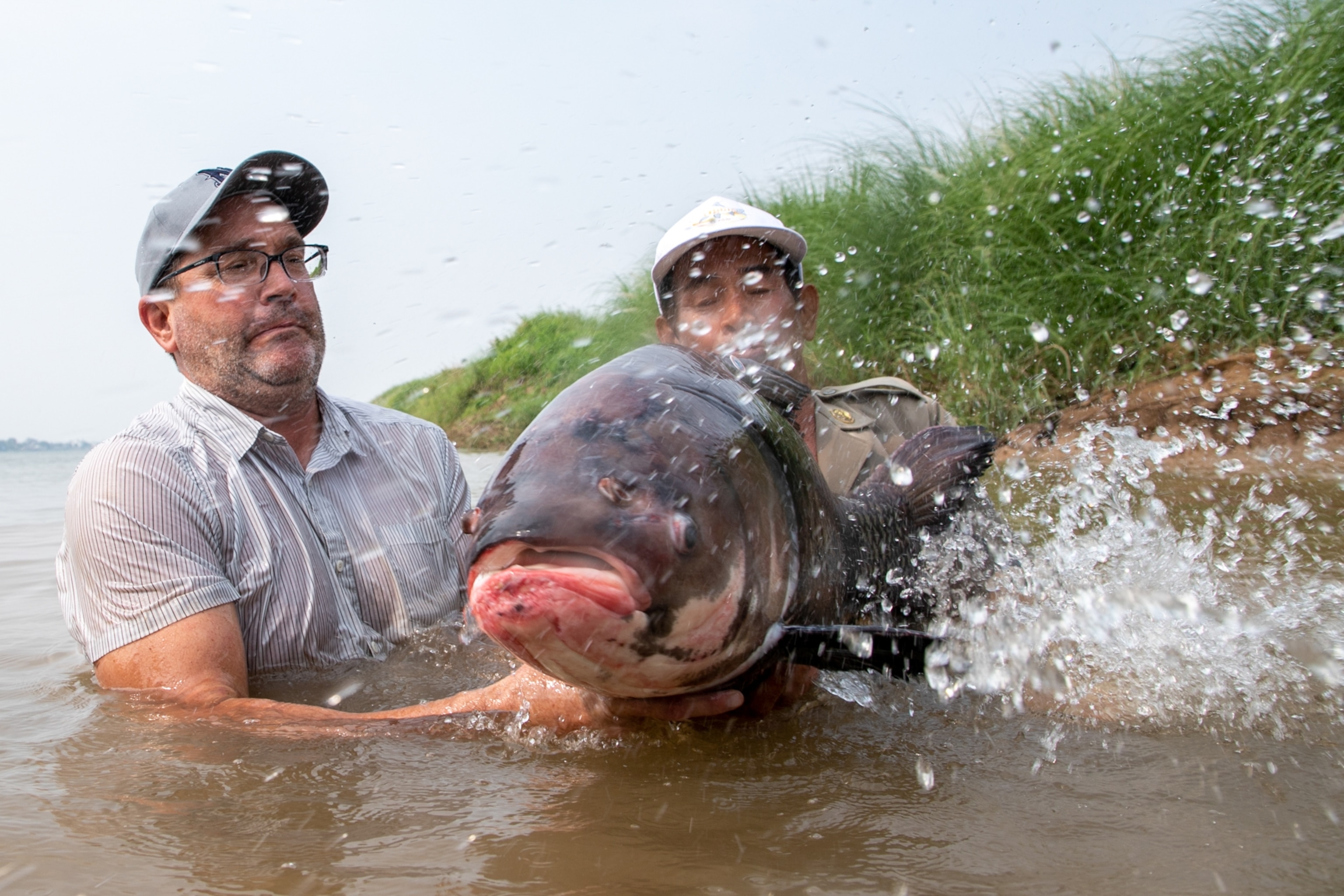
The reason the Mekong holds more megafish than any other river is likely because its immense size, productivity, and annual floods create the food, space, and connectivity that allow fish to grow extraordinarily large. In 2022, a giant freshwater stingray weighing a confirmed 661 pounds was caught and released in northern Cambodia, the largest freshwater fish ever recorded.
“If you’re looking for the planet’s freshwater giants, you look to the Mekong,” says Hogan.
In the early 1980s, the Mekong’s giants were commonplace in Kampong Cham, Cambodia. Huot Uong, now 73, recalls working on crews that hauled seine nets more than 2,000 feet long and 15 feet deep from the river. Each sweep could bring hundreds of striped catfish along with as many as 10 adult Mekong giant catfish.
Occasionally, truly enormous fish surfaced in the nets. One January day, the fishers landed a 660-pound giant catfish so oily that everyone who ate it fell ill. A month later they caught another, roughly 100 pounds heavier, so powerful it took nearly 100 men two hours to drag it ashore. No one would buy it, fearing it would make them sick. Looking back, Uong remembers thinking the boom could not last and that the river’s bounty would eventually fade.
His fears were not unfounded. The coming decline stemmed not only from overfishing but also from sweeping upstream changes. Beginning in the 1990s, China built a cascade of dams on the Upper Mekong, altering flows that migratory fish had followed for millennia. Laos expanded hydropower, sand mining intensified, and the river’s flood pulse was disrupted. “The Mekong is a system that has been engineered in ways that work against fish, and against the tens of millions of people who depend on them for food,” says Brian Eyler of the Stimson Center in Washington, D.C. and author of “Last Days of the Mekong.”
When Hogan began studying Mekong giant catfish in northern Thailand in the late 1990s, the species was already in steep decline. Records from the Chiang Khong Fishermen’s Club showed that as many as 80 large spawning fish were caught in a single season in the 1980s; by 1997, fewer than 10 remained. Within a decade, some seasons produced none at all. As the Thai fishery collapsed, Hogan shifted his focus to Cambodia, where deep pools and floodplains offered one of the last refuges for the giants.
In those early years, he worked with a small group of Cambodian colleagues, spending nights with fishing families along the river in a country with limited scientific capacity and few communication tools. Fishers had no phones; reports traveled slowly, if at all. “When you’re studying a critically endangered species and the catch goes to zero, you have to confront the possibility that it may be gone forever,” he says. “It felt like witnessing the end.”
How a hotline is saving fish
But the fish were still there. Through a research initiative called the Wonders of the Mekong project, Hogan and Cambodian colleagues spent years building trust with fishing communities, where these species are rarely targeted but sometimes caught by accident. As communication improved, reports became more consistent, among them the capture and release of the record-breaking freshwater stingray by local fishers.
In the 2024–25 season, more than a dozen Mekong giant catfish were reported, after years when, in some cases, none were reported.
To formalize the cooperation between fishing communities and conservationists, researchers developed the Mekong Fish App. In the past, fishers recorded catches by hand, if at all, and many hesitated to report protected species they had caught by accident. The app allows fishers to log catches in near real time—entering measurements, uploading photos, and automatically capturing GPS coordinates—with data shared directly with fisheries officials and Telegram alerts flagging threatened species.
“Local fishing communities have become our conservation partners because of the trust that has been built up over time,” says Heng Kong, director of the Cambodian government’s Inland Fisheries Research and Development Institute. “They feel free to report their catch.”
Over the course of six months last year, pilot communities recorded 965 fish across most of the 18 targeted species. “Before, we might see fish in the market, but we didn’t know where they were caught or how many were being taken,” says Pin Kakada, a Ph.D. student at Cambodia’s Royal University of Agriculture who led the app’s development. “Now we finally have the data.”
Alongside the app, partners launched a national hotline and, before the latest fishing season, a dedicated rapid-response team with Cambodia’s Fisheries Administration. When a critically endangered fish is caught as bycatch, fishers call the hotline or alert local officials, who dispatch the a rescue team. The program began in November 2025, and calls followed almost immediately. Most fishers prefer to see the animals released alive, says Srey Keosopheak, the provincial fisheries official who alerted Seila about the giant catfish. “It is good luck.”
Do the 92 tagged fish reflect a true rebound or simply better reporting? Hogan says likely both. Years of outreach have built trust, meaning more fish are reported instead of quietly sold. But communication alone cannot explain the jump from seasons with one or two fish to nearly 100. The catches span a wider geography and longer time frame, revealing migrations between the Tonle Sap, a vast lake that swells each rainy season, and the Mekong main stem.
Still, there are reasons for caution. Many of the fish caught have been smaller than the giants of decades past. This season, only one fish topped 200 pounds. That pattern likely reflects a population skewed toward younger fish. “A river full of small fish is hopeful,” Hogan says. “A river with big fish is healthy.”
Cautious optimism for the future of megafish
Giant freshwater fish remain in trouble almost everywhere, with steep declines recorded across much of the world. Yet there are exceptions: in the Amazon, arapaima have rebounded through Indigenous community management, and in Wisconsin, lake sturgeon are thriving after decades of protection.
Despite ongoing pressure, the Mekong offers cautious lessons, according to Hogan. “The Mekong is still facing enormous challenges. But what we’re seeing tells us that conservation can work, even in a system under intense pressure,” he says.
On a recent sunny Friday, Hogan returned to the sprawling bagnet fishery on the Tonle Sap River near its confluence with the Mekong, where wooden platforms brace vast funnel-shaped nets that intercept migrating fish. Sixty-two-year-old Chaing Pheap, whom Hogan first met 25 years ago, runs the largest station. She was the one who alerted Seila about the giant barb. “Our national fish,” she says, smiling.
Divers used surface-supplied air to retrieve dozens of live fish from submerged pens beneath the platform. Most were juveniles, but still strikingly large. Researchers separated the endangered species slated for release, roughly three dozen in all, including two Mekong giant catfish, and loaded them into boats bound for a small, uninhabited island in the middle of the Mekong, beyond the nets.
There, joined by villagers who followed along, Hogan and his team released the fish one by one. Standing waist-deep in the current, feet sinking into the mud, they watched each animal vanish in a flick of the tail. “Every fish we save is a reminder that extinction isn’t inevitable,” Hogan said, “and that these extraordinary creatures make our world a richer, more wondrous place.”
Badenoch blasts 'moaning' female Labour MPs over Burnham jobs 'quota'

Kemi Badenoch has told Labour women to earn a job in Andy Burnham's Cabinet instead of demanding they are handed jobs because of their gender.
The Tory leader lashed out today amid reports that female MPs are demanding the de-facto new prime minister introduce a 50:50 gender split 'quota' in his government.
Amid reports that former foreign secretary David Miliband is being lined up to return to the role, possibly with his brother Ed as Chancellor, one female minister also complained that Burnham could not have 'more Milibands than women' in the top posts.
But in a scathing article in the Times today Mrs Badenoch told them to 'stop moaning' and get chosen on merit instead of retreating into 'more of the failed identity politics that is holding back our country'.
'There are many, many reasons why you shouldn't have any Milibands in the cabinet,' she said.
'But complaining that the boys haven't given them the right jobs or that the boys are taking all the jobs, just shows that Labour's women still don't get it.'
The idea of quotas was also attacked by Baroness Jacqui Smith, Labour's Skills Minister.
Asked by Times Radio if Mr Burnham should reserve jobs for women, she said: 'No, I think what Andy Burnham should be doing is building the very best team around him to change this country.'

A letter written by the Women's Parliamentary Labour Party has called on Mr Burnham to ensure a 50:50 split between men and women in government jobs

Amid reports that former foreign secretary David Miliband (above, right, in 2010) is being lined up to return to the role, possibly with his brother Ed as Chancellor, one female minister complained that Burnham could not have 'more Milibands than women' in the top posts

But Mrs Badenoch told them to pipe down and get chosen on merit instead of retreating into 'more of the failed identity politics that is holding back our country'
A letter written by the Women's Parliamentary Labour Party and seen by the BBC has called on Mr Burnham to ensure a 50:50 split between men and women in government jobs after he succeeds Sir Keir Starmer.
'We are asking you to demonstrate this change from day one and address the toxicity and misogyny within our own party and government,' it said.
Labour has never had a female leader, while the Conservatives have had three, and Mrs Badenoch urged the government to follow its meritocratic example.
'If you run a meritocracy, then you do not have to worry about jobs for the boys,' she wrote.
'Every woman who is a Conservative MP, every woman who has ever won the leadership, has had to fight to get where she is.
'By contrast, Labour women are demanding guarantees from Burnham. But the truth is he doesn't have to give any guarantees.
'If none of Labour's women are prepared to get their hands dirty and challenge him for the leadership, their demands are toothless.'
'In fact, it's quite revealing that the women's parliamentary Labour Party has written to Burnham asking him to commit himself to at least 50 per cent female ministers.
'This has nothing to do with meritocracy. It is yet more of the failed identity politics that is holding back our country.'