The 2 earthquakes that struck Venezuela are known as a 'doublet.' Here's what to know about them
SAN JUAN, Puerto Rico (AP) — The two powerful earthquakes that struck Venezuela's northern coast, killing more than 180 people, were an event known as a "doublet."
Grow your mind
Subscribe to our Science Newsletter to explore the wide worlds of science, health and technology.
Doublet earthquakes happen when a pair of similar-sized quakes hit close in location and time, according to the U.S. Geological Survey. On Wednesday evening, a 7.2 magnitude quake hit first, followed by a magnitude 7.5 just 39 seconds later.
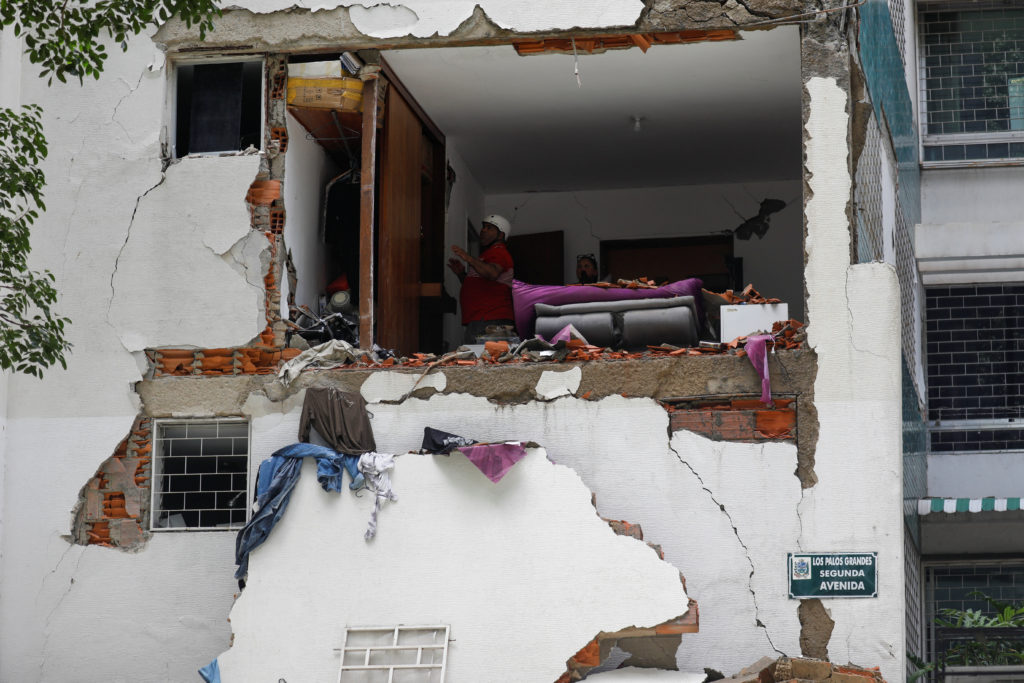
The deadly one-two punch toppled buildings in Venezuela's capital, Caracas and beyond. Some 1,500 people were injured and thousands were reported missing. The coastal region of La Guaira, which is north of Caracas, experienced some of the heaviest damage and casualties, officials said.
How rare are doublets?
While not as common as a typical earthquake where a main shock is followed by much smaller aftershocks, doublets can happen anywhere in the world, Christine Goulet, director of the USGS earthquake science center in California, told The Associated Press.
Doublets indicate a complex fault structure, like the one in Venezuela. Known as the Bocono fault, it runs along the backbone of the Venezuelan Andes for about 300 miles (500 kilometers). A previous doublet — of magnitudes 6.2 and 6.3 — struck an area west of Caracas in September 2025, killing at least one person and injuring more than 100 others. Most of the damage was reported in the states of Zulia and Lara.
What caused Wednesday's double earthquake?
Most earthquakes occur along plate boundaries, which is where tectonic plates meet.
A rupture where the Caribbean and South American tectonic plates meet unleashed the two quakes this week.
The doublet occurred where the Caribbean plate, located north of Venezuela, moves eastward relative to the South American plate at an average rate of 0.79 inches (2 centimeters) a year.
"It's a large displacement," Goulet noted. "It's on the order of the San Andreas fault."
The movement was a shallow strike-slip faulting, which occurs when two blocks of rock slide past one another horizontally.
That kind of movement is not more dangerous by default, Goulet said.
READ MORE: At least 188 people are dead in Venezuela after 2 earthquakes rocked the country's north
"A more vertical motion can be more damaging," she said, adding that other factors, including the length of the rupture, determine the amount of damage.
The boundary between the Caribbean and South American plates is less active than others, said David Naar, associate dean at the University of South Florida's College of Marine Science.
How common are earthquakes in Venezuela?
In the past century, only seven earthquakes of magnitude 6 and higher have hit in the immediate vicinity of the most recent ones, according to USGS.
These include the 2025 doublet that struck west-northwest of the latest quakes.
Individual earthquakes of magnitude 6 or higher struck in 2009, 1989 and 1975. The most devastating one hit in July 1967. It was a 6.6 magnitude quake that killed hundreds of people.
José Vitriago, who lives in Caracas, remembers that one. He was 2 years old.
"Our house broke," he recalled in an interview with state-owned TV station Venezolana de Televisión.
Vitriago said the doublet that hit Wednesday "was horrible, horrible."
Overall, five earthquakes of magnitude 7 and higher have occurred in northern Venezuela or near the coast since 1900, according to USGS.
The most catastrophic earthquake occurred in March 1812 along the Bocono fault system, killing an estimated 30,000 people.
Will more earthquakes hit Venezuela?
Scientists cannot predict earthquakes, but aftershocks are common after big ones. The USGS said there's a 99% chance of at least one magnitude 4 aftershock hitting Venezuela within the next week, and a 24% chance of a magnitude 6 one occurring.
Unlike other countries, Venezuela does not have an early earthquake warning system, which relies on sensors to detect the first waves of an earthquake.
"It's very distressing that there was basically no time to evacuate," she said. "That's extremely unfortunate."
Support trusted journalism and civil dialogue.
Badenoch blasts 'moaning' female Labour MPs over Burnham jobs 'quota'

Kemi Badenoch has told Labour women to earn a job in Andy Burnham's Cabinet instead of demanding they are handed jobs because of their gender.
The Tory leader lashed out today amid reports that female MPs are demanding the de-facto new prime minister introduce a 50:50 gender split 'quota' in his government.
Amid reports that former foreign secretary David Miliband is being lined up to return to the role, possibly with his brother Ed as Chancellor, one female minister also complained that Burnham could not have 'more Milibands than women' in the top posts.
But in a scathing article in the Times today Mrs Badenoch told them to 'stop moaning' and get chosen on merit instead of retreating into 'more of the failed identity politics that is holding back our country'.
'There are many, many reasons why you shouldn't have any Milibands in the cabinet,' she said.
'But complaining that the boys haven't given them the right jobs or that the boys are taking all the jobs, just shows that Labour's women still don't get it.'
The idea of quotas was also attacked by Baroness Jacqui Smith, Labour's Skills Minister.
Asked by Times Radio if Mr Burnham should reserve jobs for women, she said: 'No, I think what Andy Burnham should be doing is building the very best team around him to change this country.'

A letter written by the Women's Parliamentary Labour Party has called on Mr Burnham to ensure a 50:50 split between men and women in government jobs

Amid reports that former foreign secretary David Miliband (above, right, in 2010) is being lined up to return to the role, possibly with his brother Ed as Chancellor, one female minister complained that Burnham could not have 'more Milibands than women' in the top posts

But Mrs Badenoch told them to pipe down and get chosen on merit instead of retreating into 'more of the failed identity politics that is holding back our country'
A letter written by the Women's Parliamentary Labour Party and seen by the BBC has called on Mr Burnham to ensure a 50:50 split between men and women in government jobs after he succeeds Sir Keir Starmer.
'We are asking you to demonstrate this change from day one and address the toxicity and misogyny within our own party and government,' it said.
Labour has never had a female leader, while the Conservatives have had three, and Mrs Badenoch urged the government to follow its meritocratic example.
'If you run a meritocracy, then you do not have to worry about jobs for the boys,' she wrote.
'Every woman who is a Conservative MP, every woman who has ever won the leadership, has had to fight to get where she is.
'By contrast, Labour women are demanding guarantees from Burnham. But the truth is he doesn't have to give any guarantees.
'If none of Labour's women are prepared to get their hands dirty and challenge him for the leadership, their demands are toothless.'
'In fact, it's quite revealing that the women's parliamentary Labour Party has written to Burnham asking him to commit himself to at least 50 per cent female ministers.
'This has nothing to do with meritocracy. It is yet more of the failed identity politics that is holding back our country.'