Taylor Sheridan’s ‘Mayor of Kingstown’ Gave Ex-Convict Extras Panic Attacks, Caused Hospitalizations

Taylor Sheridan made shocking revelations about how several ex-convicts had to be taken to the hospital after their time on the set of Mayor of Kingstown.
“There is a scene in episode 3 of the first season where a man is arrested for killing a child. It actually is a parole violation so the guy doesn’t go to county, he goes straight back to prison immediately,” Sheridan, 56, recalled on the Monday, June 29, episode of “The Bill Simmons Podcast” show. “And when he comes in, there’s this frenzy because … there’s a bullseye on this guy [in prison].”
Sheridan recalled filming the intense sequence in a “decommissioned” prison.
“After the first take, I start hearing buzz over the radio, ‘We need a medic. Actually we need two medics.’ And I run upstairs to see what happened,” he continued. “Why do we need a medic? Did someone have a heart attack? And most of the extras in this scene were ex-cons who had actually stayed in this prison, which is empty [now].”

Related: A Guide to Every Non-'Yellowstone' Show in the Taylor Sheridan Universe
As the man behind Yellowstone and its myriad spinoffs, Taylor Sheridan is one of the most important people at Paramount Network — but the Yellowstone universe is only one part of his empire. While other super-producers — Ryan Murphy and Shonda Rhimes, for example — enlist other writers and directors to work on projects bearing […]The creator realized that the experience was triggering for some of the extras, adding, “Of course, we’re paying a few hundred bucks a day to these guys and there’s not any work because it’s COVID and so they jumped at it.”
“Two of them had panic attacks that were so bad that they had to go to the hospital,” he said. “Then there was a third one who [when] we closed them in and locked them in the cells, this guy starts screaming, ‘You gotta let me out, I can’t do this.'”
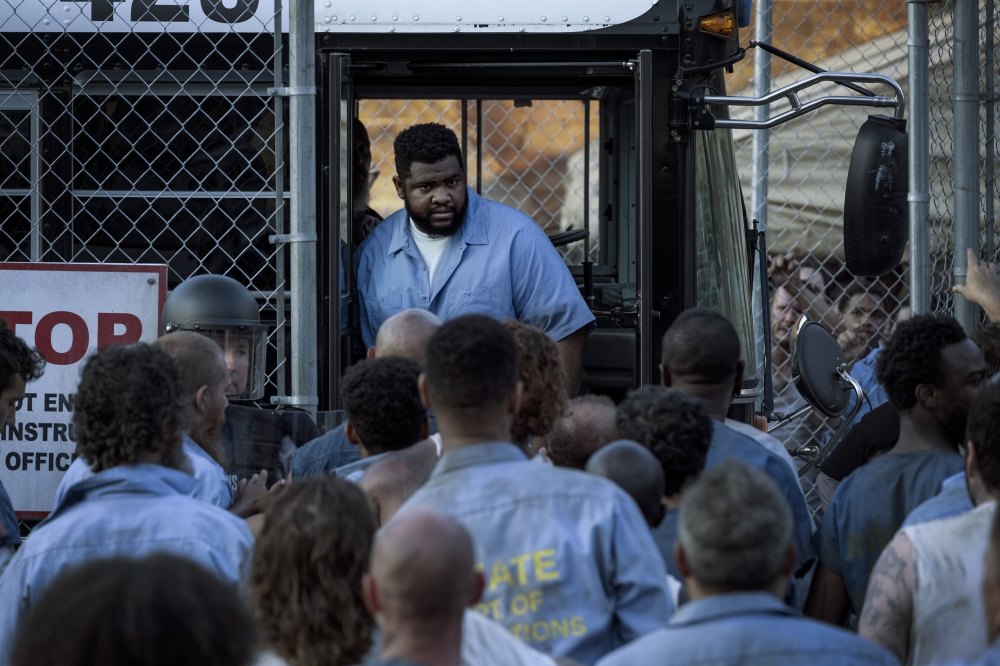
Sheridan continued, “We let him out and he starts taking off. He’s like, ‘I’m sorry, I can’t. You don’t have to pay me.’ I said, ‘No, no, no. For what I just put you through, we’re gonna pay you.’ They left and they were done. They wanted absolutely no part of even reenacting it.”
The Mayor of Kingstown is one of Sheridan’s many successful shows. Sheridan originally explored a career as an actor before writing scripts for movies, including Sicario, Hell or High Water and Wind River.
Sheridan’s focus later shifted to the small screen, which paved the way for Yellowstone‘s success. The hit series aired from 2018 to 2024 as viewers tuned in to keep tabs on the fictional Dutton family. Sheridan has also worked on original shows Landman, Lioness and Tulsa King.


Thank You!
You have successfully subscribed.

Deal of the Day
Deal Alert! This 44%-Off Throw-On Mini Dress Is Too Good to Leave in Your Cart View Deal
Related: Showrunner Changes on Taylor Sheridan Shows: 'Tulsa King' to 'Dutton Ranch'
Taylor Sheridan‘s TV universe has found immense success — but his projects have also come with many showrunner changes. After getting his start as an actor, Sheridan started writing scripts for movies. He began his TV empire with Yellowstone, which aired from 2018 to 2024. Sheridan then created prequels 1883 and 1923, as well as […]News broke in October 2025 that Sheridan closed a major with NBCUniversal. The five-year overall deal for film, TV and streaming will begin January 1, 2029, after Sheridan’s TV deal with Paramount — which goes through 2028 — officially ends.
Paramount will retain the rights to Yellowstone and the other franchises Sheridan created under his deal with the company, so he is expected to create a brand new IP for NBCUniversal. Sheridan’s move came after Paramount’s merger with Skydance.
“I spent the first 37 years of my life compromising. When I quit acting, I decided that I am going to tell my stories my way, period,” Sheridan told The Hollywood Reporter in a 2023 profile. “If you don’t want me to tell them, fine. Give them back and I’ll find someone who does — or I won’t, and then I’ll read them in some freaking dinner theater. But I won’t compromise. There is no compromising.”
Just For You


In this article

Taylor Sheridan
Inside 'football nerd' Thomas Tuchel's rise from German fifth-tier to leader of England's World Cup dreams
Though their elimination at the hands of Paraguay was hardly something to celebrate across Germany, at least in one particular corner of Bavaria, there might be less of a need to worry about the prospect of having to split one's affections further into the World Cup. Now that Die Mannschaft are heading back home, the hierarchy at FC Augsburg can get behind one of their own and cheer on England, or to be more precise, their manager Thomas Tuchel.
At 52 years of age, Tuchel ranks among the most experienced and successful coaches in the World Cup field. A domestic champion with Bayern Munich and Paris Saint-Germain, he has also won the Champions League with Chelsea and is now bidding to end England's 60-year wait for major silverware at the World Cup. It is quite the rise in a senior coaching career that began among the dilapidated buildings of FC Augsburg II, at the time playing in the fifth tier of German football.
Among those who came under his tutelage were future Germany boss Julian Nagelsmann, like Tuchel, an injury-plagued young defender who would pivot to coaching at an early age. Another was Michael Ströll, who would take an unusual path of his own to a position of great authority. Rejoining the club as an intern in the front office in 2006, Ströll rose up the ranks to be named chief executive of the Bundesliga side in 2024.
With Tuchel's long-standing assistant and video analyst Benjamin Weber on staff as Augsburg's sporting director, there is a flavor to this Bundesliga regular and their senior side that harks back to the B team playing in far less illustrious circumstances. No wonder, when you hear the admiration that their CEO has for his former boss.
"Thomas was a nerd," Ströll tells CBS Sports. "In a positive way. He was so detailed, so ambitious. Already in the fifth league of Germany at that time, you could see those qualities. You couldn't know where he would go, of course, but I was very positive he could have a good career. I just did not know that it would end up in the Bundesliga and the Premier League, winning the Champions League."
How could he? As Ströll notes, imagining such a rise would be "crazy" given where their careers began.
"If you look back 20 years ago, we started in an old building that was broken. No pitches, no hydration at the pitches, really horrible circumstances," he said.
That characterisation of Tuchel as the tactical obsessive has endured ever since and with good cause. Few other elite managers are quite as likely to pepper their press conferences with references to expected goals, whose attention to detail is such that he tried to poach the Olympiacos groundsman when Mainz manager, so impressed was he with the cut of his grass. Perhaps the archetypal Tuchel story involves a lunch with Pep Guardiola, then at Bayern Munich, one which descended into a tactical conference through the medium of salt and pepper shakers.
One wonders how that worked in the lower reaches of late 2000s German football. The answer, of course, is that it didn't. And yet Tuchel found a way.
"At the time, there was no data for the fifth league. What there was was a lot of paper and pens and writing. It doesn't matter whether he has data or technology. He only needs something around to show what he has in mind," Weber said.
"He's really a brain of football."
Tuchel's work at Augsburg II soon caught the eye of Bundesliga side Mainz, who tasked him with building on the work done by Jurgen Klopp. Weber, a former tennis player working in video analysis in the scouting department, was one of the few left on the Mainz staff who was familiar to Tuchel.
Soon, he was promoted to what he describes as something of a threadbare staff, the sort where his work encompassed everything from assessing opposition to hurrying around shops to find the right trainers for their first match together against Bayer Leverkusen. For reasons he cannot quite remember, it was extremely important that they furnished themselves with the right kind of Nikes.
"Every detail was important for us at that moment," says Weber. "There was nobody, it was just him as a head coach and me trying to handle the situations around and to deal with it."
From Mainz to Chelsea via Borussia Dortmund and Paris Saint-Germain, Weber and Tuchel would be together for 14 years of a "very tense, very big friendship", one with "very many experiences together on the positive but also on the negative". Who could have believed that the coaching wunderkind of the German fifth tier would eventually have to hold Chelsea together amid the chaos of early 2022 as sanctions on owner Roman Abramovich forced Tuchel, long known for his combustibility, to act as an emotional shield for Chelsea's fans, players and employees.
"I learned a lot, a lot," says Weber of their time together at Stamford Bridge. "I learned to be very clear, both in your speech in front of the group and your decisions.
"But I think the main thing is adaptation, to adapt every day, day by day, because the circumstances, the conditions change day by day. You come to the office and suddenly a player is injured or someone wants to leave the club, whatever. You cannot plan for that.
"You try to, and that's very good because you need to have an objective. But this adaptation day by day to deal with new situations, that's the main thing. And this is, in my opinion, also the biggest strength of him, to adapt to every moment in a football game or every moment in a football club."
Those are lessons that Weber has looked to carry through at Augsburg, where his first year as sporting director saw head coach Sandro Wagner sacked in early December, his now permanent successor Manuel Baum leading the Fuggerstädter to a top half finish in the Bundesliga. Almost two decades after playing under Tuchel as a player, Ströll also finds himself harking back to what he was taught at Augsburg II.
"The most impressive thing that I learned from him is always to think not only one step ahead, keep three steps ahead," he says. "There's no difference for him whether it's the fifth league, the Bundesliga or the Champions League.
"You always have to think further and further and further. You cannot stand still because otherwise the other opponents will pass you. That is the most impressive that I got from Thomas from our time together."
And so with no national team to cheer on and (for the time being at least) no Augsburg players in England's path, there will be a little corner of Bavaria, perhaps even just a few offices at the Augsburg Arena, that are rooting for Tuchel through the remainder of this World Cup.
"It would be great if he would win this World Cup with England," says Weber. "He would deserve this much more than many other head coaches, at least from my perspective."
Add CBS Sports on GoogleThe Supreme Court’s impactful term wraps up

Welcome to the Inside Scoop newsletter. That’s a wrap on a consequential Supreme Court term, as the highest court considered sticking points in the president’s agenda. Also, science reporter Denise Chow talks about the extreme heat blanketing the nation just in time for its 250th birthday. I’m senior editor Michelle Garcia, in for Yasmin and Emily today. Let’s get into it.
Just a moment.
We are getting your experience ready.
How 'Country Roads' became the unofficial anthem of the World Cup
Story by
 Jay Busbee Senior writerTue, June 30, 2026 at 9:50 PM UTC·3 min read
Look, we all agree the hydration breaks during World Cup matches are awful, right? Yes, yes, in theory they're supposed to keep players from collapsing in dehydrated heaps on the pitch, but in practice, they're just an opportunity to cram more ads into a broadcast. They disrupt momentum, they alter the flow of the match, and they're an unnecessary and unwelcome addition … with one notable, musical exception.
World Cup stadiums are using the hydration break as an opportunity to play "Country Roads," and it's glorious, every single time.
AdvertisementAdvertisement"U-S-A!" is our big, loud, stomping declaration of patriotism. The seven notes of "Seven Nation Army" are the horns of an invading army, but they've been co-opted by plenty of other nations. John Denver's "Country Roads," though — that's America itself in four chords and a transcendent chorus.
Try it yourself next time you're out at the sports bar/pub/grandstand. Sing the first four words — Almost heaven, West Virginia — and by the next five — Blue Ridge mountains, Shenandoah River — the crowd is singing along with you. No matter whether they're European or African, Asian or South American, they sing along to the gentle melody of the timeless John Denver classic. Listen close, and you can hear the accents as the lyrics flow by like miles on the highway.
This World Cup has given the entire planet a new view of America, the land of ranch dressing and Buc-ee's, charming small towns and cavernous stadiums. Joyful tourists document their discoveries of Americana while Americans raise toasts and sing along with their international guests. And more than anything, they're all singing along to "Country Roads" … even if they've never been within a thousand miles of West Virginia.
Why has "Country Roads" become such a phenomenon? Because it's quintessentially American. It's a song of the open road, a song of nostalgia for better days, a song about leaving home and then returning back to it. Most of all, it's a song that embodies the very best of America — the desire to get behind a wheel to chase a dream, and the pull back to one's own little stretch of land.
AdvertisementAdvertisementThose are universal human yearnings, and that's what makes the song so durable. Swap in a lyric or two, and you can make our West Virginia singer's quest your own, the way this Japanese group has done:
Plus, let's be direct: the melody is absolutely perfect for a singalong, no matter how drunk you are. Unlike, say, "The Star-Spangled Banner," a janky, jagged, multi-octave anthem, "Country Roads" proceeds in a slow and stately fashion. Hell, the soaring chorus virtually demands you throw your arms around your mates and sing along, like these fine folks at an Oktoberfest celebration in Germany:
According to legend, songwriters Bill Danoff and Taffy Nivert brought the nascent tune to singer-songwriter John Denver back in 1970, and the first time he performed it, the crowd at the tiny club immediately picked up on the chorus and sang along the second time it came around. But naturally, the record company didn't think it would be a hit. Even better — none of the three songwriters had ever even been to West Virginia. (They tried to wedge "Massachusetts" into the song's structure. Thankfully they failed.)
AdvertisementAdvertisementFaking your way through obstacles until you find glory — man, that's pure, undistilled America right there. And now, the song is everywhere, soundtracking this year's World Cup. In a competition so often defined by corruption and commercialism, "Country Roads" is as pure as it gets.
There will be plenty of gatherings in the weeks ahead, watching the USMNT and the other two dozen-plus teams still alive in the tournament. And where there are soccer fans, there are singalongs. And now, where there are singalongs, there's "Country Roads."
Go ahead and join in. You already know the words.