Supreme Court upholds state bans on transgender athletes in girls' and women's sports
 Politics
Supreme Court upholds state bans on transgender athletes in girls' and women's sports
By Melissa Quinn Senior Reporter, Politics Melissa Quinn is a senior reporter for CBSNews.com, where she covers U.S. politics, with a focus on the Supreme Court and federal courts. Read Full Bio Melissa QuinnUpdated on: June 30, 2026 / 10:15 AM EDT / CBS News
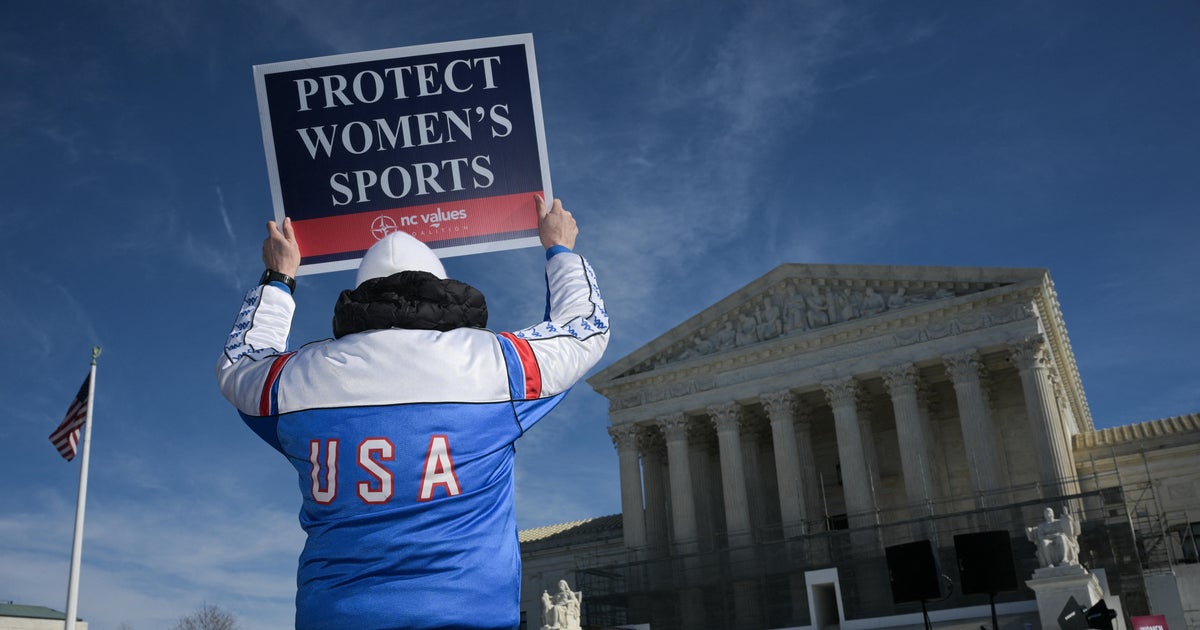
Add CBS News on GoogleWashington — The Supreme Court on Tuesday ruled states can prohibit transgender athletes from competing on girls' and women's sports teams, a decision that delivers the latest setback for transgender rights.
In two of the most closely watched cases of its term, the Supreme Court upheld laws from West Virginia and Idaho that restrict transgender athletes' participation in school sports. The cases are known as West Virginia v. B.P.J. and Little v. Hecox.
Justice Brett Kavanaugh authored the opinion for the majority, writing that under Title IX and the Equal Protection Clause, schools can base eligibility for women and girls' sports teams on biological sex.
"Consistent with Title IX and the Equal Protection Clause, we hold that the States may maintain women's and girls' sports for biological females. They may determine eligibility for women's and girls' sports based on biological sex," Kavanaugh wrote. "The Constitution and Title IX do not require an overhaul of women's and girls' sports throughout America."
The three liberal justices dissented from the majority's finding when it comes to the Equal Protection Clause, but agreed with the court's conservatives on Title IX.
The ruling protects similar laws in 27 states that have been enacted in recent years in response to high-profile instances of transgender athletes competing in girls' and women's sporting events. President Trump signed an executive order last year that prohibits educational programs that receive federal dollars from allowing transgender girls and women to play on the teams that align with their gender identity.
The NCAA and the International Olympic Committee have also updated their eligibility policies, limiting competition in women's events to only athletes assigned female at birth.
The ruling is the latest to land before the Supreme Court that tested transgender rights. In its last term, the high court upheld a Tennessee law that restricts access to certain medical treatments for minors experiencing gender dysphoria. Half of the states have similar measures in place.
But in 2020, the Supreme Court ruled that a federal civil rights law known as Title VII prohibits an employer from firing a worker because of their sexual orientation or transgender status.
The West Virginia law
West Virginia enacted its law, called the Save Women's Sports Act, in 2021. The measure requires athletic teams to be designated based on biological sex at birth and bars students assigned male at birth from playing in girls' and women's sports.
Before the law took effect, a transgender girl named Becky Pepper-Jackson, who wanted to compete on her school's girls cross-country and track teams, sued to block its enforcement. Pepper-Jackson began socially transitioning in third grade and has taken puberty-delaying medication and hormone therapy. She is now in high school.
A U.S. district court upheld West Virginia's law in 2023, but a federal appellate court in 2024 ruled that the measure unlawfully discriminates against Pepper-Jackson on the basis of sex.
At issue in the case was whether Title IX or the Constitution's Equal Protection Clause prevented a state from forbidding transgender girls and women from playing on the athletic teams that match their gender identity.
Lawyers for Pepper-Jackson had argued that the bans targeted only a small number of athletes — their client is the only transgender athlete in West Virginia, they said. Additionally, because of puberty-delaying medical treatment, Pepper-Jackson and other transgender girls like her do not have any biological athletic advantage over competitors designated female at birth, her lawyers said.
But state officials said the bans draw permissible distinctions between the sexes, classifications that are substantially related to their interest in protecting girls' and women's sports.
Title IX was enacted more than 50 years ago and prohibits sex discrimination in federally funded education programs. Two years after its passage, regulations were adopted to allow schools to operate sex-separated athletic teams, as well as separate locker rooms, restrooms and showers. Schools, though, must provide "equal athletic opportunity" for members of both sexes.
The Idaho law
The Supreme Court also weighed a challenge to a law from Idaho, which was the first state to forbid transgender athletes from participating in girls' and women's sports.
Lindsay Hecox filed her lawsuit challenging Idaho's law after seeking to compete on the women's track and cross-country teams at Boise State University and argued that the state's ban was unconstitutional and a violation of Title IX. A federal appeals court ruled in 2024 that Idaho's ban is likely unconstitutional.
Badenoch blasts 'moaning' female Labour MPs over Burnham jobs 'quota'

Kemi Badenoch has told Labour women to earn a job in Andy Burnham's Cabinet instead of demanding they are handed jobs because of their gender.
The Tory leader lashed out today amid reports that female MPs are demanding the de-facto new prime minister introduce a 50:50 gender split 'quota' in his government.
Amid reports that former foreign secretary David Miliband is being lined up to return to the role, possibly with his brother Ed as Chancellor, one female minister also complained that Burnham could not have 'more Milibands than women' in the top posts.
But in a scathing article in the Times today Mrs Badenoch told them to 'stop moaning' and get chosen on merit instead of retreating into 'more of the failed identity politics that is holding back our country'.
'There are many, many reasons why you shouldn't have any Milibands in the cabinet,' she said.
'But complaining that the boys haven't given them the right jobs or that the boys are taking all the jobs, just shows that Labour's women still don't get it.'
The idea of quotas was also attacked by Baroness Jacqui Smith, Labour's Skills Minister.
Asked by Times Radio if Mr Burnham should reserve jobs for women, she said: 'No, I think what Andy Burnham should be doing is building the very best team around him to change this country.'

A letter written by the Women's Parliamentary Labour Party has called on Mr Burnham to ensure a 50:50 split between men and women in government jobs

Amid reports that former foreign secretary David Miliband (above, right, in 2010) is being lined up to return to the role, possibly with his brother Ed as Chancellor, one female minister complained that Burnham could not have 'more Milibands than women' in the top posts

But Mrs Badenoch told them to pipe down and get chosen on merit instead of retreating into 'more of the failed identity politics that is holding back our country'
A letter written by the Women's Parliamentary Labour Party and seen by the BBC has called on Mr Burnham to ensure a 50:50 split between men and women in government jobs after he succeeds Sir Keir Starmer.
'We are asking you to demonstrate this change from day one and address the toxicity and misogyny within our own party and government,' it said.
Labour has never had a female leader, while the Conservatives have had three, and Mrs Badenoch urged the government to follow its meritocratic example.
'If you run a meritocracy, then you do not have to worry about jobs for the boys,' she wrote.
'Every woman who is a Conservative MP, every woman who has ever won the leadership, has had to fight to get where she is.
'By contrast, Labour women are demanding guarantees from Burnham. But the truth is he doesn't have to give any guarantees.
'If none of Labour's women are prepared to get their hands dirty and challenge him for the leadership, their demands are toothless.'
'In fact, it's quite revealing that the women's parliamentary Labour Party has written to Burnham asking him to commit himself to at least 50 per cent female ministers.
'This has nothing to do with meritocracy. It is yet more of the failed identity politics that is holding back our country.'
Venezuela Fury and Noah Price subsidising their life by livestreaming

Venezuela Fury and her husband Noah Price look to be making their own way in the world by raking it in from their lucrative social media accounts.
The influencer daughter of Tyson and Paris Fury, 16, has become an internet sensation after tying the knot with her husband Noah, 19, earlier this year.
Since getting married and moving in together the couple have been earning thousands of pounds a month, livestreaming their life as newlyweds in their static caravan in the East Riding of Yorkshire.
And fans can't get enough of their regular life updates on TikTok and Kick, which have proved to be very profitable for the pair.
They look to be supporting themselves after Noah denied that he was given £5million by Venezuela's family as a wedding gift.
Despite his wife's huge family wealth, an estimated combined £160 million, Noah recently told his Kick followers that he 'pays for everything' for the couple.
Making light of the claims about Venezuela's millionaire financial status, Noah said: 'I actually pay for everything unfortunately. You'd expect the millionaire to pay for it wouldn't you.'

Venezuela Fury and Noah Price are earning thousands livestreaming their caravan life - after her new groom insisted he pays all the bills and denied he had £5m handout from her dad

The influencer daughter of Tyson and Paris Fury , 16, has become an internet sensation after tying the knot with her husband Noah, 19, earlier this year
Venezuela then asked their fans: 'Do you think I am a millionaire?'
Noah joked: 'She isn't a secret millionaire guys', before she broke into song and sang: 'But I live like a millionaire!'
But it seems according to estimated calculations from their social media work, Noah and Venezuela can more than afford to support themselves.
Noah has been livestreaming on platforms such as Kick and TikTok, where viewers can send paid gifts or donations.
He was previously encouraging viewers to send gifts on his honeymoon during livestreams, suggesting this is one revenue stream.
Both Noah and Venezuela have built substantial followings on Instagram and TikTok. They can potentially earn money through sponsored posts, brand collaborations, affiliate links and creator payouts.
Kick allows its creators to take home 95 per cent of the £4.99 subscription cost that fans pay.
Streamers keep 100 per cent of direct tips and donations, minus minor standard payment processing fees.
It is unclear how many subscribers Noah currently has because this information is hidden, but he does have 7,200 followers which is publicly viewable.
An industry insider has suggested Noah is making around £400 per video on TikTok, while Venezuela is likely to make £2,000 due to her following count of 1.3 million.

An industry insider has suggested Noah is making around £400 per video on TikTok, while Venezuela is likely to make £2,000 due to her following count of 1.3 million
In one video on their honeymoon, Noah asked his followers if they'd give them some more gifts now that they were married.
In a TikTok live viewed by 20,000 he said: 'Keep liking our videos people, keep sending gifts.'
After saying thank you to several of his followers he joked they should stick around on the livestream and 'watch Venezuela punch me in the mouth'.
The other half of the honeymooning couple said: 'I am, honestly!'
Noah previously confirmed that the pair don't share their finances after they were asked whether they have a shared bank account.
'She earns her money, I earn mine,' said Noah, as Venezuela joked: 'Yeah, what you gonna do about it.'
Noah went on to debunk the rumour that Tyson gave him £5million when he tied the knot with his daughter as he insisted: 'No Tyson did not give me £5million'.
Meanwhile Venezuela is being eyed up by executives for a fly on the wall TV series.

Noah went on to debunk the rumour that Tyson gave him £5million when he tied the knot with his daughter as he insisted: 'No Tyson did not give me £5million'
Boasting 1.3 million TikTok followers, Venezuela is already entertaining fans with her honest musings and candid moments, from cooking to kitting out her and Noah's static caravan home.
And following the success of the Netflix series At Home With The Furys, it is no wonder bosses are wanting to draw on the Fury popularity.
A TV insider said: 'The couple are not A-list celebrities but everyone has become obsessed with their love story.
'People are genuinely intrigued by them. Whether it’s the fact they have married so young, Venezuela’s famous family or their gypsy lifestyle, they have the ‘X factor'.
'Several TV executives think a proper fly-on-the-wall series following their lives as newlyweds in the gypsy community would be fascinating,' they told The Sun.
It is thought Netflix would be likely to produce the series due to their already established relationship with the Furys.
Venezuela's representatives told The Daily Mail: 'We have many offers on the table regarding Venezuela which we are discussing.'