Shingles vaccine may also offer protection against dementia, studies increasingly show
 These Are the 5 Categories Linked to Ideal Heart Health05:10June 28, 2026, 6:30 AM EDT / Updated June 30, 2026, 2:02 PM EDTBy Lindsey Leake
The shingles vaccine may significantly help protect older adults against dementia, a growing body of evidence shows.
Exactly how is unclear. The nervous system, however, likely holds clues.
Shingles, a condition triggered by the reactivation of the varicella-zoster virus in the body, can cause a “war zone” of inflammation in the brain, said Dr. Jennifer Pauldurai, the medical director of the Inova Brain Health and Memory Disorders Program in Northern Virginia.
People who have had chickenpox are at risk of developing the burning, itchy rash years or decades later. Long-term, debilitating nerve pain, called postherpetic neuralgia, is the most common complication of shingles because the varicella-zoster virus hides in the peripheral nervous system.
It’s not that the shingles vaccine itself is a “magic pill,” Pauldurai said. Rather, the vaccine guards against the disease, which is known to disrupt brain health.
“When the brain is stressed or challenged with any kind of illness, underlying risks for dementia become more apparent,” Pauldurai said. “We are more likely to get dementia when our brain is not as healthy as it could be, had we not gotten sick from shingles.”
A study published June 16 in the Annals of Internal Medicine indicates 1 in 17 dementia cases could possibly be prevented by shingles vaccination. Patients in nursing facilities who had received at least one dose of the shingles vaccine within a year of admission had a 5.8% lower risk of developing dementia over the next four years, according to health records of more than 509,000 people, ages 66 and older, who had been admitted to U.S. nursing facilities from 2017 through 2022.
“That’s huge,” said Kaley Hayes, the lead study author and associate director of pharmacoepidemiology in the Center for Gerontology and Healthcare Research at the Brown University School of Public Health, who was surprised by the robust protection.
International research has yielded comparable results. A study of more than 282,000 older adults in Wales, published in Nature last year, found shingles vaccination was associated with a 3.5% reduced dementia risk over seven years.
According to a study of more than 101,000 older adults in Australia, published last year in the Journal of the American Medical Association, vaccine eligibility corresponded to a 1.8% reduced dementia risk over 7.4 years. A similar study of more than 232,000 older adults in Canada, published in February in the Lancet Neurology, linked vaccine eligibility to a 2% reduced dementia risk over 5.5 years.
The varicella-zoster virus causes both chickenpox and shingles. More than 99% of Americans born in 1980 or earlier have had chickenpox, according to the Centers for Disease Control and Prevention. The first chickenpox vaccine was approved in 1995. About 1 million people in the U.S. develop shingles annually.
Previous research has established a link between shingles infection and increased dementia risk. For example, a study published last year in the Journal of Prevention of Alzheimer’s Disease found that older adults in Italy hospitalized with severe shingles had a 13% higher risk of dementia compared to the general population.
Shingles can cause buildup of Alzheimer’s proteins
A person’s risk for shingles increases with age, largely because the immune system naturally weakens over time.
When the shingles virus is reactivated, it may trigger the accumulation of amyloid and tau in the brain, “those bad proteins related to Alzheimer’s disease,” said Dr. Timothy Chang, an assistant professor of neurology at the Mary S. Easton Center for Alzheimer’s Research and Care at the University of California, Los Angeles.
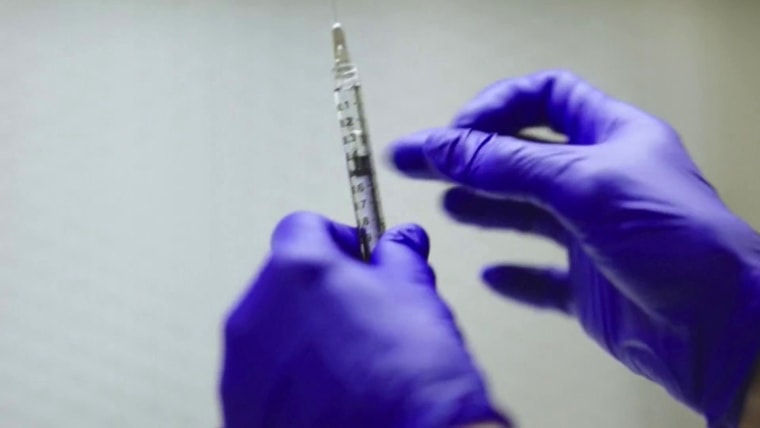 Shingles vaccine could reduce likelihood of dementia: Study00:26
Chang theorized that the shingles vaccine may also help protect against dementia by boosting overall immunity.
“Having the vaccine remind our bodies to help improve our immunity in general — not just specifically to the vaccine — can be beneficial also to reduce neuroinflammatory processes that are going on,” he said.
In addition, research has shown the shingles vaccine is associated with a lower dementia risk than the influenza and Tdap (tetanus-diphtheria-pertussis) vaccines.
“It’s a good excuse to get the vaccine, if you were on the edge of considering it,” Chang said.
Shingles is also tied to increased risk of heart disease and stroke, offering yet another reason why the vaccine may protect brain health, Hayes said.
“Obviously, a reduction in oxygen to the brain is directly correlated with cognitive function,” she said. “But there’s a further hypothesis that even if there might not be a full replication of the virus in your body ... that basically might cause some kind of micro-damage to your cerebral arteries.”
Shingles vaccine may better benefit women’s brain health
In the U.S., people 50 and older are eligible for two doses of Shingrix, the only FDA-approved shingles vaccine. The single-dose Zostavax was less effective and discontinued in 2020.
The CDC recommends Shingrix even for people who have received Zostavax or the chickenpox vaccine or previously had shingles.
Though Hayes studied Shingrix, which was approved in 2017, much of the other research linking shingles vaccination to reduced dementia risk focused on Zostavax.
Ann Philbrick, a professor in the department of pharmaceutical care and health systems at the University of Minnesota College of Pharmacy, said it’s promising that the newer vaccine appears to offer comparable neuroprotection. However, she noted this benefit wasn’t as strong in men.
In Hayes’ research, the link between Shingrix vaccination and reduced dementia risk was weaker among men, as well as people who had previously received Zostavax. Similarly, the Nature study of people in Wales showed a stronger link between Zostavax immunization and lower dementia risk among women. This may be because men and women both respond to vaccines and develop dementia differently.
Philbrick noted that people who get recommended vaccines tend to be more health-conscious. That is, people who get the shingles vaccine may already have a lower risk of dementia.
Hayes said her team’s results held up even when accounting for these limitations. And though her study was observational, it was designed to mimic a randomized controlled trial, which is the gold standard in clinical research.
The studies on people in Canada and Australia were designed to avoid possible bias from health-conscious participants. By examining people who were eligible for vaccination based on date of birth — not those who actually received the shot — researchers were left with a pool of participants who were less likely to have different lifestyles that could impact dementia risk.
Less than half of eligible Americans have gotten shingles vaccine
For Philbrick, the vaccine’s apparent protection against dementia wasn’t the most surprising thing about Hayes’ study. It was the “unfortunate” finding that less than 2% of the nursing facility patients eligible for Shingrix — whose health was already vulnerable — had received even one dose.
Only about a third of U.S. adults 50 and older and 43.8% of those 60 and older had gotten at least one dose of either shingles vaccine as of 2022, CDC records show. The rates were lower for Black and Hispanic adults compared to white adults.
Because Shingrix is typically covered by Medicare Part D, Medicaid and commercial insurance providers, cost is less of a barrier than access, Philbrick said.
“It takes an extra step, going to the pharmacy and making that appointment,” she said. “Making the follow-up appointment, too, because it is a two-dose series.”
Pauldurai, of Inova, said her patients often ask how they can prevent dementia. Though it’s not a substitute for healthy habits, getting the shingles vaccine may be one way to protect the brain.
“Much like if you were riding a bike and you know that you can’t see very well, or your legs are not very reactive,” Pauldurai said. “You’re going to wear that helmet, you’re going to stay on quiet roads, you’re not going to take that extra risk.”
Add NBC News to GoogleLindsey LeakeLindsey Leake is an award-winning health journalist and contributor to NBC News. She holds an M.A. in science writing from Johns Hopkins University, an M.A. in journalism and digital storytelling from American University and a B.A. from Princeton University.
Badenoch blasts 'moaning' female Labour MPs over Burnham jobs 'quota'
Kemi Badenoch has told Labour women to earn a job in Andy Burnham's Cabinet instead of demanding they are handed jobs because of their gender.
The Tory leader lashed out today amid reports that female MPs are demanding the de-facto new prime minister introduce a 50:50 gender split 'quota' in his government.
Amid reports that former foreign secretary David Miliband is being lined up to return to the role, possibly with his brother Ed as Chancellor, one female minister also complained that Burnham could not have 'more Milibands than women' in the top posts.
But in a scathing article in the Times today Mrs Badenoch told them to 'stop moaning' and get chosen on merit instead of retreating into 'more of the failed identity politics that is holding back our country'.
'There are many, many reasons why you shouldn't have any Milibands in the cabinet,' she said.
'But complaining that the boys haven't given them the right jobs or that the boys are taking all the jobs, just shows that Labour's women still don't get it.'
The idea of quotas was also attacked by Baroness Jacqui Smith, Labour's Skills Minister.
Asked by Times Radio if Mr Burnham should reserve jobs for women, she said: 'No, I think what Andy Burnham should be doing is building the very best team around him to change this country.'

A letter written by the Women's Parliamentary Labour Party has called on Mr Burnham to ensure a 50:50 split between men and women in government jobs

Amid reports that former foreign secretary David Miliband (above, right, in 2010) is being lined up to return to the role, possibly with his brother Ed as Chancellor, one female minister complained that Burnham could not have 'more Milibands than women' in the top posts

But Mrs Badenoch told them to pipe down and get chosen on merit instead of retreating into 'more of the failed identity politics that is holding back our country'
A letter written by the Women's Parliamentary Labour Party and seen by the BBC has called on Mr Burnham to ensure a 50:50 split between men and women in government jobs after he succeeds Sir Keir Starmer.
'We are asking you to demonstrate this change from day one and address the toxicity and misogyny within our own party and government,' it said.
Labour has never had a female leader, while the Conservatives have had three, and Mrs Badenoch urged the government to follow its meritocratic example.
'If you run a meritocracy, then you do not have to worry about jobs for the boys,' she wrote.
'Every woman who is a Conservative MP, every woman who has ever won the leadership, has had to fight to get where she is.
'By contrast, Labour women are demanding guarantees from Burnham. But the truth is he doesn't have to give any guarantees.
'If none of Labour's women are prepared to get their hands dirty and challenge him for the leadership, their demands are toothless.'
'In fact, it's quite revealing that the women's parliamentary Labour Party has written to Burnham asking him to commit himself to at least 50 per cent female ministers.
'This has nothing to do with meritocracy. It is yet more of the failed identity politics that is holding back our country.'