Scientists discover humans are naturally wired to walk anti-clockwise
Whether you're pacing while on the phone or wandering around a park, chances are you're unconsciously turning in the same direction as almost everyone else.
That’s because scientists have discovered that humans have a natural tendency to move counterclockwise.
This surprising bias persists across different countries, age groups and even when people are walking completely alone.
And it suggests the instinctive desire to turn left is an innate feature of human movement rather than a learned behaviour.
‘Our findings are highly consistent,’ the team, from the University of Navarra, wrote in the journal Nature Communications.
‘Regardless of crowd size, boundary effects or laterality traits such as handedness, footedness and eye dominance, counterclockwise motion systematically emerges.
‘Our results indicate that this symmetry-breaking phenomenon is fundamentally rooted in individual locomotor tendencies.’
They said their findings could have implications for the design of stadiums, museums, airports and shopping centres – as anti-clockwise circulation paths could ‘improve comfort’ for visitors.

Researchers have discovered people consistently move in a counterclockwise direction. In this image, the red dot indicates the end point of a two-second movement for Spanish teenagers in a schoolyard

This surprising bias persists across different countries, age groups and even when people are walking completely alone
For their study, the team carried out a series of experiments involving hundreds of people in Spain and Japan.
They asked participants to walk freely in circular enclosures, open spaces and, in one test, entirely on their own while overhead cameras or drones tracked their movement.
The researchers also observed schoolchildren in a playground, analysed existing footage of preschoolers and surveyed university students about which direction they expected people to walk.
Analysis revealed people consistently moved in a counterclockwise direction, regardless of whether they were walking in crowded groups or entirely alone.
The tendency also persisted among left-handed people, participants who naturally preferred turning right, and volunteers in Japan, where pedestrians typically avoid oncoming people by moving to the left rather than the right.
Some of the strongest evidence came from experiments in which more than 200 people were asked to walk alone inside an enclosed space.
Even without anyone else to follow or avoid, participants still showed a statistically significant tendency to drift counterclockwise, suggesting the effect originates in individual movement rather than crowd behaviour.
The tendency was even stronger among nursery school children aged around five. During free-running games, almost the entire group naturally fell into a coordinated counterclockwise pattern, suggesting the behaviour develops very early in life and is unlikely to be driven solely by learned adult habits.

The researchers speculate that subtle neurological or biological asymmetries may influence the way we move
Surprisingly when asked which direction they thought others would walk, most participants said clockwise.
Read More
It's not just humans! DOGS are also right or left handed - here's how to find out which paw your pet prefers

Exactly why humans favour the left, however, remains a mystery.
The researchers speculate that subtle neurological or biological asymmetries may influence the way we move.
They said that vortex-like behaviours have been reported in schools of fish, tadpoles and ants.
‘Temnothorax ants display a marked tendency to turn left while exploring and flying budgerigars exhibit lateral preferences when choosing equivalent apertures during route choice,’ they wrote.
‘Overall, the implications of our findings are significant. By demonstrating that individual biases–rather than collective effects–drive the observed CCW motion in pedestrian roaming, our study deepens our understanding of pedestrian dynamics and provides a new lens for studying crowd behaviour.’
Multiple Trades Blocked, Stars Hands Tied Going into Free Agency

Multiple Trades Blocked, Stars Hands Tied Going into Free AgencyNill faces a cap-space crisis after a blockbuster trade collapsed. With stars unsigned and offer sheets looming, Dallas must maneuver financial hurdles to survive a high-stakes free agency.1:53Now PlayingPaused
Why This World Cup Can Define Harry Kane's Career10:22Now PlayingPaused
White Sox Snap Road Series Losing Streak2:09Now PlayingPaused
2026 Freshman Focus: Bowling Green State1:23Now PlayingPaused
NY GIANTS IOL LUCAS PATRICK 2026 OUTLOOK1:27Now PlayingPaused
Caitlin Clark's Numbers Can't Be Ignored0:25Now PlayingPaused
'That's $285,000 Per Point!' Fans React To Massive Bowen Byram Contract Extension3:01Now PlayingPaused
Blue Jackets' Mason Marchment Linked To Pacific Club1:23Now PlayingPaused
How you can handle changes to the federal student loan program3:00Now PlayingPaused
Predators' First–Round Pick Tommy Bleyl To Play At Michigan State Next Season1:22Now PlayingPaused
Taylor Swift-Travis Kelce wedding celebration expected in NYC on Thursday, sources say2:33Now PlayingPaused
Multiple Trades Blocked, Stars Hands Tied Going into Free Agency
The Hockey News - Dallas StarsWed, July 1, 2026 at 12:00 PM UTCNill faces a cap-space crisis after a blockbuster trade collapsed. With stars unsigned and offer sheets looming, Dallas must maneuver financial hurdles to survive a high-stakes free agency.
The Decision Lebron Must Make Will be for Happiness Does That Mean Heart Break for Heat
Will LeBron James's Search for "Happiness" Lead to Miami?
The Los Angeles Lakers era is over, and there's one place James won mostAdel Burton|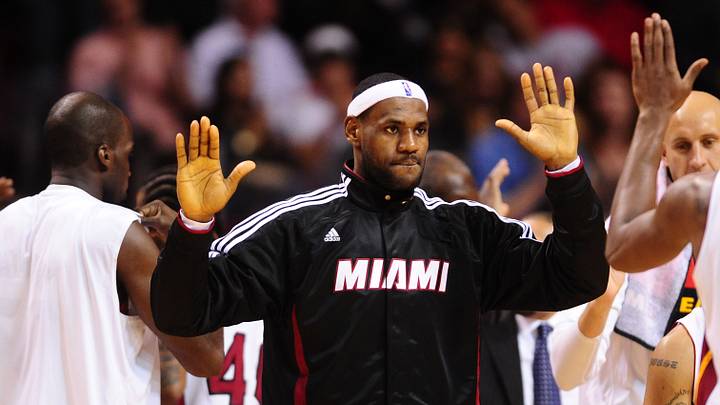
In this story:
Miami HeatFree Agency officially gets underway tonight at 6PM EST. The Miami Heat have already resigned a couple of their own players in Andrew Wiggins 3 years 64 million and Simone Fontecchio 1 year veteran minimum. The Heat continues tonight searching for more missing pieces and a familiar former franchise altering player has opted out of their final year with the Lakers making them a free agent.
What’s Important Now
Lebron James has told sources from Shams Charania and Barry Jackson that he will be leaving the Lakers to finish his career elsewhere. Shams reported that “I’m told this is a happiness-led decision for Lebron James. Wherever he lands in free agency, it will not be driven by money”.
"I'm told this is a happiness-led decision for LeBron James. ... Wherever he lands in free agency, it will not be driven by money."@ShamsCharania joins @malika_andrews with more details about LeBron James' decision to not play with the Lakers next season. pic.twitter.com/nvWxbAyZiw
— SportsCenter (@SportsCenter) June 30, 2026
What Legacy Means to Lebron
This could mean a lot of different things for Lebron. The one thing that sticks out to me is his legacy. Lebron has always been very interested in not only the history of the greats that came before him but his place among them. According to a quote from yahoo sports during an interview with coach Mike Krzyzewski Lebron said, "When I first knew that I wanted to play the game of basketball, I would always go to the local library," he said. There, he'd learn about the NBA's history and its pioneers for inspiration. It's safe to say that doing so certainly paid off.”
Lebron not only is concerned about his place among the greats but him sitting atop them on the throne as the greatest of all time. He said in an interview with Kenny “The Jet” Smith, "At that moment, I realized that I'm the greatest basketball player that people have ever seen. In all facets," he said. "[I] just did something that's never been done in the history of the sport." Talking about the 2016 NBA Championship with the Cleveland Cavaliers.
The Decision Part Two
There is an important decision to be made. Choosing where to end his Hall of Fame career could be just as important to him as the original decision in 2010. Though this one could be important for a very different reason. In 2010 the Cleveland front office struggled to put enough quality pieces around Lebron to win a championship. He choose to team up with his friend Dwayne Wade to hoist a championship trophy.
This time around is different. He knows this is his “last stop” on a magnificent career. He already stated he’s the best in the game back in 2016 and that his time he is looking for happiness according to Shams’s source. That happiness to me means competing again for a championship. Happiness could mean not tarnishing his legacy. Happiness could mean tying Kobe Bryant with five championships. Going back to Cleveland and failing to bring back a trophy in his final season doesn’t seem to me to be the fun route.
The real competition to me comes down to Golden State and Miami. He loves playing with Steph Curry. He played with Steph on the Olympic team. James said, “It’s one of the best experiences… it was everything. People ask me all the time… you finally got an opportunity to play with Steph. What was it? I was like everything and more. It was perfect.”
LeBron James on playing with Steph Curry for team USA
— Fullcourtpass (@Fullcourtpass) June 30, 2026
“It’s one of the best experiences… it was everything. People ask me all the time… you finally got an opportunity to play with Steph. What was it? I was like everything and more. It was perfect.” pic.twitter.com/duYsjoq6jD https://t.co/zAZ1s1kulX
One could argue this is a no brainer but if you had something beautiful and perfect would you risk messing that up? There is nothing that can ruin a friendship and memory quicker than the reality of playing on a team that is not good enough to compete and win it all. The Warriors have one of the oldest rosters in the NBA. Steph Curry, Draymond Green who opted out of his deal, Jimmy Butler who is never healthy.
The Miami Heat have paired the multi-talented ultra defender in Bam Adebayo with super all world Giannis Antetokounmpo. The Heat are known for catching their whale and filling out a championship roster quickly. They did this in the Wade/Shaq build in 2004 and in the big three era of 2010. Lebron knows that’s how the organization operates. Barry Jackson reported, "No surprise here but.... If LeBron wants to return, Heat would have interest, a source said. At this point, it's unclear what he wants to do."
No surprise here but.... If LeBron wants to return, Heat would have interest, a source said. At this point, it's unclear what he wants to do.
— Barry Jackson (@flasportsbuzz) June 30, 2026
What better happiness would there been than a reconciliation between the Miami front office and the fan base that loved him so much. It seems to me like unfinished business. That the fan base would cheer him again and he could ride off into the sunset competing at the highest level in the Eastern Conference that he knows so well. This time not as the villain but as the returning King, fans await his decision for them to be the “Chosen One’s”.
Published 2 minutes ago
 ADEL BURTON
A seasoned Content Creator with 2.5+ years of experience, building a YouTube channel past 8K subscribers while serving as an NBA/College Basketball Analyst for the 5 Reasons Sports Network. Simultaneously, I bring 11+ years of leadership and strategy expertise from roles at a fortune 100 company focusing on problem-solving and relationship-building for success.
Follow DigitalAdelHome/News