Robert Lewandowski Becomes Latest Soccer Legend in MLS—Official
Robert Lewandowski Becomes Latest Soccer Legend in MLS—Official
The former FC Barcelona striker is the latest global star to make the leap across the pond.Sophia Vesely|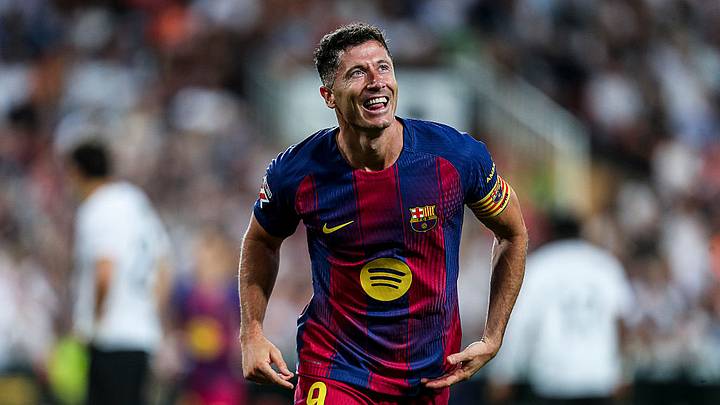
Major League Soccer’s Chicago Fire confirmed on Monday that the deal to sign former FC Barcelona star striker Robert Lewandowski is complete. The Polish front-man will join the club on a two-year contract that runs through the 2027–28 season, occupying Designated Player and international roster spots for the Fire.
Lewandowski left Barcelona as a free agent this spring after four seasons in which he scored 120 goals across all competitions. Prior to that, he had highly successful stints with Borussia Dortmund and Bayern Munich, the latter of which he represented for eight seasons. Throughout his entire career, the 37-year-old has scored 629 goals and tallied 159 assists in 869 games across all competitions.
“It feels amazing,” manager Gregg Berhalter said on the Up & Adams Show. “We want to build a world-class organization, and you need world-class players to do that.”
Berhalter added, in the club’s official statement: “His arrival reinforces our ambition to compete for trophies and raises the standards for the Club to heights worthy of this city. We cannot wait to get to work with him and have Chicago see first-hand why he is among the most revered sporting icons in the world.”
The Fire intend to debut the striker on July 16 against the Vancouver Whitecaps at Soldier Field, the first match back from the summer international break. Lewandowski’s capabilities will immediately be put to the test, as the Whitecaps—starring Berhalter’s own son, Sebastian—rank first in the Western Conference with just one loss all season.
The Fire Finally Secure Their Superstar

Inter Miami have Lionel Messi and Rodrigo De Paul. The Whitecaps have Thomas Müller, Lewandowski’s former Bayern Munich teammate.
LAFC have Son Heung Min, and now Orlando City have Antoine Griezmann, who was spotted kicking around the team’s facilities just this week.
The Fire have been big fish hunting, trying to join the bandwagon of signing soccer legends for a while. It took several failed attempts, losing out to both Brazilian superstar Neymar and Müller last year, but the club finally caught one.
Berhalter has been experimenting with a two-striker system and believes Lewandowski will slide into it seamlessly, playing alongside current star forward Hugo Cuypers and wreaking havoc for opponents.
“That’s something we are looking forward to seeing,” Berhalter said. “If you’re an opposing defense and you have to go against Robert Lewandowski and Hugo Cuypers, you’re probably going to be in for a long day.”
More than anything, though, Berhalter is excited about Lewandowski’s track record of winning. He has hoisted 32 trophies in his career, including 10 Bundesliga crowns, three La Liga titles, one FIFA Club World Cup and one UEFA Champions League title.
“Everywhere he’s gone, he’s scored goals, but more importantly, everywhere he’s gone, he’s won.”
READ THE LATEST TRANSFER NEWS AND RUMORS FROM WORLD SOCCER
Published 5 hours ago | Modified 5 hours ago
 SOPHIA VESELY
Sophia Vesely is a writer, reporter and editor for SI FC, with an emphasis on North American coverage. Her experience comes from regional journalism as a former sports reporter for the Orlando Sentinel, Dallas Morning News and Seattle Times. Vesely graduated from Swarthmore College, where she played collegiate soccer as a wingback. She specializes in MLS, NWSL and NCAA soccer.
Home/Soccer
Britain’s New 'King' Will Decide Its Fate
ProfileBritain’s New ‘King’ Will Decide Its Fate
Andy Burnham is on the verge of taking power—and of being confronted with his own limitations.
June 30, 2026, 8:21 AM By John Kampfner, the author of Braver New World: The Countries Daring to Do Things Others Won’t.
- Europe
Welcome to FP Free Week. To celebrate America’s 250th birthday, our entire site is completely unlocked this week only. Enjoy the article.
After six failed attempts in the past decade, is Andy Burnham the prime minister finally to get Britain back on its feet? The choice of the latest wannabe savior—or rather the anointing—of someone who until a few days ago wasn’t even in the House of Commons seems at first glance a curious one.
The stakes are extraordinarily high. As in France, Germany, and elsewhere in the Western world, the next few years are seen as the last chance to preserve liberal democracy from the onslaught of far-right populism. The cause was not enhanced under the two-year failed tenure of Keir Starmer, who squandered a huge parliamentary majority with his dour incrementalism, while the populist-nationalist Reform U.K. party and the Greens became major forces.
After six failed attempts in the past decade, is Andy Burnham the prime minister finally to get Britain back on its feet? The choice of the latest wannabe savior—or rather the anointing—of someone who until a few days ago wasn’t even in the House of Commons seems at first glance a curious one.
The stakes are extraordinarily high. As in France, Germany, and elsewhere in the Western world, the next few years are seen as the last chance to preserve liberal democracy from the onslaught of far-right populism. The cause was not enhanced under the two-year failed tenure of Keir Starmer, who squandered a huge parliamentary majority with his dour incrementalism, while the populist-nationalist Reform U.K. party and the Greens became major forces.
Friends and foes are projecting onto Burnham their hopes and fears. Some see his criticisms of Starmer as evidence that he will lead a leftist administration, spooking the already-skeptical bond markets with a spending spree that will further imperil the United Kingdom’s heavily indebted finances. His supporters—and there are many—see him as the breath of fresh air that the Labour Party and Britain have been waiting for.

Then-Prime Minister Gordon Brown (left) applauds Burnham at a Labour Party conference in Brighton, England, on Sept. 30, 2009.Peter Macdiarmid/Getty Images
The nonaligned see him as a chameleon and don’t know what to make of him. They point out that he first supported Tony Blair—now seen as a sacrilegious figure among many in Labour—then Gordon Brown and then the ardent socialist Jeremy Corbyn. Burnham, who tires of the accusation, and the various jokes at his expense, describes himself as a “team player” who tried to do his best no matter who was in charge.
Burnham cultivates his image fastidiously. He likes to present himself as an unstuffy, ordinary bloke who hates wearing suits, except when he must. He casts himself as an outsider but has spent almost his entire career in politics. So, can someone who likes to be liked, and who does video clips seemingly wherever he goes, be the decisive leader the United Kingdom needs?
He is unabashed. His aides point out that, unlike Starmer, he really does know how to relate to people; his nine years as mayor of the Manchester city region has given him hands-on experience to follow his 16 years in Parliament in several ministerial positions under Blair and Brown.
The fate of Britain may now rest in the hands of a man called the “King of the North.”

Burnham (center) and his wife, Marie-France van Heel, in London on Sept. 12, 2015.Justin Tallis/AFP via Getty Images
Born near Liverpool in 1970, Burnham was brought up a Catholic in a quiet commuter belt village midway between the two rival cities of the northwest of England. Could the supporter of a Liverpool football club (not the eponymous one, but the less illustrious Everton) really become a favorite of Mancunians?
His parents, a telephone engineer and a medical receptionist, were staunch Labour supporters, and he developed an early interest in politics. He has described—again part of the folklore—how he was inspired to join the party at the age of 14 after being moved by a BBC TV drama about life on the dole. He embraced the Manchester music scenes of the late ’80s and 1990s. He and his two brothers were the first in their family to go to university; at Cambridge he met his Dutch-born wife.
In his early 20s, and clearly on the fast track, he got his first break in politics, working as a researcher for a prominent member of Parliament (MP), Tessa Jowell, who would go on to be a cabinet minister under Blair and Brown. He then became an advisor to another senior minister, before entering Parliament in 2001, aged only 31. So much for his disdain for Parliament.
He didn’t hide his ambition—which politicians do?—and stood twice unsuccessfully for the leadership, in 2010 and 2015. With the Conservative government in chaos during the post-Brexit referendum era, and with the opposition under Corbyn paralyzed by strife, he escaped to Manchester, to build a new power base.
Having maneuvered the party to ditch Starmer, he has been given less than a month to build an entire administration. He is doing so with a mix of experienced and fresh faces, of old Westminster colleagues who kept in close touch, much of his team from Manchester, and outside experts. He is moving fast.

Burnham addresses supporters in Ashton, on June 18. Oli Scarff/AFP via Getty Images
It’s on the economy that the new prime minister will want to stamp his mark. He has pledged to work within the confines of the “fiscal rules” that Starmer set before the 2024 general election—to ensure that borrowing does not increase. In addition, Labour pledged no rises in income tax, corporation tax, or sales tax. These are not written into law (or, in the case of Germany, set down in the constitution) but are seen by many, though not all, senior figures in the government as articles of faith.
Despite these restrictions, he has indicated he will act in several key areas. The first is devolution of power to the English regions from London (Scotland, Wales and Northern Ireland already have their own parliaments with jurisdiction in several areas). Britain is possibly the most centralized country in Europe—although France would stake a claim—with authority, wealth, and infrastructure concentrated in London.
Burnham luxuriates in his nickname of the King of the North. In his first major speech, setting out some of the priorities for his administration, he announced he would relocate part of the Downing Street operation back to Manchester, including a new ministry for devolution.
Previous governments have held cabinet meetings outside the capital; the Treasury has moved a few of its operations to the northeast—but this would be radically different. Burnham insists it’s not just symbolism (though that, too, will matter) and that it will enhance investment to areas left behind.
Another term he enjoys is “Manchesterism.” This describes his approach as mayor of one of the few parts of the United Kingdom that has enjoyed economic growth: free markets with state intervention. The high-rise skyline of much of the city center attests to his success and that of his predecessors in drawing in tech, creative industries, and other service sectors to the city. At the same time, he has brought the mass transport network fully under public control.
Britain’s economic bind has overwhelmed governments of both parties. Six years of Conservative austerity from 2010 temporarily reduced government borrowing, but at the cost of entrenching poverty, inequality, and social dislocation. Brexit was a manifestation of that, and a subsequent accelerator.
The United Kingdom’s tax burden is set to rise to a postwar record of 38.5 percent of GDP in 2030-31. Much of that goes to debt repayments (including high interest rates), a burgeoning welfare bill to deal with more than a million off work, a health service struggling to cope with an aging population, and a pensions settlement called the “triple lock” that is absurdly generous to the influential baby boomers. Productivity has long been poor. Housing targets invariably undershoot.
Burnham’s determination to take risks, to confront these shibboleths, will be key. Among the many early ideas that he is mooting are a reform of property tax, a rise in capital gains on assets, and an increase in inheritance tax to pay for social care.
On its approach to tax, investment, and infrastructure, in the managing of many of its public services, indeed in so many areas of policy, Britain is ripe for a shake-up.


The area where Burnham will initially be most exposed is foreign affairs. He is due to take over from Starmer days after the July 7-8 NATO summit at which the increasing tensions between the White House and Europe could, if badly managed, lead to a further drawdown of U.S. forces from the continent.
He doesn’t like U.S. President Donald Trump, and the feeling is mutual. Following the Capitol riots of Jan. 6, 2021, Burnham declared: “Any UK politician who gave Trump the time of day should be ashamed right now.” When asked about the new man in Downing Street, the U.S. president said he didn’t know him but believed him to be an “extremely liberal” mayor of “a town.” As put-downs go, it wasn’t bad. But, as Italy’s prime minister, Giorgia Meloni, has shown, the Trumpian insult doesn’t have the salience of before.
Burnham is expected to appoint an experienced figure as his foreign secretary. Expect early trips to Berlin and Paris, and to Brussels, where his intentions toward the European Union will be closely watched.
As with other key areas, Burnham has sent out mixed signals. One of his strongest criticisms of Starmer was his reluctance to match warm words toward Europe with deeds. The so-called reset has taken place at a snail’s pace, even though opinion polls in the U.K. show a strong majority favor a rapprochement of sorts.

Burnham (left) and Prime Minister Keir Starmer meet children at a breakfast club during a visit to a primary school in Greater Manchester, on April 13.Paul Ellis/AFP via Getty Images
Burnham has consistently vowed to go further and faster. However, on the recent campaign trail where he achieved his spectacular by-election victory, he sounded less enthusiastic. His new constituency, Makerfield, belongs to the “red wall,” former Labour heartlands that voted to leave the EU exactly a decade ago.
Most of the main foreign-policy issues, such as Russia-Ukraine and China, will follow existing guardrails. It will be interesting to see whether he takes a tougher approach to Israel’s hard-line government of Prime Minister Benjamin Netanyahu. Support for Gaza is a touchstone issue for many activists on the left. Burnham will need to navigate that, while ensuring his party isn’t tainted by accusations of antisemitism that dogged Corbyn’s tenure.
Burnham is a far better communicator than Starmer. But will he also jettison his predecessor’s caution and show some of the courage that is sorely needed? And will he match rhetoric (the easy part) with actual deeds that make a discernible difference to people’s lives? If not, he will go the same way—and by the time of the next general elections, the door will be open for the populists to enter.
Like what you read? This week only, the paywall is down to commemorate America’s 250th birthday. To keep receiving our global analysis after the gates close, sign up for FP newsletters.
- Europe
John Kampfner is the author of Braver New World: The Countries Daring to Do Things Others Won’t.
Read More On Britain | Europe | LeadersJoin the Conversation
Commenting is a benefit of a Foreign Policy subscription.
Already a subscriber? Log In.
Join the Conversation
Join the conversation on this and other recent Foreign Policy articles when you subscribe now.
Not your account? Log out
Join the Conversation
Please follow our comment guidelines, stay on topic, and be civil, courteous, and respectful of others’ beliefs.
You are commenting as . Change your username | Log out