Poll: Americans see improved race relations since 2020, but divisions remain
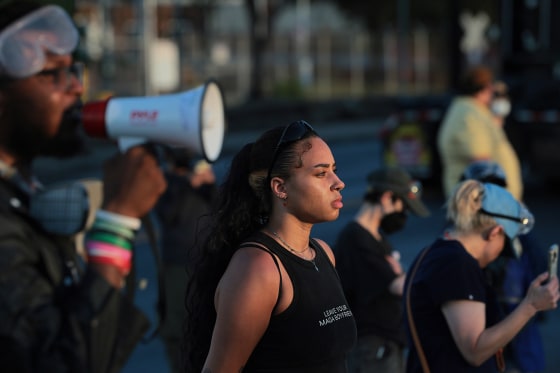
Americans say race relations in the U.S. have improved significantly since the summer of 2020, amid protests calling for racial justice and police accountability after George Floyd’s death. But deep differences in opinion remain, particularly between white and Black Americans, according to a new NBC News poll.
The poll — which was sponsored by More Perfect, a nonpartisan nonprofit dedicated to advancing democracy — finds that 50% of Americans say race relations are generally bad, while 48% say they are generally good.
The share of Americans who say race relations are good has increased by 20 points since July 2020.
Just 7% of all adults say race relations are “very” good, though that is the highest level measured in NBC News polling since 2011. And 17% of poll responders rate race relations as “very bad,” the lowest in more than a decade.
Most of the responses clustered toward the middle, with 41% calling race relations “fairly good,” up 20 points since 2020, and 33% calling them “fairly bad,” down from 39% in 2020.
But the underlying data, along with conversations with more than a dozen Americans who participated in the survey, underscore how views of race relations vary widely depending on a person’s race.
While 46% of white Americans say race relations are “fairly good,” 24% of Black Americans say the same. A similar share of white and Black adults, about one-third, rate race relations as “fairly bad.” But the biggest difference is with those who think relations are “very bad” — 15% of white Americans compared with 36% of Black Americans.
Halin Byrd, a 22-year-old Black man from Pennsylvania who participated in the survey, said he believes race relations in the country “have regressed.”
“Everybody just feels like they can just say whatever they want, for any type of racist slur. Everybody’s more comfortable now,” said Byrd, an independent voter who works in healthcare.
Todd B., a white 56-year-old Georgia Republican, said he believed race relations were generally good.
“Everyone doesn’t care about race,” said Todd, who works in information technology and, like some other poll respondents, declined to share his last name while discussing issues around race and politics. He blamed politicians and the media for sensationalizing racial divides.
Byrd said he was not surprised that white Americans tend to have rosier views of race relations.
“They have a different experience. As the saying goes, ‘Privilege is invisible to those who have it,’” Byrd said, later adding, “I kind of expect for them to think that it’s good, because for them it’s always been.”
Some white Americans said they did believe race relations were strained, like Mark, a 36-year-old white Ohio Republican, who told NBC News that people of different races are “way more divided” than they should be.
Mark said his mother, in her late 60s, tells him she’s “never seen it this bad.” He blamed much of the division on the media, which he claims blows stories out of proportion and unfairly highlights certain stories at the expense of others to conform to a narrative.
“I can’t get on my phone without seeing: ‘White guy does this’ or ‘Black guy does this.’ Why can’t it just be ‘Ohio man does this’? Why do we have to know if he’s white or Black? Having a certain skin tone doesn’t make you a criminal; we shouldn’t have race-based stats on anything,” Mark said. “Everything is sensationalized.”
While white and Black Americans are sharply divided on race relations, Latino Americans sit right about in the middle of the two groups. In that group, 16% view race relations as “very good,” 30% believe that those relations are “fairly good,” another 30% rate them “fairly bad” and 15% say “very bad.”
Asian Americans’ views are more concentrated away from the extremes. Only 2% call race relations “very good” and 7% call them “very bad,” while 59% call them “fairly good” and 32% call them “fairly bad.”
Ezel B., who is Hispanic, said that race relations have progressed, but there are still “a lot of issues,” particularly with racial stereotypes and profiling. The California Democrat, 32, also pointed to U.S. Immigration and Customs Enforcement’s mistreatment of immigrants from “brown and Black countries” amid the Trump administration’s immigration crackdown.
Faviola Maichena, a 47-year-old Wisconsin independent who is Latina, said race relations in the country were “generally bad.”
“There’s more division,” said Maichena, who works in food and beverage management, adding that she believes the Trump administration “is targeting demographic minorities for sure, Blacks, Latinos and other people.”
Other Americans, particularly Democrats and independents, also blamed President Donald Trump’s inflammatory rhetoric for stoking racial tensions.
“Trump, he’s said a lot of racist things about Somalia, Mexico, Black Americans, women. And our president’s a reflection of us. So that further gives people the green light to be more comfortable in their racism,” Byrd said.
Ann, a 25-year-old Vietnamese immigrant from Kansas, also said Trump “affects the people to feel more comfortable being racist or feel more comfortable being prejudiced.”
Ann said she believed race relations in the U.S. were “bad right now,” saying people of color struggle to get out of poverty due to “the system oppressing marginalized people.”
The NBC News poll also found that more Americans (59%) believe there is more that unites people of different races or ethnic backgrounds than divides them (39%).
Again, those views vary by race. Majorities of white, Black and Asian Americans agree there’s more that unites Americans of different races than divides, but a majority of Hispanics, 54%, say there’s more that divides those of different races.
Anthony B., a 61-year-old Pennsylvania Republican who is white, said the country is less divided by race and the media overhypes racial divisions.
“If you keep on talking about problems with race every day, it’s going to continue. If you quit talking about it, I think it won’t eliminate it, but I think it would reduce it,” Anthony said.
Other Americans, particularly people of color, still see the country as deeply divided by race. But some were cautiously optimistic that race relations would improve.
“I’m always hopeful,” said Byrd, the young Black man from Pennsylvania. “And I’m an optimist, but at the same time I’m not a fool. And then I see it’s been like this for centuries at this point. So of course, I have faith, but I’m not sure what’s going to happen.”
 Bridget Bowman
Bridget Bowman is a national political reporter for NBC News.
Annelise HansonAnnelise Hanson is an intern at NBC News.
Lauren ZolaDesk assistant at NBC News Washington.
 Ben Kamisar
Ben Kamisar is a national political reporter for NBC News
Badenoch blasts 'moaning' female Labour MPs over Burnham jobs 'quota'

Kemi Badenoch has told Labour women to earn a job in Andy Burnham's Cabinet instead of demanding they are handed jobs because of their gender.
The Tory leader lashed out today amid reports that female MPs are demanding the de-facto new prime minister introduce a 50:50 gender split 'quota' in his government.
Amid reports that former foreign secretary David Miliband is being lined up to return to the role, possibly with his brother Ed as Chancellor, one female minister also complained that Burnham could not have 'more Milibands than women' in the top posts.
But in a scathing article in the Times today Mrs Badenoch told them to 'stop moaning' and get chosen on merit instead of retreating into 'more of the failed identity politics that is holding back our country'.
'There are many, many reasons why you shouldn't have any Milibands in the cabinet,' she said.
'But complaining that the boys haven't given them the right jobs or that the boys are taking all the jobs, just shows that Labour's women still don't get it.'
The idea of quotas was also attacked by Baroness Jacqui Smith, Labour's Skills Minister.
Asked by Times Radio if Mr Burnham should reserve jobs for women, she said: 'No, I think what Andy Burnham should be doing is building the very best team around him to change this country.'

A letter written by the Women's Parliamentary Labour Party has called on Mr Burnham to ensure a 50:50 split between men and women in government jobs

Amid reports that former foreign secretary David Miliband (above, right, in 2010) is being lined up to return to the role, possibly with his brother Ed as Chancellor, one female minister complained that Burnham could not have 'more Milibands than women' in the top posts

But Mrs Badenoch told them to pipe down and get chosen on merit instead of retreating into 'more of the failed identity politics that is holding back our country'
A letter written by the Women's Parliamentary Labour Party and seen by the BBC has called on Mr Burnham to ensure a 50:50 split between men and women in government jobs after he succeeds Sir Keir Starmer.
'We are asking you to demonstrate this change from day one and address the toxicity and misogyny within our own party and government,' it said.
Labour has never had a female leader, while the Conservatives have had three, and Mrs Badenoch urged the government to follow its meritocratic example.
'If you run a meritocracy, then you do not have to worry about jobs for the boys,' she wrote.
'Every woman who is a Conservative MP, every woman who has ever won the leadership, has had to fight to get where she is.
'By contrast, Labour women are demanding guarantees from Burnham. But the truth is he doesn't have to give any guarantees.
'If none of Labour's women are prepared to get their hands dirty and challenge him for the leadership, their demands are toothless.'
'In fact, it's quite revealing that the women's parliamentary Labour Party has written to Burnham asking him to commit himself to at least 50 per cent female ministers.
'This has nothing to do with meritocracy. It is yet more of the failed identity politics that is holding back our country.'