Netflix Calls for Cap on French Content Investment Rules, Warning Current System Is ‘Unsustainable’
Netflix is calling for a cap on the mandatory investments it is required to make in French content as it pursues its lobbying push to gain earlier access to newly released movies.
The U.S. streaming giant, which has become one of the biggest private backers of French film and TV production, is warning that the current rules are becoming unsustainable, and argues that without changes, American platforms could end up accounting for nearly half of all financing for French creation by 2030, up from roughly a quarter in 2024, according to estimates cited by Le Monde.
Related Stories

Aaron Sorkin Tried to Get Jesse Eisenberg Back as Mark Zuckerberg for 'Social Reckoning,' but the Actor Doesn't 'Want to Be Conflated' With the Facebook Founder Anymore
‘The Social Reckoning’ Trailer: Jeremy Strong Is Mark Zuckerberg in Aaron Sorkin's 'Social Network' Sequel
“As an essential partner of French creation, and determined to remain one, we are sounding the alarm about the viability of the current rules for financing by broadcasters,” a Netflix spokesperson told the French newspaper.
Popular on Variety
At the heart of the debate is France’s 2021 decree implementing the European Audiovisual Media Services Directive, which has required subscription streamers such as Netflix, Prime Video and Disney+ to invest 20% of their local revenue in French and European films and series. The country imposed some of the highest obligations on streamers in Europe.
As Brussels prepares to revisit the directive this fall, Netflix is hoping the European Commission will hear their call to limit investment requirements.
Netflix now invests more than €250 million ($332 million) a year in French series, documentaries and films, including roughly $66 million in cinema. The streamer says it produced or financed 20 to 25 French works annually and points that forcing that number to grow in line with revenue would be disproportionate to audience demand in France.
Netflix, which launched in France nearly 12 years ago, has become increasingly vocal in recent months about what it views as an imbalance in the French system. As Variety previously reported, Netflix lodged an appeal last year with France’s Council of State, taking aim at the country’s windowing regulations which force Netflix to wait twice as long as Disney+ before streaming films after their theatrical release, even though they are investing substantially more in local content overall.
Under France’s current windowing rules, Canal+ can stream films six months after rollout in theaters, while Disney+ secured a nine-month window after increasing its investment commitments on movies that come out in cinemas. Netflix, meanwhile, has a 15-month window and has been pushing to have it reduced to 12 months.
Those strict windowing regulations are the reason why Netflix is not allowed to present movies in competition at Cannes, since the festival requires a theatrical release for every Palme d’Or contender. It’s also why Greta Gerwig’s “Narnia” will not have a release on IMAX in France and will be released straight to Netflix.
-
Harrison Ford Dons a Kilt to His Glenmorangie Whisky Launch Party: ‘It’s a Bit Breezy’
-
Inside the Quest for Honorary Oscars: Harrison Ford, Glenn Close and More Industry Legends Under Consideration
-
Robert Downey Jr. Says ‘Avengers: Doomsday’ Figured Out How to Make Marvel Movies ‘Not Be a Letdown’ After ‘Infinity War’ and ‘Endgame’
-
‘April X’ Director Michel K. Parandi Says Casting Connor Storrie Before ‘Heated Rivalry’ Felt Like Casting Harrison Ford in ‘Blade Runner’: I Was ‘Telling Everybody He’s Going to Be a Movie Star’
-
Clashing Over ‘Indiana Jones’: Harrison Ford and Steven Spielberg ‘Were Not 100% on Board’ With ‘Crystal Skull’ and Fought George Lucas Over Adding Aliens
7 Rams Fighting for Their Next Contract With Everything to Prove
7 Rams Fighting for Their Next Contract With Everything to Prove
Blaine Grisak|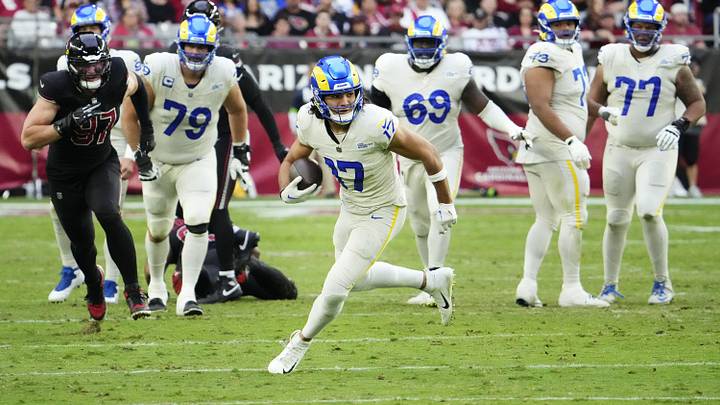
In this story:
Los Angeles RamsThe Los Angeles Rams enter a season in which several players will be playing on the final years of their contracts. Several of those players will have more to prove than others. If they prove themselves, it may be enough to convince the Rams to give them an extension. Let’s take a look at seven players with the most to prove in the last year of their contract.
WR Puka Nacua
As Puka Nacua made a case for the 2025 Offensive Player of the Year award, it almost felt like a guarantee that he would be someone the Rams would want to prioritize for an extension. However, following Nacua’s offseason drama, that no longer seems to be the case.
That’s not to say that the Rams won’t re-sign Nacua, but they may wait until the middle of the season or even after itv to get something done. It also wouldn’t be surprising to see the Rams place the franchise tag on Nacua before making a long-term investment. Over the next six months, Nacua needs to prove he is mature enough to handle a large contract.
Current Market Value: 4 years, $160.79 million
LG Steve Avila and RG Kevin Dotson
The Rams will have a decision to make this offseason when it comes to Steve Avila and Kevin Dotson. Given the other contracts that need to get done, it seems unlikely that the Rams will be able to bring back both players.
Avila would make a lot of sense as he is the younger of the two players. However, he needs to show consistency and that he can be someone the team can build around on the offensive line. Dotson is the leader of the offensive line and is possibly favored right now to get an extension. With Dotson out because of an ankle injury last season, it became evident how important he was to the offense.
Avila’s Market Value: 4 years, $54.23 million
Dotson’s Market Value: 3 years, $58.3 million
RT Warren McClendon
Back in 2022, the Rams had spent four years developing Joe Noteboom to take over for Andrew Whitworth. Despite limited starting experience, the Rams gave Noteboom an extension and paid him like a starting left tackle.
With McClendon, the Rams will have the benefit of seeing him over the course of a full season. While the Rams didn’t add competition, they have given McClendon the opportunity to prove himself before earning starter-caliber money.
Current Market Value: N/A
DT Kobie Turner
Turner is someone who the Rams will very likely prioritize when it comes to giving him a contract extension. He’s been one of the most important players on the defensive line and is someone they can build around.
Still, Turner will need to prove that he’s worth a big contract. He’s set to get paid as one of the top defensive linemen in the NFL and needs to show another level in 2026.
Current Market Value: 4 years, $129.29 million
EDGE Byron Young
When the Rams extended Myles Garrett, they essentially said that Byron Young won’t be back in 2027. That’s not necessarily the wrong decision, but it’s the fact of the situation. It would be nearly impossible for the Rams to pay two top-level edge rushers.
Young has proven that he can be productive, but is he more than just an EDGE2 on a defense? Given that Young is older, this could be his one opportunity to cash in big on the free agent market. Another productive season and a team will pay him a lot of money next offseason. Unfortunately, that team may not be the Rams.
Current Market Value: 4 years, $120.2 million
CB Emmanuel Forbes
When the Rams claimed Emmanuel Forbes off waivers in 2024, it was a low-risk, high-reward type move. This past offseason, they declined his fifth-year option, which adds some uncertainty to his future with the team.
Just because the Rams declined his option doesn’t mean they couldn’t bring him back. However, Forbes has been inconsistent and hasn’t developed in his new environment as the Rams would have hoped. The potential is there, but he’s far too inconsistent to be relied on as a CB2. If Forbes proves that he can be reliable depth, he may be worth bringing back.
Current Market Value: 2 years, $9.48 million
Sign up to our free newsletter and follow us on Facebook, X, and Instagram for the latest news.
Published 2 minutes ago
-9e1958db84397e7d78fcf6b0abf1ff59.png) BLAINE GRISAK
BLAINE GRISAKBlaine Grisak is the Lead Publisher for Rams on SI covering the Los Angeles Rams. Prior to joining On Sports Illustrated, he covered the Rams for TurfShow Times, attending events such as the NFL Draft, NFL Combine, and Senior Bowl. A graduate of Northeastern University, Blaine grew up in Montana.
Follow BGMediaOnSIHome/News
HSBC Spotlights The World's 6 Biggest 'Pain-Trades'


 Premium
HSBC Spotlights The World's 6 Biggest 'Pain-Trades'
Last week saw renewed scepticism in the AI narrative.
A multitude of reasons from leveraged single-stock ETFs to a too hawkish Fed were apparent in explaining renewed Tech weakness.
Pain trade #1: The AI trade continues unabated
Trading Giant Susquehanna Lost Over $70 Million To Mystery Insider Traders
Trading giant Susquehanna Investment Group said it was attempting to unmask the identities of individuals it claims made at least $100 million trading on inside information about a Chinese government crackdown on cross-border brokerages last month.
The Pennsylvania-based market-maker, which says it was the counterparty on most of the alleged insider trades, sued 100 John Doe defendants in Manhattan federal court on Monday. Susquehanna is seeking to recover more than $70 million it says it lost to what it believes is one of the largest insider-trading schemes in recent memory, Bloomberg reported.
While it’s unusual for a major Wall Street firm to sue as a victim of insider trading - which is normally policed by the Securities and Exchange Commission and federal prosecutors - in suing the dozens of unknown traders, aka "John Does", Susquehanna is using a tactic sometimes employed by the SEC to seek information it hopes will identify the alleged insider traders.

According to Susquehanna, many of the trades were made from accounts at Interactive Brokers Group Inc., as well as the platforms of two firms targeted in the Chinese crackdown, Futu Holdings and Up Fintech’s Tiger Brokers (we discussed this in May in "China Launches Crackdown On Cross-Border Stock Selling To Block Capital Outflows").

Susquehanna is seeking an order freezing certain accounts at those brokerages and authorizing subpoenas of them.
Susquehanna, which is one of the largest US market-makers and is active in options, stocks, energy, bonds and foreign exchange markets, said in an SEC filing that its equity positions in the first quarter totaled more than $893 billion. The closely held company based in the Philadelphia suburbs has made its co-founder Jeff Yass one of the richest people in the world with a fortune estimated at $92 billion, according to the Bloomberg Billionaires Index.
Susquehanna’s allegations focus on 200,000 short-dated put option bets placed in the two weeks before the Chinese government’s May 22 announcement that it would punish firms helping mainland Chinese clients illegally invest overseas. The statement was released by eight regulators, including the China Securities Regulatory Commission, the central bank and the public security ministry.
Almost simultaneously, regulators released a statement singling out Futu, Tiger and the unlisted Long Bridge Securities for operating in China without onshore licenses. Futu and Up Fintech’s shares plummeted in response.
In its suit, Susquehanna alleges several accounts engaged in a pattern of “high risk, high reward trading” designed to take advantage of the projected drops. In one example, a trader purchased the option to sell Futu shares at $102.45 — down from $124.58 — up to a week after the Chinese government’s announcement.

There was “powerful evidence” the traders were using material non-public information to inform their well-timed bets, Susquehanna alleges. It said the tips could have come from Chinese securities regulators or personnel at Futu or Up Fintech.
The traders collectively purchased $12 million in options, yielding a profit of more than $100 million and a return of more than 900%.

“By way of comparison, Raj Rajaratnam’s infamous insider trading scheme at Galleon Management yielded only approximately $53 million in profits,” Susquehanna said in its complaint, referring to the hedge fund manager convicted in 2011.
According to Bloomberg, the alleged insider traders’ use of Interactive Brokers could prove awkward for that firm. The suit doesn’t accuse Interactive Brokers of wrongdoing, but founder Thomas Peterffy, also one of the world’s richest men with an estimated $104 billion fortune, is an outspoken supporter of legalizing insider trading.
“I’m in favor of not having any rules against insider trading. I would like all the information out there as soon as it’s available,” he said in an recent interview on Bloomberg. “Because look, as a society, we are better off knowing as soon as possible anything that is knowable.”