Marco Rubio Begins Middle East Trip as Skeptical Gulf Allies Question Iran Deal
Marco Rubio Begins Middle East Trip as Skeptical Gulf Allies Question Iran Deal
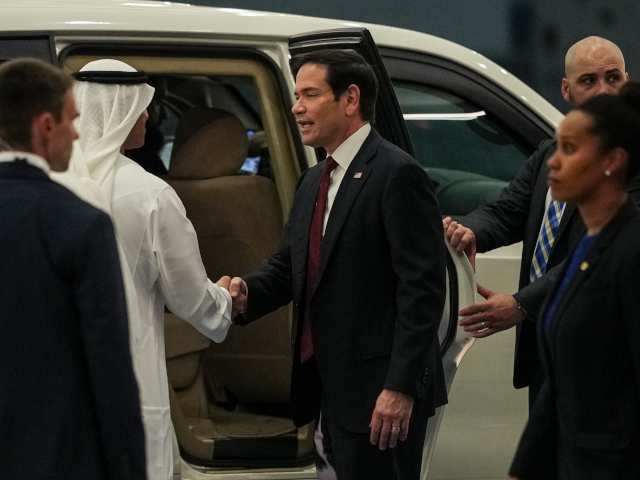

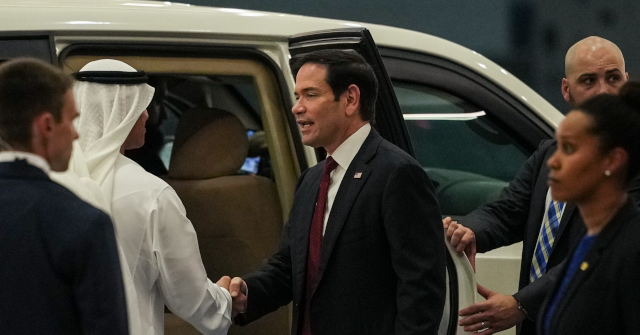
Secretary of State Marco Rubio, whose profile has been lower than usual throughout the Memorandum of Understanding (MOU) drama between the United States and Iran, met with Persian Gulf leaders on Tuesday and Wednesday to answer their questions about the peace deal.
“We want to hear from our partners. We want to make sure that their views are taken into account, and we understand their security concerns, their regional economic concerns as well,” Rubio said from Abu Dhabi on Tuesday.
“We’re not going to do anything that undermines the security of our allies, our longstanding allies in the region,” Rubio told reporters upon arriving in Kuwait on Wednesday. His previous stop was in the United Arab Emirates (UAE), and his next is Bahrain.
Rubio said from Kuwait that the Trump administration would remain “completely aligned” with partner Gulf states as negotiations with Iran continue.
“That’s why we’re meeting with all of them tomorrow, that’s why I’m taking these trips now. And it’s the reason why I’m here, apart from thanking them for the incredible support they gave us throughout this process,” he said.
The UAE, Kuwait, and Bahrain all host U.S. military bases, which the belligerent Iranians have demanded they eliminate after repeatedly attacking its Gulf neighbors. Rubio’s visit seemed intended to reassure the Emirates, Kuwait, and Bahrain that the United States would protect its allies and prevent Iran from dominating the region.
“The American flag: a symbol of liberty, unity, and freedom now flies proudly once again over Kuwait City. Kuwait is an indispensable partner for regional security and stability,” Rubio remarked at a flag-raising ceremony for the U.S. Embassy in Kuwait. The flag had to come down because Iran began attacking Kuwait with drones and ballistic missiles in March.
Rubio addressed another Persian Gulf anxiety on Tuesday when he promised that Iran would not be allowed to extort “tolls” or “fees” from shipping in the Persian Gulf. Iran has been strongly signaling that it intends to do so once the 60-day “toll-free” promise in the MOU expires.
“It’s an international waterway. No country is allowed to charge tolls or fees on an international waterway,” Rubio said, insisting that “all countries in this region would agree.”
Iran seemingly does not agree, and it appears to have made progress on winning the nation on the other side of the Strait of Hormuz, Oman, over to its point of view.
On the same day Rubio visited Abu Dhabi, Iran and Oman held talks about the future of the Strait of Hormuz, issued a joint statement declaring their “sovereign rights over their territorial waters” in the strait, and established a “working group” to “reach agreement on the future administration of navigation in the Strait of Hormuz.”
The joint statement from Iran and Oman ominously hinted at providing “services” for ships passing through the strait, mentioning “the costs associated with them in accordance with international standards.” The Iranians have been laying the groundwork to justify piracy in the strait as “fees” that will be charged for transit “services” which Tehran has been providing for “free” until now.
Iran did not directly respond to Rubio’s comments about the Strait of Hormuz, nor did it respond to President Donald Trump’s claim on Wednesday that Iran has promised there will be “no tolls, no insurance costs, and no other charges of any kind being sought or received by Iran on ships traveling the Strait of Hormuz.”
“If this is false information, negotiations would end, immediately!” Trump threatened on Truth Social.
Speaking from Kuwait, Rubio repeated President Trump’s threat to renew action against Iran if it violates the MOU, and said the Gulf states have no reason to fear the loss of American protection and support as a result of the deal.
“We have existing relationships with these countries that go back many, many decades,” he said. “We have troop presences in these countries. We have assets in these countries. The security assurances lie in the fact that — we don’t even have to talk about that, because they know it’s true. They know we’ve been there with them, and they’ve been there with us.”
“We have people there. We have people on the ground, constantly, working with them. We have air defenses embedded with them. We have aircraft in these countries,” he noted.
“I didn’t sense any doubts about our security assurances, because they’re real. They’re not promises. They’re actual. They exist,” he said.
Rubio reiterated his point about the firmness of America’s security commitment to the Gulf states when asked about Iran moving to reconstitute its damaged missile program, or fund terrorist proxies in other countries, using the huge amount of money that will flow to Tehran as a result of the MOU.
This has reportedly been a top concern of governments like the UAE and Kuwait after weathering repeated attacks from Iran. Rubio did not directly address concerns that the MOU does not explicitly prevent Iran from rebuilding, and improving, its arsenal of missiles and drones.
Iranian officials have given no sign that they interpret the MOU as limiting their military ambitions or restraining their urge to dominate the Middle East.
Iranian parliamentary speaker and lead negotiator Mohammad Bagher Ghalibaf, who was visiting Azerbaijan on Wednesday, once again referred to the MOU as a U.S. surrender document — “America’s declaration of defeat” — which was achieved by the “resistance and authority of the brave Iranian nation.”
On the same day, Iranian President Masoud Pezeshkian said from Pakistan that Iran would never accept any limitations on its missile program.
“If we did not have our missiles, which are for our self-defense, Israel and America would have plowed through Iran the way they did Gaza,” he said.
“Iran would never negotiate with anyone, under any circumstances, ever, about our defensive capabilities,” he said.
Pezeshkian’s host, Pakistani Prime Minister Shehbaz Sharif, agreed that the preliminary U.S.-Iran peace deal does not place any limits on Iran’s missiles. The Iranians have also denied Trump’s assertions that they agreed to more stringent inspections of their nuclear weapons program.
Badenoch blasts 'moaning' female Labour MPs over Burnham jobs 'quota'

Kemi Badenoch has told Labour women to earn a job in Andy Burnham's Cabinet instead of demanding they are handed jobs because of their gender.
The Tory leader lashed out today amid reports that female MPs are demanding the de-facto new prime minister introduce a 50:50 gender split 'quota' in his government.
Amid reports that former foreign secretary David Miliband is being lined up to return to the role, possibly with his brother Ed as Chancellor, one female minister also complained that Burnham could not have 'more Milibands than women' in the top posts.
But in a scathing article in the Times today Mrs Badenoch told them to 'stop moaning' and get chosen on merit instead of retreating into 'more of the failed identity politics that is holding back our country'.
'There are many, many reasons why you shouldn't have any Milibands in the cabinet,' she said.
'But complaining that the boys haven't given them the right jobs or that the boys are taking all the jobs, just shows that Labour's women still don't get it.'
The idea of quotas was also attacked by Baroness Jacqui Smith, Labour's Skills Minister.
Asked by Times Radio if Mr Burnham should reserve jobs for women, she said: 'No, I think what Andy Burnham should be doing is building the very best team around him to change this country.'

A letter written by the Women's Parliamentary Labour Party has called on Mr Burnham to ensure a 50:50 split between men and women in government jobs

Amid reports that former foreign secretary David Miliband (above, right, in 2010) is being lined up to return to the role, possibly with his brother Ed as Chancellor, one female minister complained that Burnham could not have 'more Milibands than women' in the top posts

But Mrs Badenoch told them to pipe down and get chosen on merit instead of retreating into 'more of the failed identity politics that is holding back our country'
A letter written by the Women's Parliamentary Labour Party and seen by the BBC has called on Mr Burnham to ensure a 50:50 split between men and women in government jobs after he succeeds Sir Keir Starmer.
'We are asking you to demonstrate this change from day one and address the toxicity and misogyny within our own party and government,' it said.
Labour has never had a female leader, while the Conservatives have had three, and Mrs Badenoch urged the government to follow its meritocratic example.
'If you run a meritocracy, then you do not have to worry about jobs for the boys,' she wrote.
'Every woman who is a Conservative MP, every woman who has ever won the leadership, has had to fight to get where she is.
'By contrast, Labour women are demanding guarantees from Burnham. But the truth is he doesn't have to give any guarantees.
'If none of Labour's women are prepared to get their hands dirty and challenge him for the leadership, their demands are toothless.'
'In fact, it's quite revealing that the women's parliamentary Labour Party has written to Burnham asking him to commit himself to at least 50 per cent female ministers.
'This has nothing to do with meritocracy. It is yet more of the failed identity politics that is holding back our country.'