LeBron James' stint with Lakers is Hall of Fame worthy

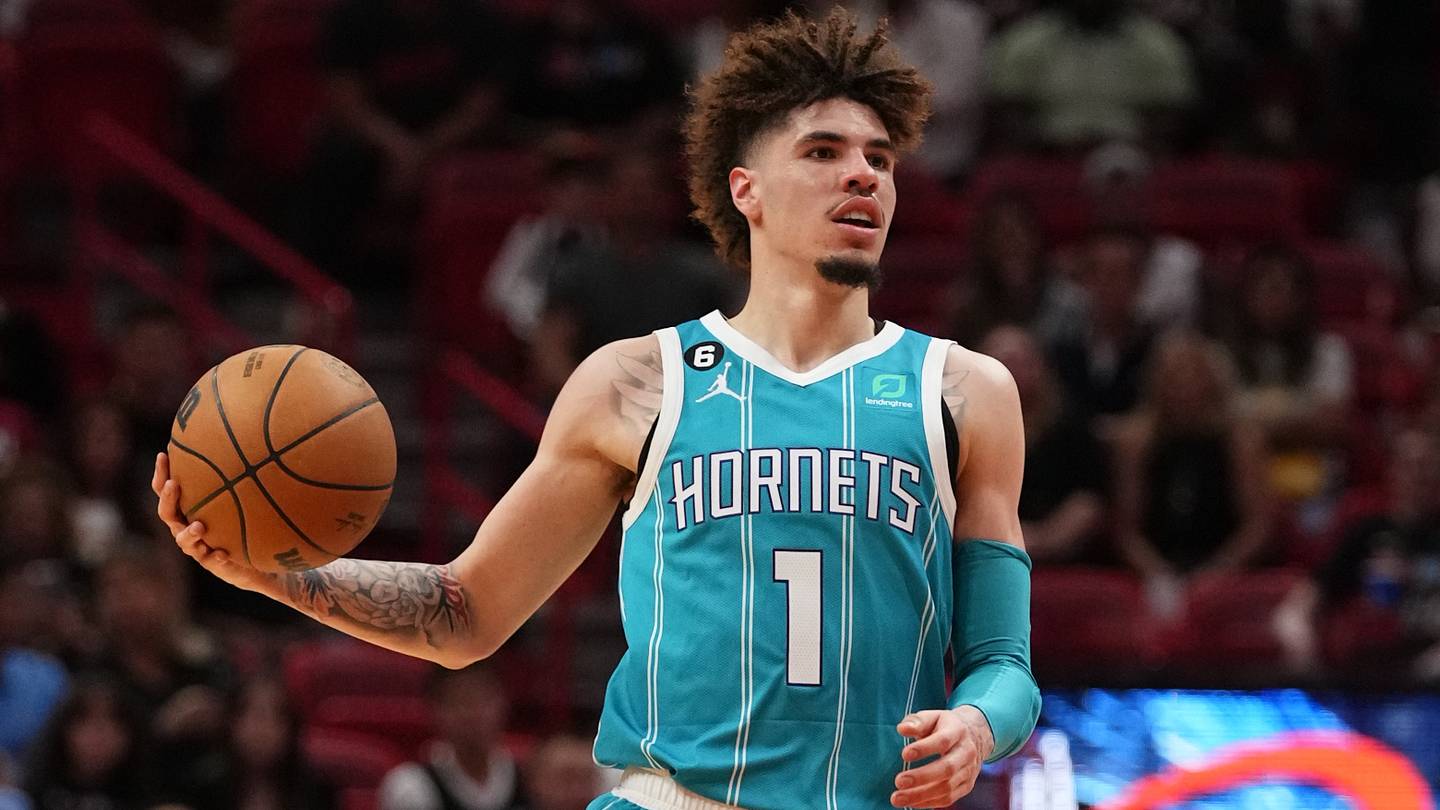
This appears to be it for LeBron James as a Laker. On Tuesday, ESPN's Shams Charania reported that James informed the Lakers he will look to play elsewhere in 2026-27.
And he can walk away with pride.
AdvertisementAdvertisementAfter signing in 2018, he played eight wildly successful seasons and became the NBA's all-time leading scorer, passing Kareem Abdul-Jabbar in 2023. The 41-year-old won an NBA championship in six playoff runs and reached the conference finals twice, all without missing a single playoff game. Individually, he took home a number of accolades, including eight All-Star nods, seven All-NBA appearances and even a 2019-20 assist title by averaging a career-high 10.2 per game.
Even in his age-41 season, James rated as one of the best players in the league, averaging a team-high 23.2 points, 7.3 assists and 6.7 rebounds this postseason for the short-handed Lakers. With Luka Dončić and Austin Reaves struggling to stay healthy, the need for James' versatility, leadership and production remained high.
Here's the crazy thing that really puts LeBron's Lakers tenure in perspective:
If you isolate James' stint with the Lakers and look at just his age-34 to age-41 seasons, he would almost certainly be a Hall of Famer based on those eight seasons alone.
AdvertisementAdvertisementAnd we can prove it.

The Naismith Memorial Basketball Hall of Fame Probability
Think about the hardware James earned as a Laker. In those eight seasons in purple and gold, he earned more All-NBA appearances than Jason Kidd, Carmelo Anthony and Clyde Drexler each had in the entire Hall of Fame careers. He won more playoff games than Hall of Famers Mitch Richmond, Bernard King and Yao Ming if you look at just James' Lakers tenure.
This isn't just an exercise in cherry-picking stats. We can look at the Naismith Memorial Basketball Hall of Fame voting history for something more comprehensive. The proprietors of the indispensable Basketball Reference studied the numbers and found that when it comes to Hall-worthy playing careers, there are a series of key statistics and accolades that are statistically significant. That is, they are predictive barometers of Springfield immortality based on those who are in the Hall and those who are not.
When it comes to NBA careers, Basketball Reference determined there are five significant factors (in no order):
All-Star Game selections
NBA top-10 leaderboard appearances in the following categories: Points, rebounds, assists, steals, blocks, minutes played
NBA championships
NBA peak win shares
Height (believe it or not, research shows, the shorter you are, the better chances you have)
Win shares, by the way, is an advanced metric that estimates the number of wins a player contributes to his team based on their box-score statistics. The other stuff is pretty self-explanatory. In the end, it answers the question: If this player retired today, what is the probability he would be elected to the Hall of Fame?
Another thing to keep in mind, this only considers whether a player is Hall of Fame worthy based purely on a player's NBA résumé. European stalwarts like Dino Radja and Šarūnas Marčiulionis would not have been deemed Hall-caliber based on their abbreviated NBA careers. But LeBron in L.A.? We can pull that up.
Leaderboard appearances? With the Lakers, he was top 10 in points in 2019-20 (8th), and assists in 2019-20 (1st), 2023-24 (6th) and 2024-25 (7th). Title? Check. All-Star appearances? He's had eight of them. The highest win shares total of his Lakers tenure came in the championship season in which he registered an impressive 9.8 figure.
AdvertisementAdvertisementWhen we type in James' résumé and apply the model, we can calculate the Hall of Fame probability based on his production in those eight seasons. So, what was his Hall of Fame probability as a Laker, according to Basketball Reference's handy HOF probability calculator? Would he be a HOF in purple and gold only?
Without further ado …
Yup, Hall of Famer. It's 86.5%.
A near lock.
We can say with pretty good certainty that James would be a Hall of Famer if we just looked at his Lakers run. That's a crazy notion on the surface. Then we peel back the layers and realize that, since he turned 33, he has as many All-NBA appearances as Tracy McGrady, Patrick Ewing and Allen Iverson did in each of their careers. And they never won a title.
AdvertisementAdvertisementAnother way to illustrate James' dominance is to compare his Lakers résumé on paper to other full Hall of Fame careers. Take Mitch Richmond, for instance. The Hall of Fame scorer enjoyed a fine 14-year career in the league, achieving six All-Star appearances and regularly appearing among the scoring leaders. James earned more All-Star (and All-NBA) appearances in just his Lakers stint and had a much bigger hand in the Lakers' championship than Richmond's 2002 ring with the team. James' Lakers career also looks favorably compared to Joe Dumars, Jo Jo White and Earl Monroe.

And that's just a handful of notable comps. This is where it gets even crazier.
LeBron's not one, not two, not three, but four Hall of Fame careers
If we can establish that James had a Hall of Fame worthy career as a Laker, it means something even bigger. It means he has stacked four separate Hall of Fame careers on top of each other, demarcated by the three offseasons in which he switched teams.
AdvertisementAdvertisementDuring the 2023-24 season, when I first looked at this possibility, James' tenure with the Lakers didn't quite clear the bar. At the time, he had reached "only" five All-Star teams and hadn't yet finished among the league leaders in assists in 2023-24 and 2024-25. But with the three extra All-Star notches on his belt and those extra leaderboard appearances, Laker LeBron would reach Springfield based on his résumé.
And believe it or not, both his first Cavs stint (with no titles, but just about every other accomplishment) and his second Cavs stint (with a title) were HOF-worthy, as well as his Miami stint in which he raised the Larry O'Brien Trophy twice and dialed up his advanced metrics to historic levels. So that leaves us with — count 'em — four Hall of Fame careers.

When James signed a four-year deal with the Lakers in 2018, no one would have blamed him for hanging it up after that deal. (Well, maybe some people; it's LeBron, after all.) He had already played 15 seasons in the league, which was as many as Michael Jordan played and more than Wilt Chamberlain, Jerry West and Larry Bird.
AdvertisementAdvertisementAnd then he played eight seasons after that. Complete with enough glory to earn a Hall of Fame spot alone. His fourth such golden run of his career.
We can't ask for much more.
Well, there's one thing: How about a fifth Hall of Fame career?
Bugatti Just Unveiled a One-of-a-Kind Mistral Hypercar
By Viju MathewViju Mathew
Viju Mathew's Most Recent Stories
- This New GT40 Replica Series Pays Homage to Ford’s Legendary 1960s Race Cars
- Road Test: This Chevy C10 Restomod Called and Wants the 1970s Back
- The 987 HP Audi Nuvolari Supercar Is the Marque’s Most Powerful Production Model Yet
 Bugatti Automobiles S.A.S.
Today’s digital techniques and yesterday’s traditional methods rarely find common ground in creative expression, yet when they do, the result can be remarkable. Enter the new W16 Mistral “Blanc Éternel” hypercar: The 1,578 hp roadster is the latest one-off calling card from the French marque’s Sur Mesure division, which specializes in customization. In this case, it also shows off Bugatti’s encore collaboration with Königliche Porzellan-Manufaktur Berlin (KPM), an atelier that has produced porcelain masterworks since 1763.
Related Stories
- This Incredible 1985 Ferrari 288 GTO Will Sell for at Least $6.75 Million at Auction
- A 239-Foot Superyacht With a Living Tree at the Center Just Hit the Seas
- Emirates's Luxe New Airport Lounge Concept Offers More Privacy Than Ever Before
Mesmerizing to look at, this singular Mistral stands out in a line already limited to only 99 examples and claimed to be the finale of street-legal models powered by the W16 mill. To that end, the “Blanc Éternel” carries the same power-train configuration as the others—Bugatti’s 8.0-liter, quad-turbo 16-cylinder heart paired with a seven-speed DSG dual-clutch gearbox. And the performance specs still equate to a zero-to-62 mph time of 2.4 seconds and a top speed of 273 mph.

Those standout stats now compete with an added aesthetic that further amplifies the Mistral’s already striking design. It’s an approach first explored by Bugatti and KPM in what was dubbed the “L’Or Blanc”—a one-of-one Veyron Grand Sport unveiled exactly 15 years ago to the day. That initial partnership between the two legacy manufacturers was, in itself, innovative.
WATCH“At first, it seems to be an unusual idea to use porcelain in a car, especially in the world’s fastest convertible,” Stefan Brungs, Bugatti’s director of sales and marketing said at the time, per the 2011 press release concerning the “L’Or Blanc” Veyron. “But this is what Bugatti stands for: the realization of exceptional ideas whilst striving for the utmost in quality and aesthetics. This allows us to continue Ettore Bugatti’s heritage, who himself loved to experiment with new materials.”
While the “L’Or Blanc” Veyron owed its appearance to the decorative cues found on a KPM vase envisioned by designer Enzo Mari, translated as streaks of blue mixing with a white backdrop, the “Blanc Éternel” Mistral takes a more black-and-white approach, literally, and presents greater linearity. It also illuminates the digital design of the Mistral.
Bugatti’s design director Frank Heyl and his team eschewed the use of clay models when it came to conceiving the Mistral’s styling, opting instead for a digital solution that, according to the press release, relies on manipulating “a network of precisely controlled surfaces” to bring together what is a “normally invisible patch layout.” The idea for the exterior dressing of this specific car was to bring the intersection of those surfaces to the fore with the juxtaposition of black lines—first taped off by hand—to provide the abstract zebra-like pattern. The motif continues in the cockpit, where taping and painting of the leather upholstery was also required.
As for the integration of porcelain, KPM has bestowed it upon its own logo, the EB logo, the gas and oil caps, and accents on the engine cover. The material also embellishes the interior, where the center armrest, speaker covers, window buttons, and gear shift are among the areas of application. The press release notes that what makes porcelain difficult to use is the fact that its size reduces by 17 percent after its time in the furnace and curing. That variance needs to be accounted for, which, it seems, KPM has been doing to since Frederick the Great, King of Prussia, founded the operation in the 18th century. Obviously, the legacy has since grown from royal tableware to hypercar accoutrements.
“Refining such a sensitive material for use in a vehicle of this performance class represents a remarkable achievement in craftsmanship,” stated Thomas Wenzel, creative director at KPM, in the aforementioned release. Less remarkable but still highlighting porcelain’s functionality is the 1,000-piece line of cups commemorating KPM’s latest creative ride with Bugatti.
As for the automaker’s lineage, it began with founder Ettore Bugatti’s penchant for advancing both form and function, a seemingly familial trait shared by his father, a furniture maker, his brother Rembrandt, an accomplished sculptor, and his son Jean, an acclaimed automotive designer. With that pedigree behind its name, the Bugatti Mistral “Blanc Éternel” could exist nowhere else but the crossroads of both boundary breaking engineering and artisanship.
Click here for more photos of the Bugatti Mistral “Blanc Éternel” hypercar.
Authors
-

Viju Mathew
Shifting gears from his degree in physical geography, Viju Mathew has spent the last decade covering most categories of the luxury market prior to becoming Robb Report's automotive editor. Along with…
Read More