Jesse Livermore: Old Lessons For Today's Markets
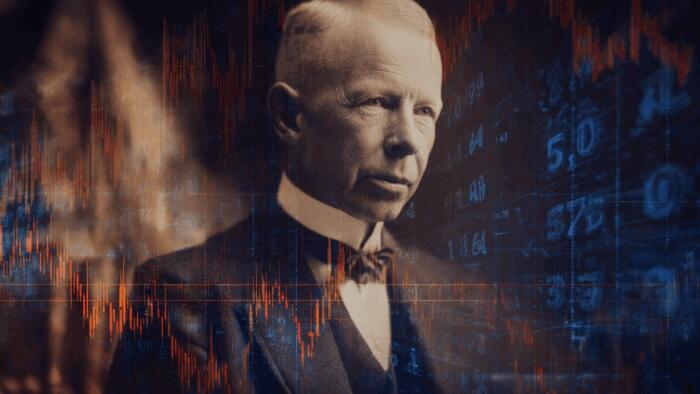


Authored by Michael Lebowitz via RealInvestmentAdvice.com,
In 1891, at 14 years old, with nothing but the clothes on his back, Jesse Livermore left his family and headed to Boston. He quickly found a job posting stock quotes at a Paine Webber brokerage office. Livermore spent his lunch hours trading in “bucket shops,” loosely regulated offices where ordinary people bet on stock prices without owning the underlying stock.

His lunchtime trading activities earned him a $1,000 profit in his first year, and by the time he was 30, he had already made and lost a considerable amount of money trading. In 1929, he hit the jackpot. It is estimated that he made over $100 million by shorting stocks during the market crash. Such an enormous gain against the backdrop of despair made him a Wall Street legend, but five years later, he filed for bankruptcy.
The prolific trading stories about Jesse Livermore and the fortunes he made and lost are well documented in two books. The first, Reminiscences of a Stock Operator (1923), authored by Edwin Lefèvre, is the better-known of the two. The second book, How to Trade in Stocks (1940), was written by Livermore himself. It conveys the many lessons of what four decades of speculation had taught him. Specifically, he presents 21 market rules. While his career was marked by the incredible volatility of his wealth, and some consider him a failure as he died broke, his market knowledge is invaluable. Accordingly, we share his 21 market rules. While the language he uses is outdated, the rules remain prescient.
Due to the length of the rules and our summaries of each, we are breaking this topic into two articles. Part Two will include rules 10 through 21.
Old Yet Valuable Insight
Today’s markets and those in which Livermore operated are vastly different. The technological transformations since Livermore’s trading days are immense. Regulation is much better today than it was then. Market news, rumors, and narratives spread at the speed of light today compared to days or weeks when Livermore traded.
Jesse Livermore wouldn’t recognize today’s markets. However, Livermore understood that at the core of every market, the most important factor is human behavior. As such, Livermore’s rules remain just as valuable in 1940 as they are today because human behaviors largely remain the same.
The human side of every person is the greatest enemy of the average investor or speculator. –How to Trade in Stocks
Rule 1: Nothing new ever occurs in the business of speculating or investing in securities and commodities.
Market cycles repeat because human psychology repeats. The specific market triggers change, but the cycles of greed and fear continue. Today, for instance, it is AI valuations; fifteen years ago, it was housing, and the decade before that, it was internet stocks. Yet despite the differing triggers, the underlying pattern of euphoria that separates reality from fundamentals remains consistent.
Understanding this rule does not require predicting the future. It only requires an understanding of where we are in the cycle.
Rule 2: Money cannot consistently be made trading every day or every week during the year.
This rule runs directly counter to what the financial services industry sells. Brokerage platforms, financial media, and trading apps are built on the false premise that more trading activity yields better results. The data argues otherwise. Research consistently shows that retail investors who trade most frequently underperform those who trade least. Livermore says that genuine great opportunities, where the risk/reward is favorable, and the trend is confirmed, are rare.
Jesse Livermore believes that most market action is noise. Treating noise as a signal is one of the most reliable ways to lose money over time.
The desire for constant action irrespective of underlying conditions is responsible for many losses in Wall Street, even among the professionals, who feel that they must take home some money every day – Reminiscences of a Stock Operator
Rule 3: Don’t trust your own opinion and back your judgment until the action of the market itself confirms your opinion.
Your investment analysis, no matter how right you think you are, is not tradeable until the market agrees with it.
Some stocks are greatly undervalued and can remain so for years. Conversely, others keep rising long after fundamental analysis no longer makes sense. The market’s price action provides real-time information about the balance of supply and demand for the shares. Wait for your analysis and the price action to align before deploying meaningful capital.
Rule 4: Markets are never wrong — opinions often are.
This is perhaps one of Livermore’s most important rules, but hardest to enact. When an investment moves against you, our instinct is to make a case for why the market is wrong. The case you make may prove to be correct in the long run. But “the long run” can be a prolonged and expensive waiting period. As he alludes to in Rule 3, markets are the collective judgment of all participants. That does not make markets rational, but it does make them the most accurate real-time measure of where the money is positioned.
We recently wrote a short piece The Market Knows What You Don’t that puts Livermore’s thoughts into the current context. As we wrote:
Humility is an underrated investment discipline. The moment we believe our views outweigh the market’s, we have stopped managing risk and started taking it. The market does not care what we think. Investors need experience and hard lessons to appreciate the market’s voice, especially when it differs from their own opinions.
Rule 5: The real money made in speculating has been in commitments showing in profit right from the start.
A position that immediately moves against you is important information. Livermore observed that the trades that produced the largest returns almost always worked from the opening entry. To his point, if you enter a trade at a pivotal point, like a confirmed breakout, the market should validate your position by moving in your favor. A trade that requires patience before it begins to work is a trade that you may have misjudged. Early confirmation is not a guarantee of profits, but its absence can be an important warning.
Rule 6: As long as a stock is acting right and the market is right, do not be in a hurry to take profits.
We are psychologically wired to take profits quickly, locking in small gains out of fear they will disappear. Per Jesse Livermore, the largest returns come from a small number of positions that are held through extended moves. Selling a position simply because it has risen is a mistake unless something has changed in the underlying conditions or price action.
It’s also worth noting that most investors also tend to hold on to losing positions too long, hoping for a recovery. The habit of selling winners too early and holding onto losers is called the Disposition Effect. Shefrin and Statman, who coined the term in 1985, describe it as the inclination to “ride losers and sell winners.”
Losing money is the least of my troubles. A loss never bothers me after I take it. I forget it overnight. But being wrong — not taking the loss — that is what does damage to the pocketbook and to the soul. – Reminiscences of a Stock Operator
Rule 7: One should never permit speculative ventures to run into investments.
Rule 7 is a follow-up on Rule 6. When a speculative position declines, the temptation is to reframe it as a long-term investment to avoid accepting the loss. The position was entered under a specific thesis with an expected time horizon. If the thesis has failed or the time horizon has passed without confirmation, the rationale for holding the position has changed. Renaming a failed speculation as a “long-term hold” does not change its economics. It only delays the recognition of a loss and ties up capital that could be deployed profitably. Know why you own what you own, and revisit that thesis regularly.
Rule 8: The money lost by speculation alone is small compared with the gigantic sums lost by so-called investors who have let their investments ride.
Rule 8 challenges the conventional wisdom that long-term buy-and-hold investing is inherently safer than active management. Livermore’s point is that passive inaction can produce catastrophic results when positions deteriorate, and nothing is done to mitigate the losses. Consider investors who held Cisco through its 80% decline from 2000 to 2002 and then waited over 20 years for it to return to its highs. Capital preservation is not a secondary consideration. It is the foundation on which everything else is built.
The graph below shows the decades during which many Cisco investors were trying to claw back from losses, even though they could have bought better performing stocks.

Rule 9: Never buy a stock because it has had a big decline from its previous high.
What matters is not where a stock was trading but whether the conditions that drove the decline have changed. Buying into a declining trend because a stock “looks cheap” relative to its former price is a costly mistake investors often make.
Summary Part One
We write articles like this as much for us as for our readers. Taking the time to compile Livermore’s rules and summarize them reminds us that we are human and prone to making investment mistakes. The rules Jesse Livermore presents, regardless of whether we agree with them or not, allow us to step back from our daily job of watching markets and managing investments and to ask ourselves some important questions that are often ignored.
Badenoch blasts 'moaning' female Labour MPs over Burnham jobs 'quota'

Kemi Badenoch has told Labour women to earn a job in Andy Burnham's Cabinet instead of demanding they are handed jobs because of their gender.
The Tory leader lashed out today amid reports that female MPs are demanding the de-facto new prime minister introduce a 50:50 gender split 'quota' in his government.
Amid reports that former foreign secretary David Miliband is being lined up to return to the role, possibly with his brother Ed as Chancellor, one female minister also complained that Burnham could not have 'more Milibands than women' in the top posts.
But in a scathing article in the Times today Mrs Badenoch told them to 'stop moaning' and get chosen on merit instead of retreating into 'more of the failed identity politics that is holding back our country'.
'There are many, many reasons why you shouldn't have any Milibands in the cabinet,' she said.
'But complaining that the boys haven't given them the right jobs or that the boys are taking all the jobs, just shows that Labour's women still don't get it.'
The idea of quotas was also attacked by Baroness Jacqui Smith, Labour's Skills Minister.
Asked by Times Radio if Mr Burnham should reserve jobs for women, she said: 'No, I think what Andy Burnham should be doing is building the very best team around him to change this country.'

A letter written by the Women's Parliamentary Labour Party has called on Mr Burnham to ensure a 50:50 split between men and women in government jobs

Amid reports that former foreign secretary David Miliband (above, right, in 2010) is being lined up to return to the role, possibly with his brother Ed as Chancellor, one female minister complained that Burnham could not have 'more Milibands than women' in the top posts

But Mrs Badenoch told them to pipe down and get chosen on merit instead of retreating into 'more of the failed identity politics that is holding back our country'
A letter written by the Women's Parliamentary Labour Party and seen by the BBC has called on Mr Burnham to ensure a 50:50 split between men and women in government jobs after he succeeds Sir Keir Starmer.
'We are asking you to demonstrate this change from day one and address the toxicity and misogyny within our own party and government,' it said.
Labour has never had a female leader, while the Conservatives have had three, and Mrs Badenoch urged the government to follow its meritocratic example.
'If you run a meritocracy, then you do not have to worry about jobs for the boys,' she wrote.
'Every woman who is a Conservative MP, every woman who has ever won the leadership, has had to fight to get where she is.
'By contrast, Labour women are demanding guarantees from Burnham. But the truth is he doesn't have to give any guarantees.
'If none of Labour's women are prepared to get their hands dirty and challenge him for the leadership, their demands are toothless.'
'In fact, it's quite revealing that the women's parliamentary Labour Party has written to Burnham asking him to commit himself to at least 50 per cent female ministers.
'This has nothing to do with meritocracy. It is yet more of the failed identity politics that is holding back our country.'