Jaylen Brown trade destinations: Six possible landing spots for Celtics star after failed Giannis pursuit
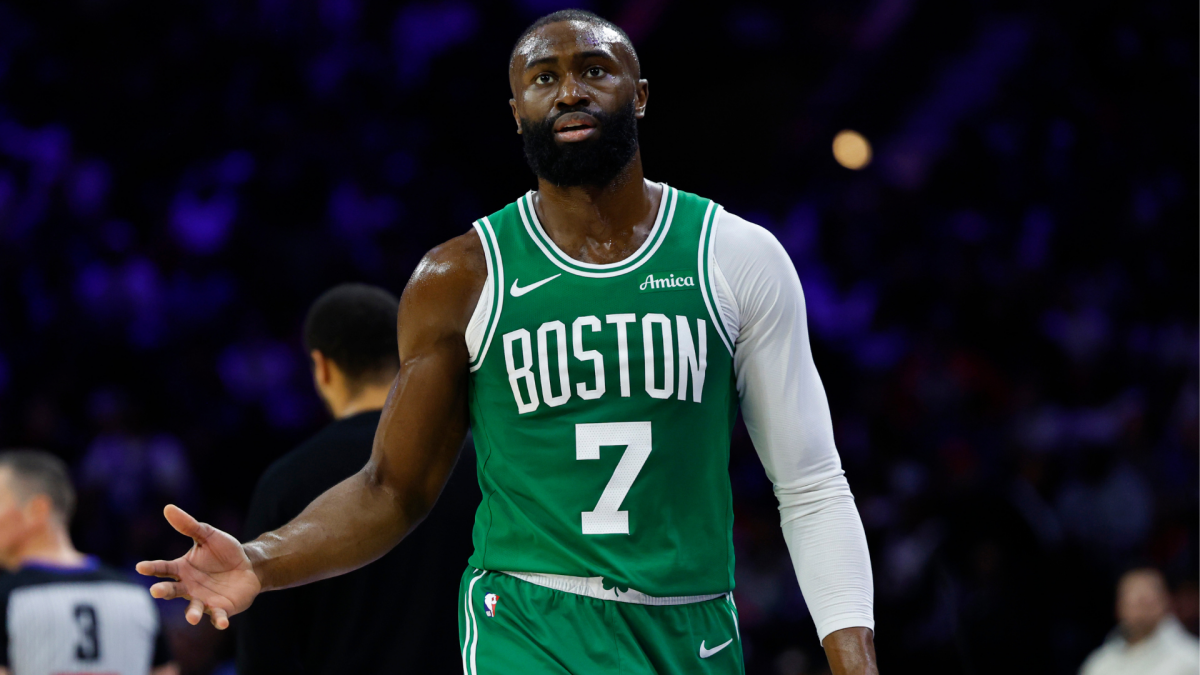
With or without Giannis Antetokounmpo involved, a Jaylen Brown trade made plenty of sense for the Boston Celtics. We're in the most restrictive CBA environment in NBA history, and the Celtics currently have both Brown and Jayson Tatum on supermax contracts that pay them around 35% of the salary cap. That might be tenable if one of them were an MVP candidate, as Antetokounmpo is, but since neither is, the financial burden that those contracts impose on the rest of the roster might not be tenable.
That's a lesson the Celtics may have learned in the first round of the playoffs, when they blew a 3-1 lead to the Philadelphia 76ers. Yes, Tatum missed Game 7, but a lot of the broader problems with Boston's roster construction were on full display in that series. Their big men were not defensively versatile enough. Their point-of-attack defense wasn't good enough. They relied too heavily on 3-point shooting, and sure enough, all four of their first-round losses to Philadelphia saw them hit less than 30% of their 3s.
Even Brad Stevens, the team's director of basketball operations, acknowledged the need for more offensive versatility after that defeat. "One of the things we've gotta figure out is how to have more of an impact at the rim," Stevens said after the Celtics were eliminated. "I do think we need to add to our team to do that." Boston ranked 27th in the NBA in points in the paint last season.
What's next for Celtics after losing out on Giannis Antetokounmpo? And what does it all mean for Jaylen Brown? Jack Maloney
Antetokounmpo would have been the obvious antidote. Now that he's off the table and heading to the Miami Heat following Monday night's blockbuster trade with the Milwaukee Bucks, the Celtics need to look elsewhere.
Brown is their best trade chip. He's their chance to really reimagine what this team looks like moving forward, and they are reportedly open to offers. So with the NBA Draft now at hand, let's look at some of the sensible trade fits for the reigning Second-Team All-NBA player.

Houston Rockets
Houston has been a widely-discussed Brown suitor in part because his former coach in Boston, Ime Udoka, now leads the Rockets. The question here is how the Rockets would construct a trade -- both in terms of finances and assets.
Reports have suggested that Amen Thompson is the only Rockets player who is truly off limits. Would that make Alperen Sengun the centerpiece of this sort of trade? He's not exactly Boston's typical center target. The Celtics prefer bigs who shoot and are schematically versatile on defense. Sengun checks neither box, and he makes around $23 million less than Brown.
How would the Rockets fill in that void? Fred VanVleet on his $25 million player option? That creates a point guard hole. Reed Sheppard and Dorian Finney-Smith, perhaps? Sheppard overlaps with Payton Pritchard in terms of skill set, and Finney-Smith is bad money.
The alternative here would be to build a deal around Kevin Durant as the primary matching salary. His salary gets you closer to Brown's -- he'll earn almost $44 million next season -- and you could fill in the rest with Finney-Smith. Of course, Durant is 37. He may help Boston now, but he'd drastically shorten their runway. Houston would have to fill in the gap with draft picks. The Rockets have plenty to trade: swap rights with the Brooklyn Nets in 2027 (and Boston has a pretty strong history with Nets picks), plus control over the Phoenix Suns' choices in 2027 and 2029. Boston has been interested in Durant in the past. Does that interest still exist?
Houston has a lot of assets to work with, but probably doesn't have the specific sort of players the Celtics would want unless Thompson was on the table. This might have to be a three-team deal, but that's a solvable problem. All of this depends on what sort of team the Celtics want to build without Brown, and what kind of group the Rockets would want around him.

Portland Trail Blazers
Portland was widely viewed as a potential facilitator of a Giannis-to-Boston trade purely for holding control over Milwaukee's picks between 2028 and 2030. The theory was that the Bucks could get those picks back and Portland could get Brown. Well, those picks probably aren't quite as valuable to Boston as they would have been to Milwaukee, but the Blazers still do have plenty to work with here.
How interested would Boston be in Scoot Henderson? He has the athletic tools to generate a ton of rim pressure, but his finishing numbers have been terrible thus far in the NBA. His shot and point-of-attack defense have improved. He'd be a nice swing for Boston, but probably isn't enough on his own to be the centerpiece of a trade like this, especially with a rookie extension looming. Would Portland offer Donovan Clingan, its imposing, young rim protector? The answer is probably no. He'd be needed as a piece for the Brown version of the team. Toumani Camara, a star wing defender who took a leap offensively last season, would make sense as well.
Making the money work is tricky on several levels. Just matching Brown's $58 million salary alone isn't easy, but looming over everything Portland does this offseason is the reality that it needs cap space next summer if it hopes to renegotiate and extend Deni Avdija's contract. If they don't do so, he will be a free agent in 2028 with plenty of eager suitors. This is a bit of a puzzle, and it might require a third team, but Portland does have a lot of asset value to work with.

San Antonio Spurs
The Spurs were one of many teams linked to Brown last offseason, when the Celtics were seemingly considering a gap year. No deal materialized, but San Antonio's circumstances have changed since then.
Dylan Harper was ready to compete far sooner than anyone could have realized, and after De'Aaron Fox's poor, injury-plagued Finals, upgrading Fox's salary slot into Brown would not only improve San Antonio's talent, but also balance out its roster. Putting Harper, Brown, Stephon Castle, and Victor Wembanyama on one team would create a heavy championship favorite. Brown's supermax contract has three years left compared to the four Fox has on his deal, which is notable since it means Brown's deal will expire before Harper's inevitably expensive rookie extension kicks in.
That sort of upgrade would be costly for the Spurs. San Antonio is loaded with tradable draft capital, including a 2028 swap with Boston that they could retract. While Castle and Harper would surely be off the table, maybe other younger players like Carter Bryant or Julian Champagnie would be gettable. Fox is certainly a bad contract in a vacuum, but he might actually make some sense for the Celtics specifically. He doesn't pressure the rim at nearly the rate that he used to, but he's still above average on that front and would likely do well in an environment with the sort of shooting that Boston can offer.
Still, at best, Fox has only modest positive value; more likely, he's neutral or negative. The draft and/or young player compensation alongside him would have to be enormous, and the Spurs would have to be very confident that Harper is ready to both start and organize an offense at a championship level. They'd have the most talented starting five in the NBA by far if they pulled this off, but they wouldn't be without questions of their own to answer.

New Orleans Pelicans
The Celtics have been linked to Trey Murphy III on the trade market, and while they have a big enough trade exception to absorb him without sending out Brown, he'd be a nice foundation for a Brown trade as a younger, cheaper replacement at small forward. His shooting and athleticism would fit in well in Boston, though he'd be a meaningful downgrade on defense. The key would be what else the Pelicans put on the table.
New Orleans was fairly loose with picks last summer in its pursuit of Derik Queen. Is there a big enough pick package to bridge this gap? Would Boston perhaps be interested in Zion Williamson as its source of rim pressure? The Queen-Williamson pairing makes little sense, so a trade, especially after a relatively healthy year for Williamson, would be wise. Maybe the Celtics could even come away with both of New Orleans' coveted wings, with defensive ace Herbert Jones sneaking into the trade as well.
Should the Pelicans want Brown? Probably not. He's a win-now player and the Pelicans are still developing two lottery picks from last year's draft in Queen and Jeremiah Fears. By the time they're ready, Brown's prime will likely be over. But if the Pelicans just want star power and a chance to be moderately competitive, Brown fits the bill. If Boston wants to turn one great player into a pile of good ones, this is the logical fit.
Giannis Antetokounmpo trade winners and losers: Why Heat fall in both categories, great news for Knicks Sam Quinn

Atlanta Hawks
Brown is from Georgia, and a return to his home state has been rumored for quite some time. If part of the appeal here for Boston is breaking up Brown's contract, the Hawks are perhaps better positioned to help than any other team. They do not have a single player earning more than $30 million next season. Jalen Johnson would be off the table, but between players like Onyeka Okongwu and Nickeil Alexander-Walker, there are plenty of value deals at Atlanta's disposal here.
Timing would be tricky with Atlanta picking at No. 8 overall in Tuesday night's NBA Draft. If a trade isn't completed by then, the asset is inherently less valuable purely because Boston wouldn't get to make the pick for the Hawks there. The Hawks could offer future picks instead, or perhaps their scouting philosophies are similar enough that Boston could just take the player.
Are the Hawks close enough to contention to justify a Brown trade? I'd lean no, at least unless they think Johnson has another big leap in him. They also have many players who depend on this sort of roster construction. Is Dyson Daniels offensively viable without a center who can shoot like Okongwu, for instance? There's a delicate alchemy to this team, and it shouldn't be altered lightly.

Denver Nuggets
The Nuggets and Celtics are in somewhat similar positions as former champions who might need a shakeup. That has made a Brown-for-Jamal Murray trade a common rumor. I just want to lay out how complicated such a trade would be in reality.
Brown is on a 35% max contract. Murray is on a 30% max contract. If they were traded one-for-one, the Nuggets, by virtue of taking in more money than they sent out, would be hard-capped at the first apron. That's untenable since they're essentially at the second apron as is. So Denver would have to aggregate salaries, creating a second apron hard cap instead. Even that would be difficult to deal with, because the moment Denver hard caps itself, the rest of the league knows the number the Nuggets cannot legally match in attempting to keep restricted free agent Peyton Watson. They'd be inviting someone like the Los Angeles Lakers to come in and steal him.
So the Watson situation would probably need to be settled first and the Nuggets would have to dump a lot of salary. Would Boston be willing to take Christian Braun into its $27.7 million trade exception? That's one of the NBA's worst contracts, and the Nuggets don't have much in the way of draft capital to compensate Boston for taking him. More likely, Cameron Johnson would have to go to Boston, which would all but dash Boston's dreams of ducking the luxury tax and resetting its repeater clock... and then Aaron Gordon would have to be traded elsewhere for a guard, because without Murray, the Nuggets would be at an enormous dribbling deficit. They'd essentially be remaking their entire team aside from Nikola Jokić.
So, is a Murray-for-Brown trade possible? I suppose in theory. Is it practical? No, at least not at the moment. NBA front offices are creative. If Denver values Brown more than Murray and Boston absolutely loves Murray as a replacement for Brown, this is potentially solvable. Just don't bet on it. The Nuggets are a dark horse at best here.
Add CBS Sports on GoogleBadenoch blasts 'moaning' female Labour MPs over Burnham jobs 'quota'

Kemi Badenoch has told Labour women to earn a job in Andy Burnham's Cabinet instead of demanding they are handed jobs because of their gender.
The Tory leader lashed out today amid reports that female MPs are demanding the de-facto new prime minister introduce a 50:50 gender split 'quota' in his government.
Amid reports that former foreign secretary David Miliband is being lined up to return to the role, possibly with his brother Ed as Chancellor, one female minister also complained that Burnham could not have 'more Milibands than women' in the top posts.
But in a scathing article in the Times today Mrs Badenoch told them to 'stop moaning' and get chosen on merit instead of retreating into 'more of the failed identity politics that is holding back our country'.
'There are many, many reasons why you shouldn't have any Milibands in the cabinet,' she said.
'But complaining that the boys haven't given them the right jobs or that the boys are taking all the jobs, just shows that Labour's women still don't get it.'
The idea of quotas was also attacked by Baroness Jacqui Smith, Labour's Skills Minister.
Asked by Times Radio if Mr Burnham should reserve jobs for women, she said: 'No, I think what Andy Burnham should be doing is building the very best team around him to change this country.'

A letter written by the Women's Parliamentary Labour Party has called on Mr Burnham to ensure a 50:50 split between men and women in government jobs

Amid reports that former foreign secretary David Miliband (above, right, in 2010) is being lined up to return to the role, possibly with his brother Ed as Chancellor, one female minister complained that Burnham could not have 'more Milibands than women' in the top posts

But Mrs Badenoch told them to pipe down and get chosen on merit instead of retreating into 'more of the failed identity politics that is holding back our country'
A letter written by the Women's Parliamentary Labour Party and seen by the BBC has called on Mr Burnham to ensure a 50:50 split between men and women in government jobs after he succeeds Sir Keir Starmer.
'We are asking you to demonstrate this change from day one and address the toxicity and misogyny within our own party and government,' it said.
Labour has never had a female leader, while the Conservatives have had three, and Mrs Badenoch urged the government to follow its meritocratic example.
'If you run a meritocracy, then you do not have to worry about jobs for the boys,' she wrote.
'Every woman who is a Conservative MP, every woman who has ever won the leadership, has had to fight to get where she is.
'By contrast, Labour women are demanding guarantees from Burnham. But the truth is he doesn't have to give any guarantees.
'If none of Labour's women are prepared to get their hands dirty and challenge him for the leadership, their demands are toothless.'
'In fact, it's quite revealing that the women's parliamentary Labour Party has written to Burnham asking him to commit himself to at least 50 per cent female ministers.
'This has nothing to do with meritocracy. It is yet more of the failed identity politics that is holding back our country.'