How the Border Patrol uses rodeos to recruit
 Get your news from a source that’s not owned and controlled by oligarchs. Sign up for the free Mother Jones Daily.
The young man sitting on the compact metal bullpen at the rodeo in Uvalde, Texas, hardly looks old enough to drive. But in the saddle, he appears confident; the boy growls and beats his chest. At the sound of the buzzer, the 1,500-pound bull explodes into the arena, the crowd cheers, and he holds on for his life. This is “the most dangerous eight seconds in sports,” he tells me.
It’s Labor Day weekend, and I am at the Uvalde Palomino Fest, the county’s annual fair and rodeo. The dusty fairgrounds are full of young people enjoying fried dough and rickety carnival rides. The rodeo’s cowboy swagger radiates out from the arena into the crowd, where nearly every young man is wearing a light Stetson and a shiny belt buckle.
At the end of a row of vendors—next to a booth selling hats and a knife retailer—sits a now-familiar sight at such events: a US Border Patrol recruiting booth.


For nearly two decades, the government has been hiring workers for border enforcement at rodeos. In 2008, US Customs and Border Protection, the Border Patrol’s parent agency, began its sponsorship of the Professional Bull Riders (PBR), the largest competitive bull-riding league in the world, which brings sanctioned rodeo competitions to hundreds of cities every year.
The contract for the initial partnership petered out during the Obama years. But during President Donald Trump’s first term, amid a broad push to hire for the Border Patrol, the administration reupped the association, signing a $1.5 million deal with PBR. In 2019, the government allotted $3 million annually for the next five fiscal years for the PBR sponsorship, for a total of $15 million.

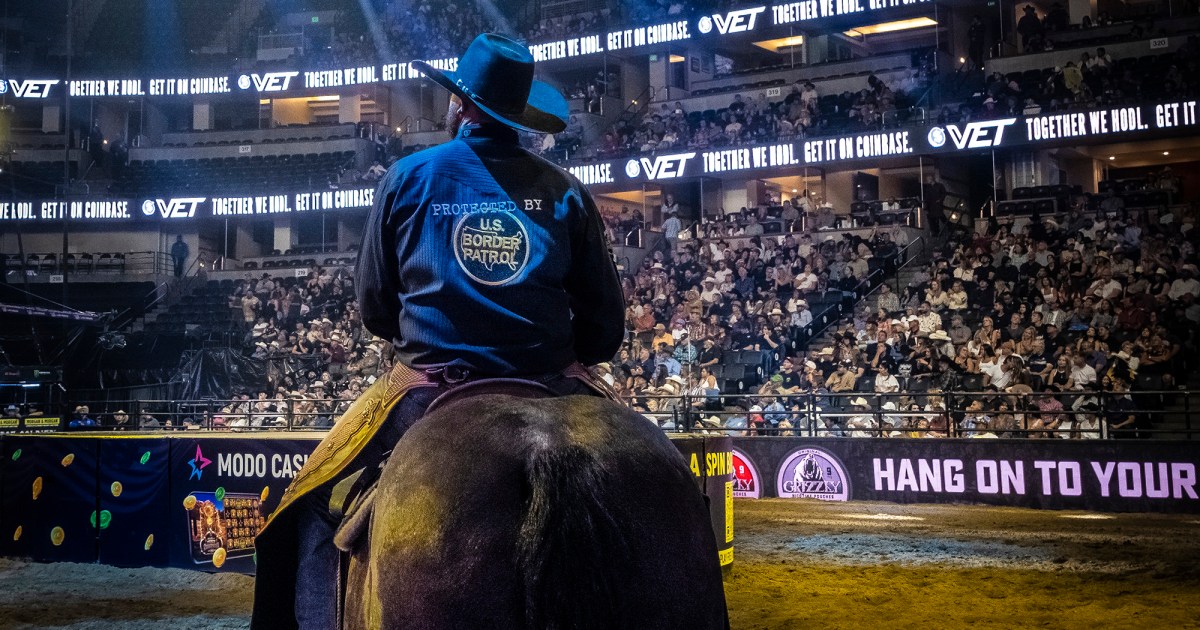
At PBR league events, bullfighters are branded with slick jerseys declaring the event “Protected by US Border Patrol.” Pickup men—mounted riders who corral the bull once it’s thrown its rider—sport Border Patrol ads on their shirts and leather chaps. At some events, the Border Patrol makes a dramatic entrance, rappelling from the rafters into the arena as the national anthem plays. Often, a recruiting booth is positioned outside the event, with pencils and drink koozies, ready to “target specific applicants who fit Border Patrol’s applicant profile,” according to a 2024 CBP hiring report.
“They sponsor this? Fuck them. No, really. Fuck them—I mean it. And you can quote me on that.”
“I think they target rodeos because they are looking for young men with a high probability of being masculine and patriotic,” one vender says. “Lots of young, rough men attend these rodeos.”


Andrew Giangola, the Vice President of Strategic Communications at PBR, says their rodeo events “attract fans who often value service, discipline, and patriotism—traits that align closely with the mission and culture of the Border Patrol.” He notes that the rodeo fans are “more likely to be receptive to careers in law enforcement or the military.”
Soon, the existing hiring program could see exponential growth. This year, Trump’s One Big Beautiful Bill Act earmarked billions in funding for US Immigration and Customs Enforcement and CBP expansion with perks and bonuses to attract new personnel. Current incentives for new Border Patrol agents include a $20,000 payout for new hires, with $10,000 paid after training and $10,000 payable after three years of service. Those posted in what are described as “prioritized locations,” such as Presidio, Texas, and Ajo, Arizona, can receive an additional $10,000. Trump’s bill continues these bonuses for an additional 3,000 new Border Patrol hires.
At the Palomino Fest rodeo in Uvalde, young men can see the appeal. “If college didn’t work out, I would do it,” says Daniel, 18, who is starting his freshman year at the University of Texas at San Antonio. Jayanjru, 18, tells me he thinks CBP recruiters are looking for people with toughness and bravery. “I would do it,” he says, adding, “I would have fun doing it, too.”

CBP’s in-person recruitment extends far beyond rodeos. The agency has booths at colleges, job fairs, and other athletic competitions. A 2024 hiring report states that officials choose recruiting locations to target “optimal candidates,” including places with a focus on physical fitness: CrossFit gyms, Spartan Races, and Tough Mudder events. During the latter, Border Patrol logos occasionally appear throughout the obstacle course, and recruiters are ready to make their pitch to interested athletes.


At a September 6 Tough Mudder race in Big Bear, California, when I told participants about this, they appeared to be surprised by the collaboration. “They sponsor this?” asks Genesis, taking a break mid-race, “that’s kinda…weird.”
Another racer, Jacob, tells me it’s frustrating. “No, I didn’t know. My parents are immigrants, my girlfriend is an immigrant,” he says. “If we just improved the [immigration] process, we wouldn’t need to recruit more agents.” One man, Sergio, is more blunt: “They sponsor this? Fuck them. No, really. Fuck them—I mean it. And you can quote me on that.”
But for some racers, the recruiting effort makes perfect sense. “I think it’s great,” says Delaney, who is in training as a first responder. “I love it.”
Employees of the race noted that even though the Border Patrol is a regular presence at Tough Mudder, the logos and recruiting booths had been absent from the last few events. “I think they read the room,” says one worker who wished to remain anonymous. “ICE is giving them a bad name.”


Literature and websites for the Department of Homeland Security state emphatically that ICE and the Border Patrol are two distinct agencies. By definition, CBP’s jurisdiction is at ports of entry and the border. ICE primarily operates in the US interior. But there has been a blurring of lines under the previous and current Trump administrations. In early 2020, ICE acknowledged that it used CBP agents in raids and removal operations to address “challenges stemming from sanctuary city policies.”
On August 14, armed agents in Border Patrol uniforms swarmed the location of a press conference for California Gov. Gavin Newsom in what many believe to be a brazen show of force. The agents apprehended a single fruit vendor, who was later released.
Just 30 miles south of Los Angeles in Anaheim, I attended a PBR league rodeo to ask Southern Californians how they felt about the CBP collaboration. Here, Border Patrol branding is featured on costumes and in glowing LED advertising on the arena floor, alongside Lucas Oil and Camping World.
But its recruiting tactics worried some locals.
“I think it’s tacky; it’s weird to have something like this in Anaheim,” said Ashley, an Orange County native. “It’s giving big-brother vibes.”
“That’s so fucking lame,” said Xavier, an LA resident, looking at the Border Patrol-branded bullfighter on my phone. “Every person in that arena knows someone affected by the raids.”
Badenoch blasts 'moaning' female Labour MPs over Burnham jobs 'quota'

Kemi Badenoch has told Labour women to earn a job in Andy Burnham's Cabinet instead of demanding they are handed jobs because of their gender.
The Tory leader lashed out today amid reports that female MPs are demanding the de-facto new prime minister introduce a 50:50 gender split 'quota' in his government.
Amid reports that former foreign secretary David Miliband is being lined up to return to the role, possibly with his brother Ed as Chancellor, one female minister also complained that Burnham could not have 'more Milibands than women' in the top posts.
But in a scathing article in the Times today Mrs Badenoch told them to 'stop moaning' and get chosen on merit instead of retreating into 'more of the failed identity politics that is holding back our country'.
'There are many, many reasons why you shouldn't have any Milibands in the cabinet,' she said.
'But complaining that the boys haven't given them the right jobs or that the boys are taking all the jobs, just shows that Labour's women still don't get it.'
The idea of quotas was also attacked by Baroness Jacqui Smith, Labour's Skills Minister.
Asked by Times Radio if Mr Burnham should reserve jobs for women, she said: 'No, I think what Andy Burnham should be doing is building the very best team around him to change this country.'

A letter written by the Women's Parliamentary Labour Party has called on Mr Burnham to ensure a 50:50 split between men and women in government jobs

Amid reports that former foreign secretary David Miliband (above, right, in 2010) is being lined up to return to the role, possibly with his brother Ed as Chancellor, one female minister complained that Burnham could not have 'more Milibands than women' in the top posts

But Mrs Badenoch told them to pipe down and get chosen on merit instead of retreating into 'more of the failed identity politics that is holding back our country'
A letter written by the Women's Parliamentary Labour Party and seen by the BBC has called on Mr Burnham to ensure a 50:50 split between men and women in government jobs after he succeeds Sir Keir Starmer.
'We are asking you to demonstrate this change from day one and address the toxicity and misogyny within our own party and government,' it said.
Labour has never had a female leader, while the Conservatives have had three, and Mrs Badenoch urged the government to follow its meritocratic example.
'If you run a meritocracy, then you do not have to worry about jobs for the boys,' she wrote.
'Every woman who is a Conservative MP, every woman who has ever won the leadership, has had to fight to get where she is.
'By contrast, Labour women are demanding guarantees from Burnham. But the truth is he doesn't have to give any guarantees.
'If none of Labour's women are prepared to get their hands dirty and challenge him for the leadership, their demands are toothless.'
'In fact, it's quite revealing that the women's parliamentary Labour Party has written to Burnham asking him to commit himself to at least 50 per cent female ministers.
'This has nothing to do with meritocracy. It is yet more of the failed identity politics that is holding back our country.'