Hegseth Orders Review Of US Force Posture In Europe, Warns NATO Laggards Of Consequences


Authored by Tom Ozimek via The Epoch Times,
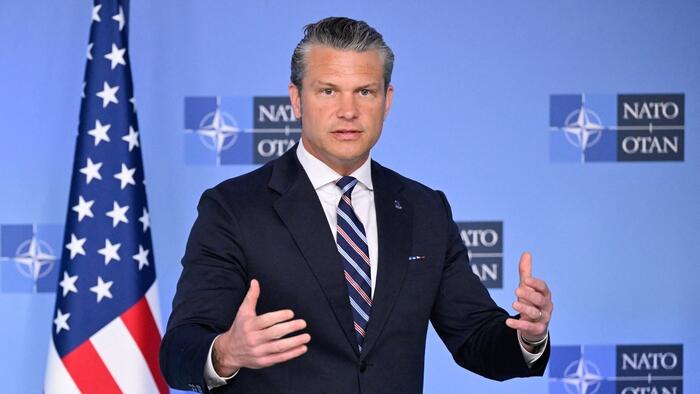
U.S. Secretary of War Pete Hegseth on June 18 announced a six-month review of U.S. force posture and basing in Europe, warning that NATO allies failing to meet defense spending commitments could face consequences as Washington pushes the alliance toward what he called a new era of burden-sharing.

Speaking at a meeting of NATO defense ministers in Brussels, Hegseth said the review would examine America’s military footprint in Europe and help ensure that European allies assume primary responsibility for the continent’s conventional defense.
“I’m announcing today a six-month Department of War review that will examine America’s force posture and basing in Europe,” Hegseth said.
The review comes as the Trump administration is pushing NATO members to increase defense spending and take over capabilities long provided by the United States.
Earlier this month, NATO officials disclosed that the United States would no longer assign certain capabilities—including an aircraft carrier strike group, support ships, aerial refueling aircraft, and dozens of combat aircraft—to NATO crisis-response plans.
The Trump administration has said that the United States must preserve greater military flexibility as it prepares for the possibility of simultaneous conflicts, particularly in the Indo-Pacific region.
Hegseth described the U.S. force posture review as part of a broader transformation of the alliance into “NATO 3.0,” a return to what he characterized as NATO’s original mission as a hard-edged military alliance focused on deterrence and warfighting.
“It will be designed to ensure that NATO is moving fast and irreversibly toward Europe leading, stepping up to take primary responsibility for the defense of Europe, stepping up to ensure our forces are postured for America’s global needs,” Hegseth said.
Although Hegseth did not question the U.S. commitment to NATO’s Article 5 collective defense clause, he indicated that allies failing to meet spending targets could see reductions in U.S. contributions.
“Going forward, our annual NATO dues will be contingent on other countries meeting their defense spending targets,” he said. ”Where other allies do not spend with urgency, our dues contributions will go down. ... It’s a review that some countries will fail and others will pass with flying colors.”
NATO 3.0
Hegseth sharply criticized what he described as decades of underinvestment by European allies.
“For too long, NATO has been a paper tiger and a one-way street,” he said. “No more.”
He argued that after the Cold War, NATO drifted away from its core military mission and toward issues unrelated to deterrence and defense. He described an era in which the alliance had lost its way by focusing on “gender equity and climate change and defense austerity.”
Instead, he said, the alliance must return to being “a real military alliance that’s focused on hard power and real deterrence.”
Hegseth said European allies had made progress in boosting military spending, citing NATO’s new benchmark of spending 5 percent of gross domestic product on defense and related investments.
He also highlighted planned increases in U.S. defense spending, saying that U.S. President Donald Trump had committed to defense budgets exceeding $1 trillion in 2026 and $1.5 trillion in 2027.
“We will lead and exceed our own NATO spending standards,” Hegseth said.
US Contributions Already Cut
The review comes weeks after Washington informed allies that it would reduce certain contributions to NATO’s force model, a planning framework that assigns military capabilities to respond to crises and defend alliance territory.
“In May, the Department of War told allies that we’re reducing our contributions to the NATO force model,” Hegseth said, noting that some allies had already begun stepping in to fill the gaps.

NATO Secretary-General Mark Rutte holds a news conference ahead of a defense ministers' meeting at the alliance's headquarters in Brussels on June 17, 2026. Yves Herman/Reuters
NATO Secretary-General Mark Rutte confirmed on June 18 that those reductions have already taken effect.
“The question yesterday came up: Is this immediate or not?” Rutte told reporters before the ministerial meeting. “It is immediate.”
Rutte clarified that the changes relate to NATO planning assumptions rather than actual wartime commitments.
“Why I’m a little bit reluctant to say this is because it is a planning tool,” he said. “So what would happen in reality? If war would break out ... all allies, including the U.S., will max out what they can do to make sure we can fight the war.”
Despite the changes to force planning, NATO officials said that the alliance’s nuclear deterrence posture remains intact.
In a statement following a June 18 meeting of NATO’s nuclear planning group, allies reaffirmed that they maintain a “safe, secure, effective, and credible nuclear posture to preserve peace, prevent coercion and deter aggression.”
They described the alliance’s strategic nuclear forces as the “supreme guarantee of Allied security” that underpins NATO’s deterrence architecture.
Badenoch blasts 'moaning' female Labour MPs over Burnham jobs 'quota'

Kemi Badenoch has told Labour women to earn a job in Andy Burnham's Cabinet instead of demanding they are handed jobs because of their gender.
The Tory leader lashed out today amid reports that female MPs are demanding the de-facto new prime minister introduce a 50:50 gender split 'quota' in his government.
Amid reports that former foreign secretary David Miliband is being lined up to return to the role, possibly with his brother Ed as Chancellor, one female minister also complained that Burnham could not have 'more Milibands than women' in the top posts.
But in a scathing article in the Times today Mrs Badenoch told them to 'stop moaning' and get chosen on merit instead of retreating into 'more of the failed identity politics that is holding back our country'.
'There are many, many reasons why you shouldn't have any Milibands in the cabinet,' she said.
'But complaining that the boys haven't given them the right jobs or that the boys are taking all the jobs, just shows that Labour's women still don't get it.'
The idea of quotas was also attacked by Baroness Jacqui Smith, Labour's Skills Minister.
Asked by Times Radio if Mr Burnham should reserve jobs for women, she said: 'No, I think what Andy Burnham should be doing is building the very best team around him to change this country.'

A letter written by the Women's Parliamentary Labour Party has called on Mr Burnham to ensure a 50:50 split between men and women in government jobs

Amid reports that former foreign secretary David Miliband (above, right, in 2010) is being lined up to return to the role, possibly with his brother Ed as Chancellor, one female minister complained that Burnham could not have 'more Milibands than women' in the top posts

But Mrs Badenoch told them to pipe down and get chosen on merit instead of retreating into 'more of the failed identity politics that is holding back our country'
A letter written by the Women's Parliamentary Labour Party and seen by the BBC has called on Mr Burnham to ensure a 50:50 split between men and women in government jobs after he succeeds Sir Keir Starmer.
'We are asking you to demonstrate this change from day one and address the toxicity and misogyny within our own party and government,' it said.
Labour has never had a female leader, while the Conservatives have had three, and Mrs Badenoch urged the government to follow its meritocratic example.
'If you run a meritocracy, then you do not have to worry about jobs for the boys,' she wrote.
'Every woman who is a Conservative MP, every woman who has ever won the leadership, has had to fight to get where she is.
'By contrast, Labour women are demanding guarantees from Burnham. But the truth is he doesn't have to give any guarantees.
'If none of Labour's women are prepared to get their hands dirty and challenge him for the leadership, their demands are toothless.'
'In fact, it's quite revealing that the women's parliamentary Labour Party has written to Burnham asking him to commit himself to at least 50 per cent female ministers.
'This has nothing to do with meritocracy. It is yet more of the failed identity politics that is holding back our country.'