Hegseth appears out of step in criticisms of NATO allies
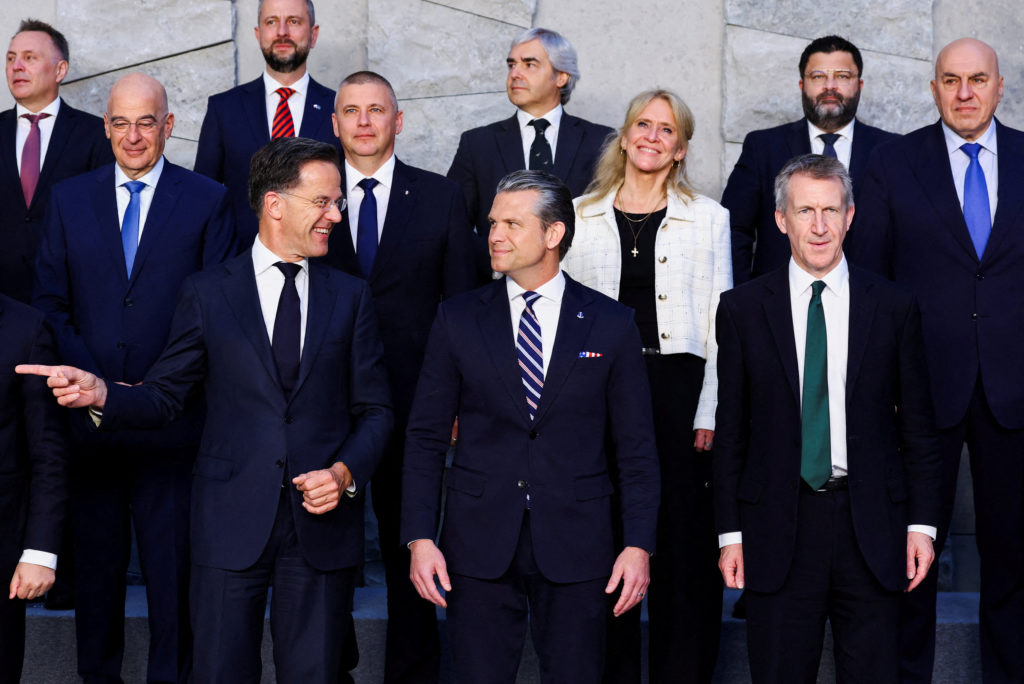
BRUSSELS (AP) — Hours after U.S. Defense Secretary Pete Hegseth upbraided his NATO allies and announced a Pentagon review of their performance, the leaders of many European nations were assessing a check list of progress made on security priorities.
In essence, Hegseth was telling the Europeans things they already know.
The list included their hike in defense spending, investment in industry to boost the production of military equipment, best use of lessons learned from the war in Ukraine, and the need to buy or develop drones, air defense systems and long-range weapons.
Educate your inbox
Subscribe to Here’s the Deal, our politics newsletter for analysis you won’t find anywhere else.
At a summit ending Friday, they mulled how to put joint European Union funding to best use and cut red tape to speed purchases, weighed the state of "military mobility" to speed the deployment of troops and equipment, and upgrade ports and airports.
"Europe's defense readiness must be decisively ramped up by 2030," they reaffirmed. The list was not new, rather something they have developed since Russia's full-scale invasion of Ukraine in 2022.
Intelligence agencies have warned that Russian President Vladimir Putin could order an attack elsewhere in Europe before the end of the decade, especially if he defeats Ukraine. Already they accuse Russia of acts of sabotage and misinformation across Europe.
About two-thirds of EU member countries also stand in NATO's ranks, and the added unpredictability of the Trump administration has only girded them to forge ahead alone. Hegseth's Pentagon review was just the latest surprise.
Pentagon chief blasts US allies
Hegseth does not attend many NATO meetings, and he left Thursday's gathering of defense ministers early. But his first major speech to the allies in February 2025 and his follow-up this week were memorable.
On Thursday he berated NATO as a "paper-tiger," said allies had been "shameful" and that "too many failed" a test put to them by President Donald Trump when he sought use of their bases in Europe to launch attacks on Iran.
He even took a shot at their focus on "gender equity and climate change" and slammed their migration policies.
Hegseth then gave them six months to shape up for a Pentagon performance review that tied the presence of U.S. forces in Europe and American investment in NATO to whether he believes they are pulling their weight.
"It's protection racket framing that undermines NATO solidarity, trust in the U.S. commitment to NATO, and, ultimately, U.S. security interests," said Rachel Ellehuus, Director-General of the Royal United Services Institute think-tank.
Terms of the review are unknown
What the review really involves is not clear.
"It will be designed to ensure that NATO is moving fast and irreversibly toward Europe leading, stepping up to take primary responsibility for the defense of Europe," Hegseth said. "Some countries will fail and others will pass with flying colors."
It might last "up to six months, could be less," he said, and involve U.S. military commanders, members of Congress and the allies themselves.
He said that U.S. payments into a joint NATO budget that runs its headquarters and other facilities will depend on how they're doing. "Where other allies do not spend with urgency, our dues contributions will go down," Hegseth said.
Talking to reporters at Brussels airport before flying out, he said it would also address "where is the right place for basing. Where can we make sure we have access and overflight when we need it, so that America is properly postured on the continent."
NATO played no active role in the Iran war, but did shield alliance territory from possible attack.
NATO Secretary-General Mark Rutte could shed no light on what Hegseth's review might entail.
"There's still no clarity on exactly what the outcome will be, because that will depend on the review. So, we'll see what happens," Rutte said, adding that: "Wherever we can be helpful, we will be helpful." Rutte might learn more when he travels to Washington next week.
The numbers show U.S. allies doing quite well
As far as Rutte's concerned, European allies and Canada are doing well, although they could always do more.
"What we are seeing is staggering amounts of money coming in," he told reporters. "Europe and Canada are spending in 2025 more than $90 billion extra compared to 2024, which is almost a 20% increase in defense spending."
The extra money must now be converted into more military equipment, weapons and ammunition.
At their summit last year, the allies agreed to boost their military budgets to match that of the United States in terms of gross domestic product. Trump left the meeting a happy man, calling his NATO counterparts a "nice group of people." But the review does not augur well for their next summit in Turkey on July 7-8.
Still, top European military officers now hold more command roles at NATO, and U.S. allies have taken charge of funneling arms and money into Ukraine as the Trump administration has stepped back.
Some Europeans and Canada are also spending billions to buy vital air defense systems from the United States that they donate to Ukraine, whose war with Russia they see as an existential threat to Europe.
Indeed, it's hard to see what more could be done, and faster, except perhaps to provide unfettered access to their airspace and bases on their territory for America to wage its wars elsewhere.
Ellehuus, a former top U.S. advisor at NATO, said that force positioning "should be driven by detailed threat assessments, operational requirements, and military planning – not used as a form of reward, punishment or revenge."
"Such framing undermines allies while they're actively trying to solve the problem and telegraphs to adversaries that U.S. security commitments have a price tag," she said.
Support trusted journalism and civil dialogue.
Badenoch blasts 'moaning' female Labour MPs over Burnham jobs 'quota'

Kemi Badenoch has told Labour women to earn a job in Andy Burnham's Cabinet instead of demanding they are handed jobs because of their gender.
The Tory leader lashed out today amid reports that female MPs are demanding the de-facto new prime minister introduce a 50:50 gender split 'quota' in his government.
Amid reports that former foreign secretary David Miliband is being lined up to return to the role, possibly with his brother Ed as Chancellor, one female minister also complained that Burnham could not have 'more Milibands than women' in the top posts.
But in a scathing article in the Times today Mrs Badenoch told them to 'stop moaning' and get chosen on merit instead of retreating into 'more of the failed identity politics that is holding back our country'.
'There are many, many reasons why you shouldn't have any Milibands in the cabinet,' she said.
'But complaining that the boys haven't given them the right jobs or that the boys are taking all the jobs, just shows that Labour's women still don't get it.'
The idea of quotas was also attacked by Baroness Jacqui Smith, Labour's Skills Minister.
Asked by Times Radio if Mr Burnham should reserve jobs for women, she said: 'No, I think what Andy Burnham should be doing is building the very best team around him to change this country.'

A letter written by the Women's Parliamentary Labour Party has called on Mr Burnham to ensure a 50:50 split between men and women in government jobs

Amid reports that former foreign secretary David Miliband (above, right, in 2010) is being lined up to return to the role, possibly with his brother Ed as Chancellor, one female minister complained that Burnham could not have 'more Milibands than women' in the top posts

But Mrs Badenoch told them to pipe down and get chosen on merit instead of retreating into 'more of the failed identity politics that is holding back our country'
A letter written by the Women's Parliamentary Labour Party and seen by the BBC has called on Mr Burnham to ensure a 50:50 split between men and women in government jobs after he succeeds Sir Keir Starmer.
'We are asking you to demonstrate this change from day one and address the toxicity and misogyny within our own party and government,' it said.
Labour has never had a female leader, while the Conservatives have had three, and Mrs Badenoch urged the government to follow its meritocratic example.
'If you run a meritocracy, then you do not have to worry about jobs for the boys,' she wrote.
'Every woman who is a Conservative MP, every woman who has ever won the leadership, has had to fight to get where she is.
'By contrast, Labour women are demanding guarantees from Burnham. But the truth is he doesn't have to give any guarantees.
'If none of Labour's women are prepared to get their hands dirty and challenge him for the leadership, their demands are toothless.'
'In fact, it's quite revealing that the women's parliamentary Labour Party has written to Burnham asking him to commit himself to at least 50 per cent female ministers.
'This has nothing to do with meritocracy. It is yet more of the failed identity politics that is holding back our country.'