China's Refiners Slash Runs To Lowest Since 2017, As Asia Refiners Slow Purchases Of Mid-East Oil
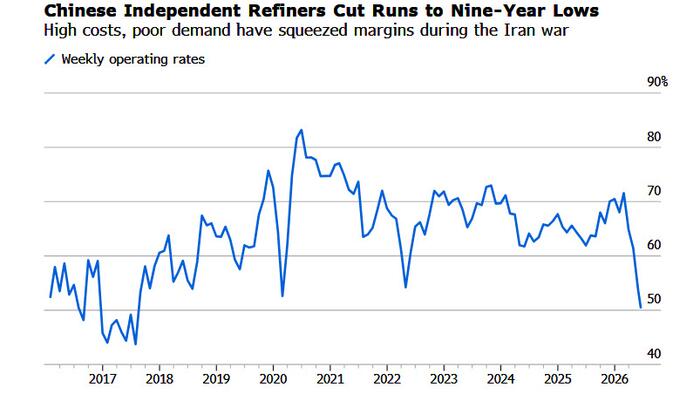


A little over a month ago, we explained that energy traders are "Traders Puzzled As Physical Oil Prices Tumble Amid Surging Chinese Crude Sales, Plunging Imports", and highlighted how already razor-thin independent refiner (teapot) margins had plunged to record negative as a result of the war in Iran and government policies meant to keep prices from rising.

Fast forward to today when the previously discussed dynamics have gotten progressively worse, and this morning Bloomnberg writes that China’s independent oil refiners have slashed operating rates to a nine-year lo.
Run rates at so-called teapots fell to 50.5% in the week to June 21, dropping below pandemic-era lows to the weakest since 2017, according to consultant JLC. High feedstock costs, weak domestic fuel demand, and curbs on product exports have squeezed processors’ margins, prompting them to scale back.

As we noted previously, China - the world’s largest oil importer - sharply reduced crude imports after the conflict erupted in late February as prices initially spiked, sending oil imports to a 9 year low, a key reason why oil prices did not spike even higher in the past few months.

As Bloomberg notes, the nation’s sustained slowdown in flows has brought into focus a nationwide shift away from fossil fuels that’s been driven by greater electrification.
The teapots’ downturn in run rates comes as Iran is now seeking to revive crude exports under a temporary US sanctions waiver. Still, the weak refining economics could limit any near-term rebound in their purchases.
“Teapots are not short of feedstocks, with private-sector commercial inventories in Shandong still above 2025 highs,” said Emma Li, lead China market analyst at Vortexa Ltd., referring to the coastal province where many teapots are located.
Teapot run rates slid further in the second half of June, which means July “could represent a trough before utilization begins to recover,” she said.
In a separate report, Bloomberg also notes that Asian refiners have slowed purchases of Middle Eastern crude after a buying spree over the past three weeks, with oil majors and traders stepping in to take some of the surplus barrels.
Purchases from Abu Dhabi National Oil Co (ADNOC) eased after three rounds of tenders, with a fourth that closes this week set to show a similar pattern, Bloomberg reported citing traders familiar with the matter. More barrels were snapped up by majors and trading houses including Shell and Mercuria.
Adnoc sold around 60 million barrels that will load over June to August across its first three tenders, most of which will flow to Asia. The offers are for grades that are loaded within the Persian Gulf, although buyers will be able to take cargoes via a ship-to-ship transfer outside of the Strait of Hormuz.
Some of the barrels being sold in the latest Adnoc tender are expected to flow toward Europe, said energy traders. That would follow a recent trend, which saw a wave of Middle Eastern oil heading in that direction as China stepped back.
Most refiners have already completed their orders for this month and next, and available crude would need to be significantly discounted to prompt any more buying, traders said. Adnoc has also asked customers with long-term contracts to immediately resume loading supplies, crimping spot demand.
Iraq and Kuwait have also been ramping up output as producers position for a reopening of Hormuz, with talks over a lasting agreement to end the Iran war showing some progress. That’s led to prices for Middle Eastern oil tumbling, with the forward curve of two of the region’s main benchmark grades — Dubai and Murban — now in a bearish contango structure.
A temporary US waiver allowing purchases of Iranian oil has added to swelling supply options, although complications surrounding the financing and insurance of cargoes remain and could be too risky for some refiners. Still, as we reported earlier this week, "Iran Oil Exports Through Hormuz Hit Wartime High,"
Some in the market are assessing whether storing crude could be an option for the impending wave of supply. Traders said freight costs remain too expensive for floating storage to be effective...

... but countries with sites on land should be able to easily accommodate surplus barrels.
Badenoch blasts 'moaning' female Labour MPs over Burnham jobs 'quota'

Kemi Badenoch has told Labour women to earn a job in Andy Burnham's Cabinet instead of demanding they are handed jobs because of their gender.
The Tory leader lashed out today amid reports that female MPs are demanding the de-facto new prime minister introduce a 50:50 gender split 'quota' in his government.
Amid reports that former foreign secretary David Miliband is being lined up to return to the role, possibly with his brother Ed as Chancellor, one female minister also complained that Burnham could not have 'more Milibands than women' in the top posts.
But in a scathing article in the Times today Mrs Badenoch told them to 'stop moaning' and get chosen on merit instead of retreating into 'more of the failed identity politics that is holding back our country'.
'There are many, many reasons why you shouldn't have any Milibands in the cabinet,' she said.
'But complaining that the boys haven't given them the right jobs or that the boys are taking all the jobs, just shows that Labour's women still don't get it.'
The idea of quotas was also attacked by Baroness Jacqui Smith, Labour's Skills Minister.
Asked by Times Radio if Mr Burnham should reserve jobs for women, she said: 'No, I think what Andy Burnham should be doing is building the very best team around him to change this country.'

A letter written by the Women's Parliamentary Labour Party has called on Mr Burnham to ensure a 50:50 split between men and women in government jobs

Amid reports that former foreign secretary David Miliband (above, right, in 2010) is being lined up to return to the role, possibly with his brother Ed as Chancellor, one female minister complained that Burnham could not have 'more Milibands than women' in the top posts

But Mrs Badenoch told them to pipe down and get chosen on merit instead of retreating into 'more of the failed identity politics that is holding back our country'
A letter written by the Women's Parliamentary Labour Party and seen by the BBC has called on Mr Burnham to ensure a 50:50 split between men and women in government jobs after he succeeds Sir Keir Starmer.
'We are asking you to demonstrate this change from day one and address the toxicity and misogyny within our own party and government,' it said.
Labour has never had a female leader, while the Conservatives have had three, and Mrs Badenoch urged the government to follow its meritocratic example.
'If you run a meritocracy, then you do not have to worry about jobs for the boys,' she wrote.
'Every woman who is a Conservative MP, every woman who has ever won the leadership, has had to fight to get where she is.
'By contrast, Labour women are demanding guarantees from Burnham. But the truth is he doesn't have to give any guarantees.
'If none of Labour's women are prepared to get their hands dirty and challenge him for the leadership, their demands are toothless.'
'In fact, it's quite revealing that the women's parliamentary Labour Party has written to Burnham asking him to commit himself to at least 50 per cent female ministers.
'This has nothing to do with meritocracy. It is yet more of the failed identity politics that is holding back our country.'