Breitbart Business Digest: China Pukes on Merz's Plaza Accord Proposal
Breitbart Business Digest: China Pukes on Merz’s Plaza Accord Proposal
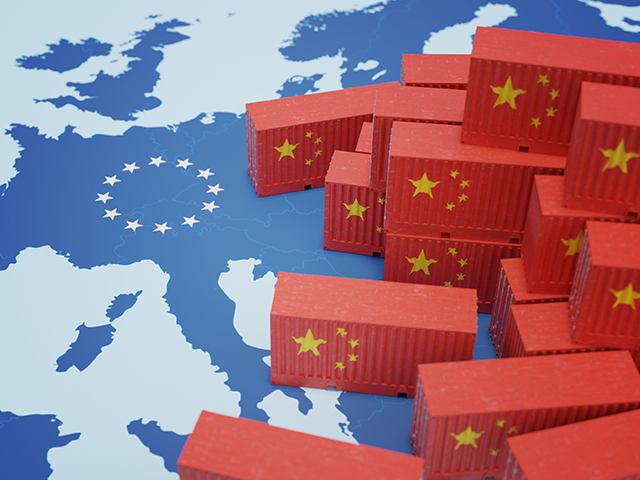

Europe Struggles to Get Out from the Flood of Chinese Goods
Europe is quickly learning that China has no interest in addressing unsustainable trade imbalances. Far from it. China produces its trade imbalances intentionally and treats any effective attempts to ameliorate them as acts of economic aggression.
Over the past five years, China’s exports to the Europe have exploded, rising 45 percent. Europe’s goods trade deficit soared from 291 billion euros in 2023 to around 360 billion euros in 2025. The reason for this is well-known. As the U.S. has sought to reduce our trade deficit with China by raising tariffs, China has sought to use Europe as a substitute buyer for its exports.
This is not going over well with Europe. Its politically powerful manufacturers understand surging imports are a mortal threat. They know full well what the “China shock” did to American manufacturing and to entire regions in the U.S. that were once global manufacturing leaders. And since European Union rules constrain deficit spending by national governments, Europe has less flexibility to respond to trade imbalances by expanding the fiscal deficit. So the Europeans are trying to figure out how to respond to China.
Europe is not totally blameless for the current plight. Years of criticism of President Trump’s tariffs from European economic leaders make levying tariffs politically difficult. Europe’s fanatical pursuit of reducing local carbon emissions and energy extraction—preferring, apparently, that distant rather than local emissions and energy extraction contribute to climate change—has damaged its industrial capacity and competitiveness. And its unwillingness to seriously limit international migrants has sapped the idea that Europe has an identity worth defending.
There Is No Third Way to Rebalance Trade with China
So Europe is trying to find a “third way” to respond to Chinese mercantilism. One proposal involves requiring import diversity in the name of “derisking” supply chains. The most moderate position, the one the “responsible” globalists in Europe are gathering around, sees the yuan’s exchange rate with the euro as a major factor in the surge. An undervalued yuan makes China’s products cheaper in Europe and Europe’s pricier in China, leading to surging imports in Europe and a gaping trade deficit. Addressing currency valuations is attractive because it seems less “protectionist” to many policymakers than import duties.
Recently, German Chancellor Friedrich Merz appeared to back this position, pointing to the 1985 Plaza Accord as a historical example of how trade imbalances could be addressed through an agreement on currency valuations. Under the Plaza Accord, finance ministers and heads of central banks of the United States, Japan, West Germany, Britain, and France agreed to intervene in currency markets to reduce the value of the dollar and raise the value of the yen.
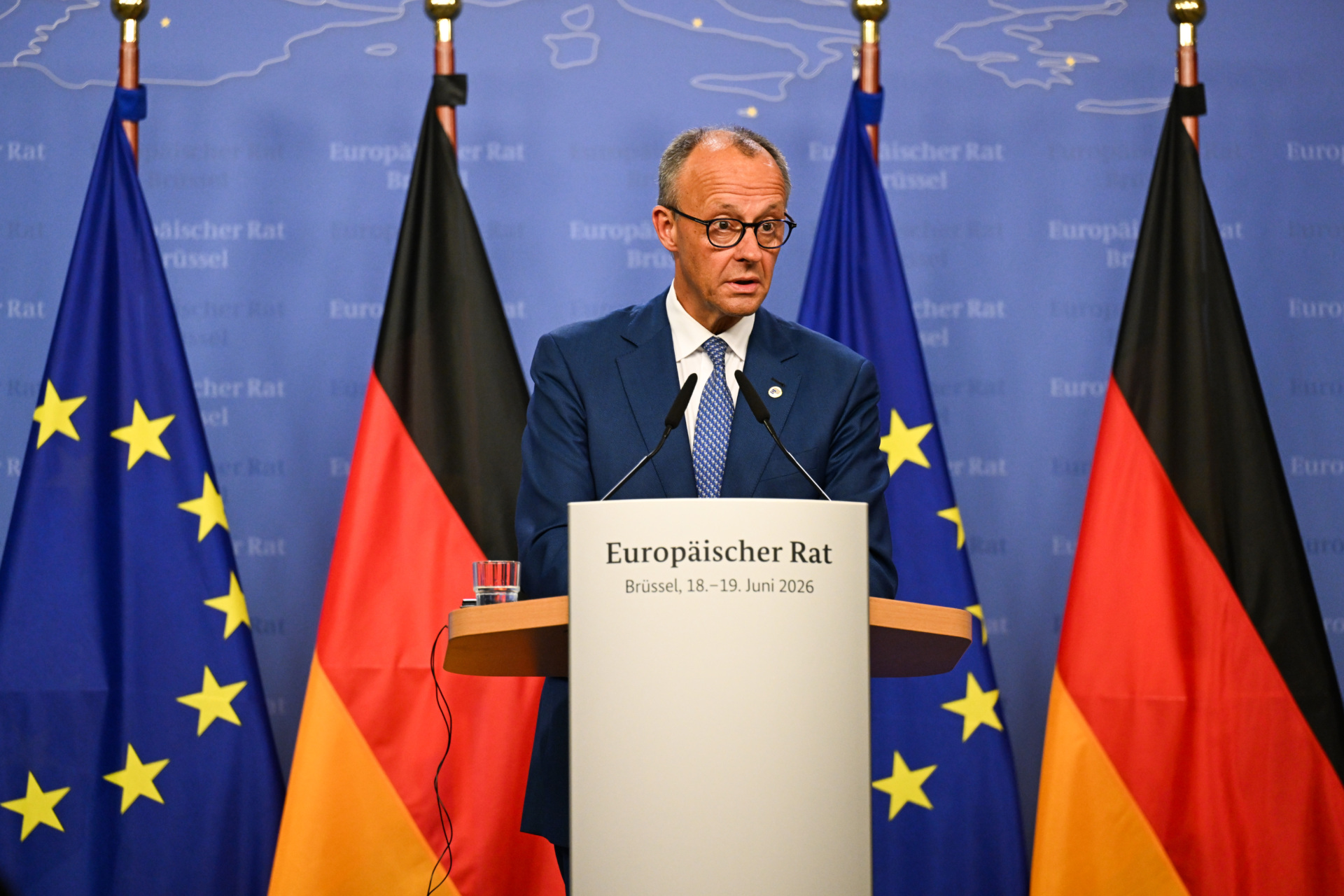
German Chancellor Friedrich Merz speaks at a news conference following a European Council meeting in Brussels, Belgium, on June 19, 2026. European Union leaders sought to strike a balance between addressing deepening trade imbalances with China while not provoking a damaging conflict with China. (Wiktor Dabkowski/Bloomberg via Getty Images)
This is more wishful thinking than a strategy. At the currency level, the Plaza Accord worked even better than planned: the dollar fell from around 242 yen to 150 yen the following year. On trade imbalances, however, the effect was more muted and delayed: the U.S. trade deficit with Japan expanded for the first few years, contracted for a few, but then started growing again. At best, it’s likely the Plaza Accord slowed the growth of the trade deficit with Japan. What’s more, one of the big drivers of the Plaza Accord was the Cold War. The five countries that participated were united in their efforts to stave off global communism. There’s no similar threat for China and the EU to respond to.
Yet even this was too much for the mouthpiece for China’s communist party, the Global Times newspaper. This is from a recent editorial in the Global Times:
Following the recent EU summit, German Chancellor Friedrich Merz stirred controversy over the renminbi exchange rate, claiming that the currency was undervalued by as much as 30 percent and citing the 1985 “Plaza Accord” – which plunged Japan into its “lost decades” – as a solution…
The call to repeat the “Plaza Accord” is, in essence, not an economic solution but a form of political pressure. After the US reached the “Plaza Accord” with its major trading partners in 1985, the yen appreciated significantly, the economy fell into a prolonged recession, and the dollar depreciated sharply; yet this did not resolve the US trade imbalance…
China will not accept using exchange rates as a pretext for oppression, nor will it return to the old era of great powers coordinating the fate of a few countries. Today’s China is not the Japan of the past; the scale of China’s economy, the depth of its market, the integrity of its industries, and its policy autonomy are all on a different level.
Note that almost no respectable economists outside of China believe that the Plaza Accord plunged Japan into its “lost decades” of slow growth. There is a body of work that holds that Japan’s excessive fiscal and monetary response to the Plaza Accord inflated a financial bubble in equities and real estate and that the subsequent efforts to keep bad banks and uncompetitive companies afloat led to prolonged stagnation. This is decidedly a minority view among U.S. economists. The mainstream view assigns a much smaller role to the Plaza Accord and a larger role to the particular combination of excessive stimulus, financial deregulation, leverage, weak bank capital, regulatory forbearance, zombie lending, and premature tightening of monetary policy moves later in the 1990s.
But that’s largely beside the point because the Global Times response tells us how China’s ruling communist party sees the Plaza Accord. And that is first that it was a “pretext for oppression” and second that it crippled Japan’s economy. In the view of China’s regime, the “moderate” position of currency adjustment outlined by Merz and modeled on the Reagan administration’s Plaza Accord—which was at the time seen as the “third way” between the highly ideological free-traders and the much-maligned protectionists—is an act of economic imperialism.
In the end, it’s likely that Europe will discover that there’s just one way to rebalance trade with China and that is tariffs high enough to discourage imports. But the journey to that discovery will likely involve many false steps like Merz’s dream of a Sino-version of the Plaza Accord.
Badenoch blasts 'moaning' female Labour MPs over Burnham jobs 'quota'

Kemi Badenoch has told Labour women to earn a job in Andy Burnham's Cabinet instead of demanding they are handed jobs because of their gender.
The Tory leader lashed out today amid reports that female MPs are demanding the de-facto new prime minister introduce a 50:50 gender split 'quota' in his government.
Amid reports that former foreign secretary David Miliband is being lined up to return to the role, possibly with his brother Ed as Chancellor, one female minister also complained that Burnham could not have 'more Milibands than women' in the top posts.
But in a scathing article in the Times today Mrs Badenoch told them to 'stop moaning' and get chosen on merit instead of retreating into 'more of the failed identity politics that is holding back our country'.
'There are many, many reasons why you shouldn't have any Milibands in the cabinet,' she said.
'But complaining that the boys haven't given them the right jobs or that the boys are taking all the jobs, just shows that Labour's women still don't get it.'
The idea of quotas was also attacked by Baroness Jacqui Smith, Labour's Skills Minister.
Asked by Times Radio if Mr Burnham should reserve jobs for women, she said: 'No, I think what Andy Burnham should be doing is building the very best team around him to change this country.'

A letter written by the Women's Parliamentary Labour Party has called on Mr Burnham to ensure a 50:50 split between men and women in government jobs

Amid reports that former foreign secretary David Miliband (above, right, in 2010) is being lined up to return to the role, possibly with his brother Ed as Chancellor, one female minister complained that Burnham could not have 'more Milibands than women' in the top posts

But Mrs Badenoch told them to pipe down and get chosen on merit instead of retreating into 'more of the failed identity politics that is holding back our country'
A letter written by the Women's Parliamentary Labour Party and seen by the BBC has called on Mr Burnham to ensure a 50:50 split between men and women in government jobs after he succeeds Sir Keir Starmer.
'We are asking you to demonstrate this change from day one and address the toxicity and misogyny within our own party and government,' it said.
Labour has never had a female leader, while the Conservatives have had three, and Mrs Badenoch urged the government to follow its meritocratic example.
'If you run a meritocracy, then you do not have to worry about jobs for the boys,' she wrote.
'Every woman who is a Conservative MP, every woman who has ever won the leadership, has had to fight to get where she is.
'By contrast, Labour women are demanding guarantees from Burnham. But the truth is he doesn't have to give any guarantees.
'If none of Labour's women are prepared to get their hands dirty and challenge him for the leadership, their demands are toothless.'
'In fact, it's quite revealing that the women's parliamentary Labour Party has written to Burnham asking him to commit himself to at least 50 per cent female ministers.
'This has nothing to do with meritocracy. It is yet more of the failed identity politics that is holding back our country.'
Venezuela Fury and Noah Price subsidising their life by livestreaming

Venezuela Fury and her husband Noah Price look to be making their own way in the world by raking it in from their lucrative social media accounts.
The influencer daughter of Tyson and Paris Fury, 16, has become an internet sensation after tying the knot with her husband Noah, 19, earlier this year.
Since getting married and moving in together the couple have been earning thousands of pounds a month, livestreaming their life as newlyweds in their static caravan in the East Riding of Yorkshire.
And fans can't get enough of their regular life updates on TikTok and Kick, which have proved to be very profitable for the pair.
They look to be supporting themselves after Noah denied that he was given £5million by Venezuela's family as a wedding gift.
Despite his wife's huge family wealth, an estimated combined £160 million, Noah recently told his Kick followers that he 'pays for everything' for the couple.
Making light of the claims about Venezuela's millionaire financial status, Noah said: 'I actually pay for everything unfortunately. You'd expect the millionaire to pay for it wouldn't you.'

Venezuela Fury and Noah Price are earning thousands livestreaming their caravan life - after her new groom insisted he pays all the bills and denied he had £5m handout from her dad

The influencer daughter of Tyson and Paris Fury , 16, has become an internet sensation after tying the knot with her husband Noah, 19, earlier this year
Venezuela then asked their fans: 'Do you think I am a millionaire?'
Noah joked: 'She isn't a secret millionaire guys', before she broke into song and sang: 'But I live like a millionaire!'
But it seems according to estimated calculations from their social media work, Noah and Venezuela can more than afford to support themselves.
Noah has been livestreaming on platforms such as Kick and TikTok, where viewers can send paid gifts or donations.
He was previously encouraging viewers to send gifts on his honeymoon during livestreams, suggesting this is one revenue stream.
Both Noah and Venezuela have built substantial followings on Instagram and TikTok. They can potentially earn money through sponsored posts, brand collaborations, affiliate links and creator payouts.
Kick allows its creators to take home 95 per cent of the £4.99 subscription cost that fans pay.
Streamers keep 100 per cent of direct tips and donations, minus minor standard payment processing fees.
It is unclear how many subscribers Noah currently has because this information is hidden, but he does have 7,200 followers which is publicly viewable.
An industry insider has suggested Noah is making around £400 per video on TikTok, while Venezuela is likely to make £2,000 due to her following count of 1.3 million.

An industry insider has suggested Noah is making around £400 per video on TikTok, while Venezuela is likely to make £2,000 due to her following count of 1.3 million
In one video on their honeymoon, Noah asked his followers if they'd give them some more gifts now that they were married.
In a TikTok live viewed by 20,000 he said: 'Keep liking our videos people, keep sending gifts.'
After saying thank you to several of his followers he joked they should stick around on the livestream and 'watch Venezuela punch me in the mouth'.
The other half of the honeymooning couple said: 'I am, honestly!'
Noah previously confirmed that the pair don't share their finances after they were asked whether they have a shared bank account.
'She earns her money, I earn mine,' said Noah, as Venezuela joked: 'Yeah, what you gonna do about it.'
Noah went on to debunk the rumour that Tyson gave him £5million when he tied the knot with his daughter as he insisted: 'No Tyson did not give me £5million'.
Meanwhile Venezuela is being eyed up by executives for a fly on the wall TV series.

Noah went on to debunk the rumour that Tyson gave him £5million when he tied the knot with his daughter as he insisted: 'No Tyson did not give me £5million'
Boasting 1.3 million TikTok followers, Venezuela is already entertaining fans with her honest musings and candid moments, from cooking to kitting out her and Noah's static caravan home.
And following the success of the Netflix series At Home With The Furys, it is no wonder bosses are wanting to draw on the Fury popularity.
A TV insider said: 'The couple are not A-list celebrities but everyone has become obsessed with their love story.
'People are genuinely intrigued by them. Whether it’s the fact they have married so young, Venezuela’s famous family or their gypsy lifestyle, they have the ‘X factor'.
'Several TV executives think a proper fly-on-the-wall series following their lives as newlyweds in the gypsy community would be fascinating,' they told The Sun.
It is thought Netflix would be likely to produce the series due to their already established relationship with the Furys.
Venezuela's representatives told The Daily Mail: 'We have many offers on the table regarding Venezuela which we are discussing.'