Bessent: Our Strength Comes From What We Can Build
Bessent: Our Strength Comes From What We Can Build
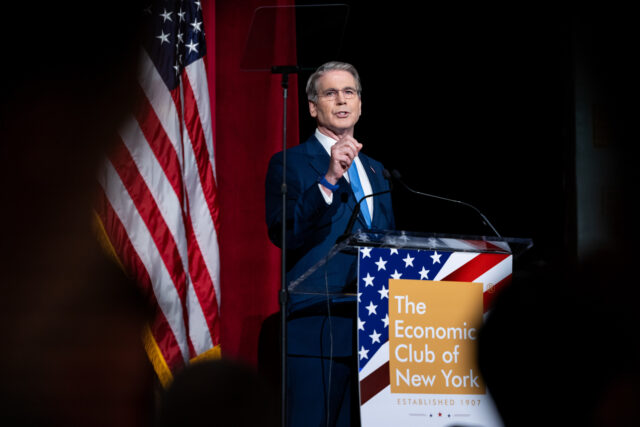

Treasury Secretary Scott Bessent on Tuesday laid out a doctrine of “economic statecraft,” telling the Economic Club of New York that the United States would wield its economic power “in service of our sovereignty” and warning that a country unable to produce what it needs “is not truly secure.”
Speaking at the club’s America 250 Gala Dinner on the eve of the nation’s 250th anniversary, Bessent organized the Trump administration’s approach around what he called five core principles, anchored by the argument that national strength begins at home with the capacity to build.
“We have rediscovered at great cost what Hamilton taught us: that every nation ‘ought to endeavor to possess within itself all the essentials of national supply,'” Bessent said, invoking the nation’s first Treasury secretary. “That our strength, in other words, is derived from what we can build, for the nation that cannot produce what it needs is not truly secure. The nation that depends on its adversaries for critical inputs is not truly sovereign. And the nation that reduces its economics to consumption is not truly prosperous.”
Bessent defined economic statecraft as “the disciplined use of America’s economic power in service of our sovereignty,” and said the most fitting way to honor the country’s founders was “to meet the most pressing challenges of our own time with the same resolve that they brought to theirs.”
The first and foundational principle, he said, is that economic security begins with national capacity — the ability to “build, invent, finance, and scale the industries that will define the next century.” He named semiconductors, artificial intelligence, quantum computing, advanced manufacturing, shipbuilding, critical minerals, and pharmaceuticals among them, calling them “not more than sectors of the economy” but “the sources of national power.”
Bessent argued that the long-dominant question in commercial and political life — “Where is the lowest cost?” — was no longer sufficient. The relevant test now, he said, is whether a supply chain can survive a crisis, withstand coercion, and continue operating through a pandemic, cyberattack, war, or financial shock without leaving the country “at the mercy of a foreign chokepoint abroad.” He stressed that resilience does not require every component to be made domestically, only that the nation know its vulnerabilities and reduce them before a crisis.
The second principle, Bessent said, is reciprocity. Access to the American market, he argued, is “no longer unconditional.” Countries “cannot seek access to our market while denying fair access to theirs,” he said, nor invite American capital while imposing discriminatory taxes, forced technology transfer, or “indigenous innovation requirements designed to favor domestic champions.”
He drew a line between legitimate regulation and discrimination, saying regulation “descends into discrimination when it targets American firms because they are American.” The United States, he said, “possesses many tools at its disposal to remedy practices that distort trade and undermine reciprocity. We will always seek to use those tools judiciously, but we will never hesitate to use them decisively.”
His third and fourth principles addressed the rules of the emerging economy and the role of financial leadership. Bessent said the next era of competition would be shaped by “the platforms, systems, and protocols through which commerce flows,” and that standards themselves had become a form of strategy. He pointed to digital assets, stablecoins, and tokenization as areas where the United States “should not consign itself to the sidelines,” and cast the dollar’s global role as both an advantage and an obligation requiring disciplined use of sanctions.
The fifth principle, which Bessent called the most important, was that economic statecraft “must serve the American people.”
“We need an economy in which our working families are not merely consumers of what the world produces, but participants in what America builds,” he said, calling for the gains of national strength to be “broadly shared beyond the boardrooms and trading floors to the families and communities who sustain it.”
America’s competitive advantage, he added, “has never been confined to the bounty of our natural resources or the depth of our capital markets,” but has “always resided in the character and the capacity of our people” — the insight he said “transformed a small republic on the edge of a continent into the most prosperous nation over the long sweep of human civilization.”
“It now falls on us to preserve that inheritance,” Bessent said, “not by seeking a smaller role in the world, but a stronger foundation for our leadership.”
The address was the third in a series in which Bessent has developed the administration’s economic doctrine, following remarks at the Economic Club of Dallas, where he described the “structural vulnerabilities” that produced a “drift into dependence,” and at the Reagan Library, where he said America had “awoken to the risks we can no longer ignore.” He closed Tuesday by describing the doctrine as one “open to the world while anchored at home.”
Badenoch blasts 'moaning' female Labour MPs over Burnham jobs 'quota'

Kemi Badenoch has told Labour women to earn a job in Andy Burnham's Cabinet instead of demanding they are handed jobs because of their gender.
The Tory leader lashed out today amid reports that female MPs are demanding the de-facto new prime minister introduce a 50:50 gender split 'quota' in his government.
Amid reports that former foreign secretary David Miliband is being lined up to return to the role, possibly with his brother Ed as Chancellor, one female minister also complained that Burnham could not have 'more Milibands than women' in the top posts.
But in a scathing article in the Times today Mrs Badenoch told them to 'stop moaning' and get chosen on merit instead of retreating into 'more of the failed identity politics that is holding back our country'.
'There are many, many reasons why you shouldn't have any Milibands in the cabinet,' she said.
'But complaining that the boys haven't given them the right jobs or that the boys are taking all the jobs, just shows that Labour's women still don't get it.'
The idea of quotas was also attacked by Baroness Jacqui Smith, Labour's Skills Minister.
Asked by Times Radio if Mr Burnham should reserve jobs for women, she said: 'No, I think what Andy Burnham should be doing is building the very best team around him to change this country.'

A letter written by the Women's Parliamentary Labour Party has called on Mr Burnham to ensure a 50:50 split between men and women in government jobs

Amid reports that former foreign secretary David Miliband (above, right, in 2010) is being lined up to return to the role, possibly with his brother Ed as Chancellor, one female minister complained that Burnham could not have 'more Milibands than women' in the top posts

But Mrs Badenoch told them to pipe down and get chosen on merit instead of retreating into 'more of the failed identity politics that is holding back our country'
A letter written by the Women's Parliamentary Labour Party and seen by the BBC has called on Mr Burnham to ensure a 50:50 split between men and women in government jobs after he succeeds Sir Keir Starmer.
'We are asking you to demonstrate this change from day one and address the toxicity and misogyny within our own party and government,' it said.
Labour has never had a female leader, while the Conservatives have had three, and Mrs Badenoch urged the government to follow its meritocratic example.
'If you run a meritocracy, then you do not have to worry about jobs for the boys,' she wrote.
'Every woman who is a Conservative MP, every woman who has ever won the leadership, has had to fight to get where she is.
'By contrast, Labour women are demanding guarantees from Burnham. But the truth is he doesn't have to give any guarantees.
'If none of Labour's women are prepared to get their hands dirty and challenge him for the leadership, their demands are toothless.'
'In fact, it's quite revealing that the women's parliamentary Labour Party has written to Burnham asking him to commit himself to at least 50 per cent female ministers.
'This has nothing to do with meritocracy. It is yet more of the failed identity politics that is holding back our country.'
Venezuela Fury and Noah Price subsidising their life by livestreaming

Venezuela Fury and her husband Noah Price look to be making their own way in the world by raking it in from their lucrative social media accounts.
The influencer daughter of Tyson and Paris Fury, 16, has become an internet sensation after tying the knot with her husband Noah, 19, earlier this year.
Since getting married and moving in together the couple have been earning thousands of pounds a month, livestreaming their life as newlyweds in their static caravan in the East Riding of Yorkshire.
And fans can't get enough of their regular life updates on TikTok and Kick, which have proved to be very profitable for the pair.
They look to be supporting themselves after Noah denied that he was given £5million by Venezuela's family as a wedding gift.
Despite his wife's huge family wealth, an estimated combined £160 million, Noah recently told his Kick followers that he 'pays for everything' for the couple.
Making light of the claims about Venezuela's millionaire financial status, Noah said: 'I actually pay for everything unfortunately. You'd expect the millionaire to pay for it wouldn't you.'

Venezuela Fury and Noah Price are earning thousands livestreaming their caravan life - after her new groom insisted he pays all the bills and denied he had £5m handout from her dad

The influencer daughter of Tyson and Paris Fury , 16, has become an internet sensation after tying the knot with her husband Noah, 19, earlier this year
Venezuela then asked their fans: 'Do you think I am a millionaire?'
Noah joked: 'She isn't a secret millionaire guys', before she broke into song and sang: 'But I live like a millionaire!'
But it seems according to estimated calculations from their social media work, Noah and Venezuela can more than afford to support themselves.
Noah has been livestreaming on platforms such as Kick and TikTok, where viewers can send paid gifts or donations.
He was previously encouraging viewers to send gifts on his honeymoon during livestreams, suggesting this is one revenue stream.
Both Noah and Venezuela have built substantial followings on Instagram and TikTok. They can potentially earn money through sponsored posts, brand collaborations, affiliate links and creator payouts.
Kick allows its creators to take home 95 per cent of the £4.99 subscription cost that fans pay.
Streamers keep 100 per cent of direct tips and donations, minus minor standard payment processing fees.
It is unclear how many subscribers Noah currently has because this information is hidden, but he does have 7,200 followers which is publicly viewable.
An industry insider has suggested Noah is making around £400 per video on TikTok, while Venezuela is likely to make £2,000 due to her following count of 1.3 million.

An industry insider has suggested Noah is making around £400 per video on TikTok, while Venezuela is likely to make £2,000 due to her following count of 1.3 million
In one video on their honeymoon, Noah asked his followers if they'd give them some more gifts now that they were married.
In a TikTok live viewed by 20,000 he said: 'Keep liking our videos people, keep sending gifts.'
After saying thank you to several of his followers he joked they should stick around on the livestream and 'watch Venezuela punch me in the mouth'.
The other half of the honeymooning couple said: 'I am, honestly!'
Noah previously confirmed that the pair don't share their finances after they were asked whether they have a shared bank account.
'She earns her money, I earn mine,' said Noah, as Venezuela joked: 'Yeah, what you gonna do about it.'
Noah went on to debunk the rumour that Tyson gave him £5million when he tied the knot with his daughter as he insisted: 'No Tyson did not give me £5million'.
Meanwhile Venezuela is being eyed up by executives for a fly on the wall TV series.

Noah went on to debunk the rumour that Tyson gave him £5million when he tied the knot with his daughter as he insisted: 'No Tyson did not give me £5million'
Boasting 1.3 million TikTok followers, Venezuela is already entertaining fans with her honest musings and candid moments, from cooking to kitting out her and Noah's static caravan home.
And following the success of the Netflix series At Home With The Furys, it is no wonder bosses are wanting to draw on the Fury popularity.
A TV insider said: 'The couple are not A-list celebrities but everyone has become obsessed with their love story.
'People are genuinely intrigued by them. Whether it’s the fact they have married so young, Venezuela’s famous family or their gypsy lifestyle, they have the ‘X factor'.
'Several TV executives think a proper fly-on-the-wall series following their lives as newlyweds in the gypsy community would be fascinating,' they told The Sun.
It is thought Netflix would be likely to produce the series due to their already established relationship with the Furys.
Venezuela's representatives told The Daily Mail: 'We have many offers on the table regarding Venezuela which we are discussing.'