As Governments Silence Critics During War, Writers Are Among the First to Pay the Price
War often gives governments license to curtail freedom of expression, and writers are often among the first to pay the price, because they question official narratives, test the boundaries of permissible speech, and invite others to do the same. Recently, U.S. President Donald Trump, within inches of a journalist’s face on Air Force One, accused him of treason, after the reporter asked a simple news-gathering question about the possibility the United States might renew attacks on Iran: “What would be the use in repeating the bombing?”
Time and again, those who write about war — be they novelists, commentators, poets, or even economists — suffer the consequences. It is no coincidence that three of the world’s 10 most prolific jailers of writers — Russia, Iran, and Israel — have also been implicated in grave human rights abuses. Russia is waging a brutal war in Ukraine, Iran has a long record of violent repression and mass atrocities against civilians and dissidents, and Israel has been accused by United Nations bodies and independent experts of committing genocidal acts in Gaza. The United States made its first appearance as a jailer of writers in PEN America’s Freedom to Write Index for 2025 by holding a known critic of the Israeli government – British commentator Sami Hamdi – in ICE detention.
Crackdowns on writers, culture, and free expression during wartime emerged as a key trend in the data gathered by PEN America for this year’s Freedom to Write Index, which tracks cases of writers jailed 48 hours or more.
Writers in Wartime
The scars on free expression caused by war run deep and last years. As well as silencing critical voices, war destroys the very institutions of culture that writers seek to preserve and be part of. We see this in Gaza, where libraries, universities, and bookshops lie in ruins, and in Ukraine, which has been bearing witness to cultural destruction by Russia for more than a decade. In Russia itself, authorities held 18 writers in prison or detention in 2025, most for their anti-war expression or their suspected involvement in such expression, continuing a trend that began in 2022 following the full-scale invasion of Ukraine. Most of Russia’s cases are long-standing, reflecting its sustained crackdown on any anti-war speech, but as if underlining its commitment to suppressing anti-war speech, a Russian military court in March sentenced historian and columnist Alexander Skobov to 16 years in prison for his anti-war stance on social media.
The pattern of imprisoning writers during times of war is also clear in Iran, where writers face mounting danger from both deepening internal repression in 2025 and this year and the ongoing life-threatening consequences of Israeli and U.S. airstrikes. Iran’s sweeping roundup of critical voices — both established and emerging — meant that it had the biggest jump in cases of imprisoned writers, with a 23 percent spike in cases (from 43 in 2024 to 53 in 2025). Among those was one of Iran’s most prominent public intellectuals and economists, Parviz Sedaghat, whose writing included criticism of the Iranian regime’s policies as well as opposition to western sanctions and foreign intervention by the likes of Israel and the United States.
Long before the outbreak of the 12-day Israeli and U.S. bombing, including of Iran’s nuclear facilities, in June 2025, Iran had one of the world’s worst records on free expression. The June war and its aftermath further narrowed the space for dissent, with reports of arrests of dissident scholars, poets, and activists. As the conflict unfolded, some anti-government protesters hoped that U.S. pressure or even military action, encouraged by rhetoric from Trump suggesting the possibility of regime change, might weaken or dislodge the Islamic Republic. Instead, the Iranian authorities used the crisis to justify renewed repression. At the same time, military strikes by Israel and the United States heightened the risks facing those writers already wrongfully detained, including writers held in notorious prisons such as Evin in Tehran.
Israeli authorities have also cracked down on Israeli writers who spoke out against the June 2025 Iran war or who criticized Israel’s actions in Gaza. Israeli writer and journalist Israel Frey, for example, was detained and charged with terrorism after commenting on the deaths of five Israeli soldiers in Gaza. Five Palestinian writers – journalists Mohamed Al-Atrash, Nawaf El-Amer, Radwan Qatanani, and Rula Hassanein, as well as scholar Anwar Rostom — were detained either on charges of incitement or with no charges at all, clearly targeted for their commentary on the war in Gaza.
The Dark Debut of the U.S. in the Index
The inclusion of the United States in the Index for the first time reflects a troubling willingness by the U.S. government to use immigration detention and other coercive state powers against individuals whose speech challenges government policy, including foreign policy. Sami Hamdi was detained by U.S. Immigration and Customs Enforcement (ICE) in October 2025 during a speaking tour in the United States, despite not being accused of any crime. Hamdi agreed to leave the United States after he was released and the authorities allowed him to depart for the United Kingdom without a removal order.
Hamdi’s case did not occur in isolation. The Trump administration has targeted pro-Palestinian voices through visa revocations, detention, and deportation proceedings. Among the most widely reported cases was that of Turkish doctoral student and writer Rumeysa Öztürk, who was detained after co-authoring a student newspaper opinion piece calling on her university to respond more forcefully to the humanitarian crisis in Gaza. The use of detention or immigration enforcement in response to peaceful expression sends a chilling message: that criticism of government policy, particularly in times of war, may carry personal consequences beyond public debate.
The appearance of the United States in the Index matters, not only for the individual writers who lose their freedom and their voices, but also because when a country that has long claimed to champion free expression begins detaining writers for their speech, it weakens the global norm that writers must be free to challenge power, especially in times of conflict.
Beyond the Index’s “top 10 jailers,” wars and conflicts are a threat to free speech in other places, too. In India, scholar and online commentator Ali Khan Mahmudabad was detained because of his criticism of his government’s “Operation Sindoor,” a May 2025 missile assault on Pakistani military bases in retaliation for attacks the previous month in India-controlled Kashmir.
So even when writers around the world are separated by country and/or language and by medium, they are connected by a willingness to question authority and the courage to disrupt the steady drumbeat of war and atrocities. An attack on even one writer should be read as a warning to everyone else that the right to dissent is in danger. Their imprisonment demands solidarity from all who value free expression: fellow writers who raise their voices, publishers and media outlets that keep their stories alive, advocates who campaign for their release, and governments that use diplomatic channels to challenge repression. The most effective response to the silencing of writers is to ensure that their words — and the principles they represent — continue to be heard.
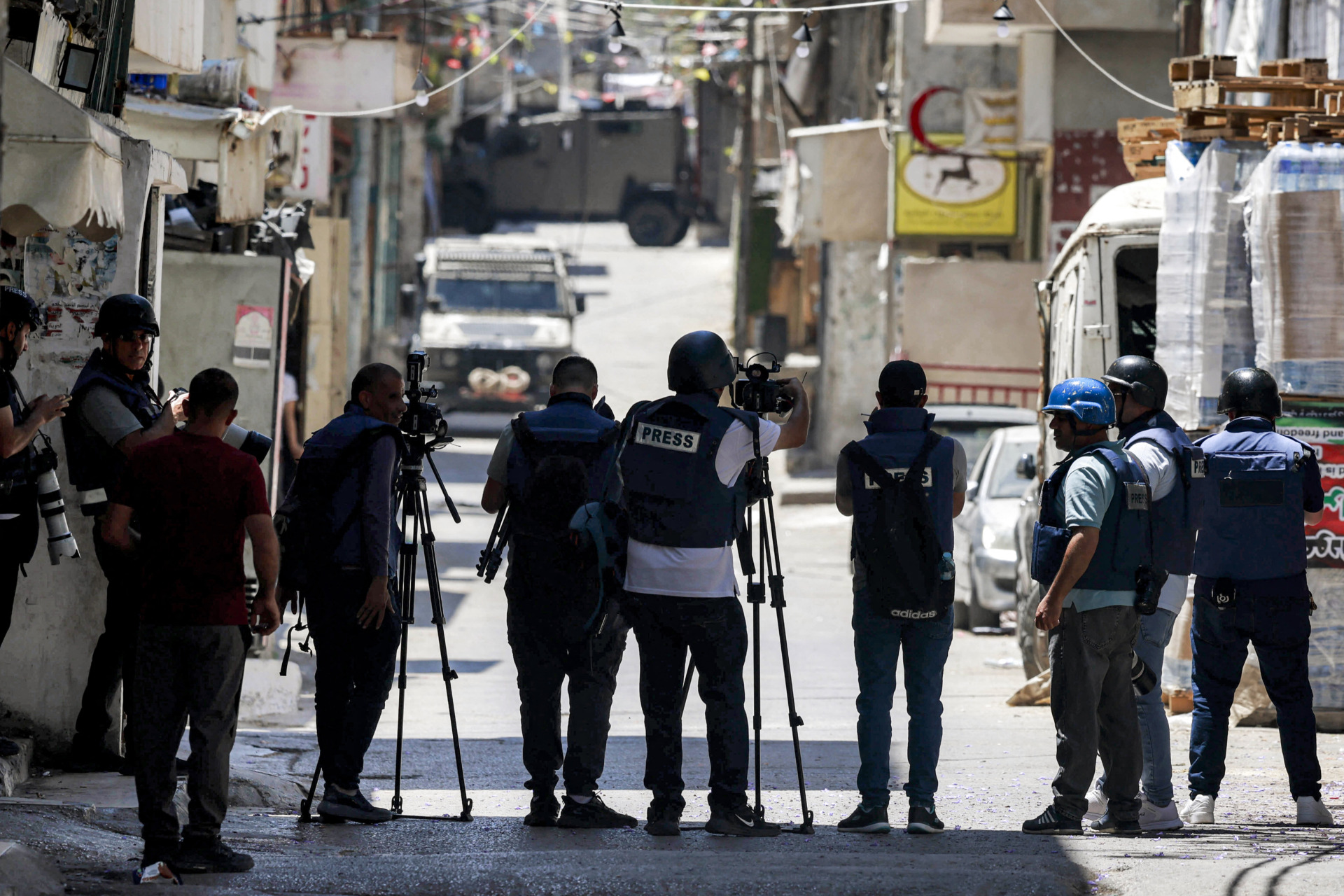
FEATURED IMAGE: Journalists film as an Israeli army armoured vehicle approaches along an alley in the Balata camp for Palestinian refugees, east of Nablus in the occupied West Bank, during a military operation on June 7, 2026. Since the war in Gaza broke out in October 2023 with Hamas's attack on Israel, near-daily violence has rocked the West Bank, which Israel has occupied since 1967. Israeli soldiers or settlers have killed at least 1,080 Palestinians since then, including both militants and civilians, according to an AFP tally based on Palestinian health ministry data. (Photo by Jaafar ASHTIYEH / AFP via Getty Images)Read Next:

Why Interpol’s Member Nations Should Reject Its New Privileges and Immunities Agreement
Jun. 23, 2026 Ted R. Bromund, Charlie Magri and 1 more
Beyond the Vanishing Point? What the Destruction of Civilian Infrastructure in Armed Conflicts Reveals about the State and the Role of IHL Today
Jun. 23, 2026 Barbara Morais Figueiredo
As U.N. Secretary-General Candidates Make Pitch to be Mediator-in-Chief, Will Peacebuilding End Up On the Cutting Room Floor?
Jun. 23, 2026 Jordan Street and Maria Kisumbi
Litigation Tracker: Legal Challenges to Trump Administration Actions
Jun. 22, 2026 Just Security 12323Featured Articles:
As U.N. Secretary-General Candidates Make Pitch to be Mediator-in-Chief, Will Peacebuilding End Up On the Cutting Room Floor?
Jun. 23, 2026 Jordan Street and Maria Kisumbi
The Law of Armed Conflict and the Attack on Kyiv’s Monastery of the Caves and Dormition Cathedral
Jun. 22, 2026 Michael Schmitt
Immigration Habeas Tracker: Government Obstruction, Judicial Trust, and Accountability
Jun. 22, 2026 Siven Watt
Timeline of Boat Strikes and Related Actions
Jun. 22, 2026 Jeremy Chin, Margaret Lin and 2 moreBadenoch blasts 'moaning' female Labour MPs over Burnham jobs 'quota'

Kemi Badenoch has told Labour women to earn a job in Andy Burnham's Cabinet instead of demanding they are handed jobs because of their gender.
The Tory leader lashed out today amid reports that female MPs are demanding the de-facto new prime minister introduce a 50:50 gender split 'quota' in his government.
Amid reports that former foreign secretary David Miliband is being lined up to return to the role, possibly with his brother Ed as Chancellor, one female minister also complained that Burnham could not have 'more Milibands than women' in the top posts.
But in a scathing article in the Times today Mrs Badenoch told them to 'stop moaning' and get chosen on merit instead of retreating into 'more of the failed identity politics that is holding back our country'.
'There are many, many reasons why you shouldn't have any Milibands in the cabinet,' she said.
'But complaining that the boys haven't given them the right jobs or that the boys are taking all the jobs, just shows that Labour's women still don't get it.'
The idea of quotas was also attacked by Baroness Jacqui Smith, Labour's Skills Minister.
Asked by Times Radio if Mr Burnham should reserve jobs for women, she said: 'No, I think what Andy Burnham should be doing is building the very best team around him to change this country.'

A letter written by the Women's Parliamentary Labour Party has called on Mr Burnham to ensure a 50:50 split between men and women in government jobs

Amid reports that former foreign secretary David Miliband (above, right, in 2010) is being lined up to return to the role, possibly with his brother Ed as Chancellor, one female minister complained that Burnham could not have 'more Milibands than women' in the top posts

But Mrs Badenoch told them to pipe down and get chosen on merit instead of retreating into 'more of the failed identity politics that is holding back our country'
A letter written by the Women's Parliamentary Labour Party and seen by the BBC has called on Mr Burnham to ensure a 50:50 split between men and women in government jobs after he succeeds Sir Keir Starmer.
'We are asking you to demonstrate this change from day one and address the toxicity and misogyny within our own party and government,' it said.
Labour has never had a female leader, while the Conservatives have had three, and Mrs Badenoch urged the government to follow its meritocratic example.
'If you run a meritocracy, then you do not have to worry about jobs for the boys,' she wrote.
'Every woman who is a Conservative MP, every woman who has ever won the leadership, has had to fight to get where she is.
'By contrast, Labour women are demanding guarantees from Burnham. But the truth is he doesn't have to give any guarantees.
'If none of Labour's women are prepared to get their hands dirty and challenge him for the leadership, their demands are toothless.'
'In fact, it's quite revealing that the women's parliamentary Labour Party has written to Burnham asking him to commit himself to at least 50 per cent female ministers.
'This has nothing to do with meritocracy. It is yet more of the failed identity politics that is holding back our country.'
Venezuela Fury and Noah Price subsidising their life by livestreaming

Venezuela Fury and her husband Noah Price look to be making their own way in the world by raking it in from their lucrative social media accounts.
The influencer daughter of Tyson and Paris Fury, 16, has become an internet sensation after tying the knot with her husband Noah, 19, earlier this year.
Since getting married and moving in together the couple have been earning thousands of pounds a month, livestreaming their life as newlyweds in their static caravan in the East Riding of Yorkshire.
And fans can't get enough of their regular life updates on TikTok and Kick, which have proved to be very profitable for the pair.
They look to be supporting themselves after Noah denied that he was given £5million by Venezuela's family as a wedding gift.
Despite his wife's huge family wealth, an estimated combined £160 million, Noah recently told his Kick followers that he 'pays for everything' for the couple.
Making light of the claims about Venezuela's millionaire financial status, Noah said: 'I actually pay for everything unfortunately. You'd expect the millionaire to pay for it wouldn't you.'

Venezuela Fury and Noah Price are earning thousands livestreaming their caravan life - after her new groom insisted he pays all the bills and denied he had £5m handout from her dad

The influencer daughter of Tyson and Paris Fury , 16, has become an internet sensation after tying the knot with her husband Noah, 19, earlier this year
Venezuela then asked their fans: 'Do you think I am a millionaire?'
Noah joked: 'She isn't a secret millionaire guys', before she broke into song and sang: 'But I live like a millionaire!'
But it seems according to estimated calculations from their social media work, Noah and Venezuela can more than afford to support themselves.
Noah has been livestreaming on platforms such as Kick and TikTok, where viewers can send paid gifts or donations.
He was previously encouraging viewers to send gifts on his honeymoon during livestreams, suggesting this is one revenue stream.
Both Noah and Venezuela have built substantial followings on Instagram and TikTok. They can potentially earn money through sponsored posts, brand collaborations, affiliate links and creator payouts.
Kick allows its creators to take home 95 per cent of the £4.99 subscription cost that fans pay.
Streamers keep 100 per cent of direct tips and donations, minus minor standard payment processing fees.
It is unclear how many subscribers Noah currently has because this information is hidden, but he does have 7,200 followers which is publicly viewable.
An industry insider has suggested Noah is making around £400 per video on TikTok, while Venezuela is likely to make £2,000 due to her following count of 1.3 million.

An industry insider has suggested Noah is making around £400 per video on TikTok, while Venezuela is likely to make £2,000 due to her following count of 1.3 million
In one video on their honeymoon, Noah asked his followers if they'd give them some more gifts now that they were married.
In a TikTok live viewed by 20,000 he said: 'Keep liking our videos people, keep sending gifts.'
After saying thank you to several of his followers he joked they should stick around on the livestream and 'watch Venezuela punch me in the mouth'.
The other half of the honeymooning couple said: 'I am, honestly!'
Noah previously confirmed that the pair don't share their finances after they were asked whether they have a shared bank account.
'She earns her money, I earn mine,' said Noah, as Venezuela joked: 'Yeah, what you gonna do about it.'
Noah went on to debunk the rumour that Tyson gave him £5million when he tied the knot with his daughter as he insisted: 'No Tyson did not give me £5million'.
Meanwhile Venezuela is being eyed up by executives for a fly on the wall TV series.

Noah went on to debunk the rumour that Tyson gave him £5million when he tied the knot with his daughter as he insisted: 'No Tyson did not give me £5million'
Boasting 1.3 million TikTok followers, Venezuela is already entertaining fans with her honest musings and candid moments, from cooking to kitting out her and Noah's static caravan home.
And following the success of the Netflix series At Home With The Furys, it is no wonder bosses are wanting to draw on the Fury popularity.
A TV insider said: 'The couple are not A-list celebrities but everyone has become obsessed with their love story.
'People are genuinely intrigued by them. Whether it’s the fact they have married so young, Venezuela’s famous family or their gypsy lifestyle, they have the ‘X factor'.
'Several TV executives think a proper fly-on-the-wall series following their lives as newlyweds in the gypsy community would be fascinating,' they told The Sun.
It is thought Netflix would be likely to produce the series due to their already established relationship with the Furys.
Venezuela's representatives told The Daily Mail: 'We have many offers on the table regarding Venezuela which we are discussing.'