Arizona gun shop owner faces terrorism-related charges for allegedly selling high-caliber weapons bound for Mexican cartels - ICIJ

Arizona gun shop owner faces terrorism-related charges for allegedly selling high-caliber weapons bound for Mexican cartels
It is the first such case filed since the Trump administration designated several of the criminal groups as foreign terrorist organizations in 2025.
By Ben Dooley Image: Luke Sharrett/Bloomberg via Getty Images April 30, 2026
Federal prosecutors have charged an Arizona gun dealer with attempting to provide material support to terrorists, signaling a new approach to slowing the deluge of weapons flowing across the border into Mexico.
The indictment, filed in March, revolves around the sale of several high caliber firearms to an undercover agent who posed as a gun runner for a Mexican drug cartel. The case is the first of its kind brought against a firearms dealer in the state and likely the first such action in the United States, according to an analysis of federal court records by the International Consortium of Investigative Journalists.
The Trump administration designated six Mexican drug cartels as terrorist organizations in February 2025, opening the door for law enforcement agencies to take a variety of actions against the groups and those who do business with them.
Criminal organizations in Mexico and elsewhere have long relied on the loosely regulated U.S. gun market to procure firearms, including powerful, military-style rifles they have used in shootouts with government forces and in civilian massacres.
In February, those arsenals were on full display as cartel gunmen unleashed violence across Mexico in response to the Mexican Army killing New Generation Jalisco Cartel leader Nemesio Rubén Oseguera Cervantes, known as El Mencho.
More than 60 people died during the violence.
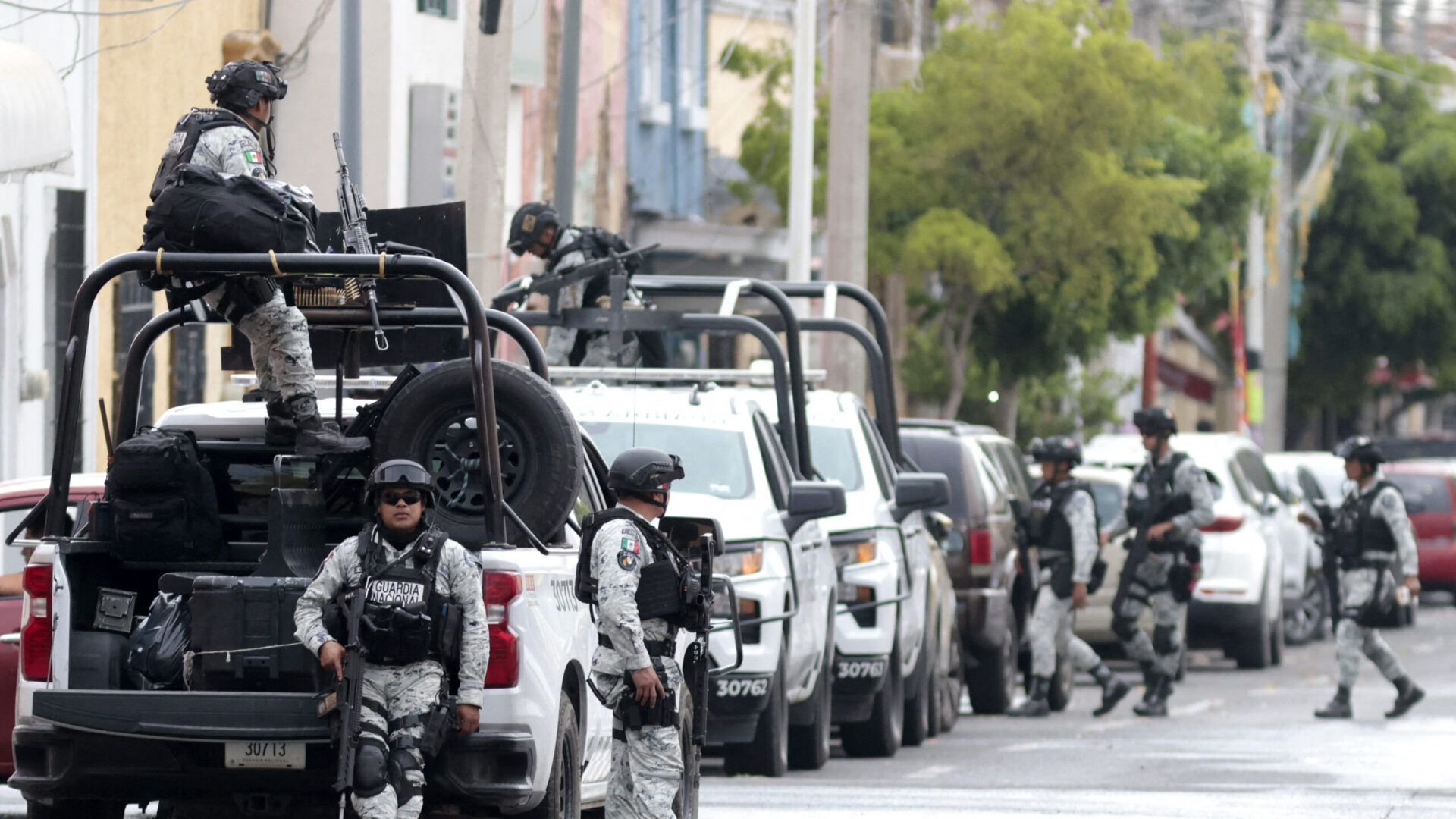
In the wake of the attacks, Mexican defense secretary Ricardo Trevilla Trejo told reporters that 80 percent of the more than 23,000 firearms seized by the Mexican government since late 2024 originated in the United States
U.S. gun dealers have rarely been held accountable for their role in facilitating the movement of those weapons.
There are over 77,000 licensed firearms dealers across the country, compared to two in all of Mexico, according to the most recent government data. And there are few federal restrictions on what kinds of guns they can sell or who can buy them.
In theory, the federal government can bring criminal charges against dealers who facilitate trafficking or can take administrative action against them, such as revoking their license, but in practice that is often difficult, according to Marianna Mitchem, a former senior official at the ATF who worked on industry regulation and currently serves as the Senior Firearms Industry Advisor at Everytown for Gun Safety, a non-profit that advocates for stronger firearms regulation.
“Both avenues are available, but both require proving the dealer’s culpability, and for years that difficulty has been used as a reason not to try,” Mitchem said.
The terrorism-related charges unveiled in Arizona in March appear to be a “test case” for a new strategy to reign in illicit firearms sales, according to Jason Red, a former investigator at the Department of Homeland Security in Arizona, who worked on gun trafficking investigations.
Mark Oliva, managing director of public affairs for the National Shooting Sports Foundation, a firearms industry trade association, said that the group, “supports the Department of Justice’s efforts to keep firearms from being illegally trafficked, whether that is to criminal elements within the United States or narcoterrorists beyond our borders.”
In recent years, Arizona has become a hub for gunrunners moving high-caliber firearms from the United States to Mexico. Drug cartels have used the firearms, some of which are closely modeled on U.S. military weapons, to go toe-to-toe with the Mexican authorities, who complain that they are often outgunned by the powerful criminal organizations.
The U.S. Bureau of Alcohol, Tobacco, Firearms and Explosives (ATF) regularly conducts gun traces on behalf of foreign governments, including Mexico, in an effort to identify the origins of firearms used in crimes.
From 2015 through 2024, more of those guns came from Arizona’s Maricopa County, home to the capital city of Phoenix, than from any other county in the United States, according to ATF data obtained by Stop U.S. Arms to Mexico, a project of Global Exchange, a human rights organization.
“If you look at the data over the last decade, you can see a very clear growth from Arizona as a preferred source, if you will, for firearms and ammunition,” said Cecilia Farfán-Méndez, head of the North American Observatory at the Global Initiative Against Transnational Organized Crime, a Geneva-based watchdog group.
She attributes the growth to two main factors: the state’s permissive gun laws and its role as a logistics hub for both legal and illegal goods, ranging from avocados to fentanyl.
“You have this business-friendly environment where you can purchase these high-caliber weapons and assault rifles and ammunition, and you already have potential resources in place to move them south,” she said.
In 2022, the government of Mexico filed a lawsuit in Arizona against five federally licensed gun dealers there, alleging that they “routinely supply high-powered firearms to criminal organizations in Mexico.”
Grips by Larry, the Arizona store named in the charges filed by federal prosecutors in March, was not included in the suit. The business came to the ATF’s attention during an investigation into guns being trafficked to Mexico from the Phoenix metropolitan area, according to a criminal complaint prosecutors filed in June 2025 against one of the store’s employees.
That April, an ATF officer, accompanied by an informant, purchased three guns at the shop as part of a sting operation, it said.
The weapons were civilian versions of guns designed for combat — a .50-caliber semi-automatic rifle and two belt-fed “squad” weapons designed for U.S. infantry, according to the complaint. The officer, it said, paid $42,000 in cash on behalf of the informant, who told employees that the guns would probably go “directly to Mexico.”
Over the next two months, the store sold the officer an additional three firearms, including a civilian variant of a .50-caliber machine gun. When one employee was informed that the gun was bound for the New Generation Jalisco Cartel, the complaint alleges, he “stated he understood and continued with the sale.”
In June 2025, federal prosecutors indicted Grips by Larry’s owner Laurence Gray and a second individual on charges related to gun trafficking. Gray was charged with attempting to provide material support to a foreign terrorist organization and conspiracy to provide support to a designated foreign terrorist organization in a superseding indictment in March.
Gray and the other defendant have pleaded not guilty to the respective charges. Attempts to reach Gray through his lawyer were unsuccessful.
An examination of federal court records by ICIJ found three other indictments alleging that traffickers purchased at least nine additional firearms at Grips by Larry with the intent of sending them to Mexico. There is no indication that the business knew the plans for those weapons, and prosecutors did not allege any wrongdoing by Grips by Larry or its employees in those cases.
Among the guns allegedly sold by the shop were four .50-caliber firearms — civilian variants of heavy machine guns used by the U.S. military and prized by Mexican cartels. Mexican authorities seized one of them in March 2023, court documents said.
The terrorism designation opens up the possibility of new penalties for gun shops that turn a blind eye to trafficking, according to Jonathan Lowy, the president and founder of Global Action on Gun Violence, an advocacy group based in Washington, D.C.
Lowy, who is leading the Mexican lawsuit against Arizona gun shops, said that despite overarching questions about the legality and appropriateness of designating cartels as foreign terrorist organizations, the classification has the force of law and could be used in other cases involving firearms dealers or even manufacturers.
The case, he said, could send “a message to manufacturers and distributors to clean up their act.”
Badenoch blasts 'moaning' female Labour MPs over Burnham jobs 'quota'

Kemi Badenoch has told Labour women to earn a job in Andy Burnham's Cabinet instead of demanding they are handed jobs because of their gender.
The Tory leader lashed out today amid reports that female MPs are demanding the de-facto new prime minister introduce a 50:50 gender split 'quota' in his government.
Amid reports that former foreign secretary David Miliband is being lined up to return to the role, possibly with his brother Ed as Chancellor, one female minister also complained that Burnham could not have 'more Milibands than women' in the top posts.
But in a scathing article in the Times today Mrs Badenoch told them to 'stop moaning' and get chosen on merit instead of retreating into 'more of the failed identity politics that is holding back our country'.
'There are many, many reasons why you shouldn't have any Milibands in the cabinet,' she said.
'But complaining that the boys haven't given them the right jobs or that the boys are taking all the jobs, just shows that Labour's women still don't get it.'
The idea of quotas was also attacked by Baroness Jacqui Smith, Labour's Skills Minister.
Asked by Times Radio if Mr Burnham should reserve jobs for women, she said: 'No, I think what Andy Burnham should be doing is building the very best team around him to change this country.'

A letter written by the Women's Parliamentary Labour Party has called on Mr Burnham to ensure a 50:50 split between men and women in government jobs

Amid reports that former foreign secretary David Miliband (above, right, in 2010) is being lined up to return to the role, possibly with his brother Ed as Chancellor, one female minister complained that Burnham could not have 'more Milibands than women' in the top posts

But Mrs Badenoch told them to pipe down and get chosen on merit instead of retreating into 'more of the failed identity politics that is holding back our country'
A letter written by the Women's Parliamentary Labour Party and seen by the BBC has called on Mr Burnham to ensure a 50:50 split between men and women in government jobs after he succeeds Sir Keir Starmer.
'We are asking you to demonstrate this change from day one and address the toxicity and misogyny within our own party and government,' it said.
Labour has never had a female leader, while the Conservatives have had three, and Mrs Badenoch urged the government to follow its meritocratic example.
'If you run a meritocracy, then you do not have to worry about jobs for the boys,' she wrote.
'Every woman who is a Conservative MP, every woman who has ever won the leadership, has had to fight to get where she is.
'By contrast, Labour women are demanding guarantees from Burnham. But the truth is he doesn't have to give any guarantees.
'If none of Labour's women are prepared to get their hands dirty and challenge him for the leadership, their demands are toothless.'
'In fact, it's quite revealing that the women's parliamentary Labour Party has written to Burnham asking him to commit himself to at least 50 per cent female ministers.
'This has nothing to do with meritocracy. It is yet more of the failed identity politics that is holding back our country.'