Ancient Roman scrolls destroyed by Mount Vesuvius digitally unrolled in full for first time
How do you read a book you can’t open? That’s precisely what Brent Seales, a professor at the University of Kentucky, has spent his career trying to figure out. And on Thursday, his life’s work has reached a pinnacle: Seales, alongside a huge group of volunteers and scientists working as part of the Vesuvius Challenge, has helped developed technology to see inside books and scrolls we can’t open without destroying them.
At a press conference, Nat Friedman, one of the Challenge’s main backers and former CEO of GitHub, unveiled several digitally unrolled scrolls from the ancient Roman town of Herculaneum, which was buried under lava by Mount Vesuvius in 79 AD. One of the scrolls, called PHerc 1667, can now be read in its entirety. “We were not only able to completely unroll this scroll, from end to end, but we were able to extract nearly all the text, and make it legible,” Friedman said.
The scroll has been digitally unwrapped using a technique pioneered by Seales called Volume Cartographer, which takes scans of a 3D manuscript, layer by layer, and then effectively flattens these into 2D images that can then be read. The scans are made by synchrotron scanners, which are massive particle accelerators that can beam high-power x-rays at the object, revealing its inner layers down to the atomic level.
On supporting science journalism
If you're enjoying this article, consider supporting our award-winning journalism by subscribing. By purchasing a subscription you are helping to ensure the future of impactful stories about the discoveries and ideas shaping our world today.

Pherc. 1667 digitally unwrapped from end-to-end — revealing 20 columns of continuous text.
Photo courtesy of Vesuvius Challenge.
What the Vesuvius Challenge has done is to take some two decades-worth of Seales’ work and accelerate it—in part by using artificial intelligence to help speed up and automate the work, and in part by getting a huge community of people to contribute to the Challenge.
“AI has been a huge accelerator, and a huge accelerant, because the technique itself, we needed a breakthrough to amplify the way we could detect the ink inside these scans,” explains Seale. “To go to scale, we needed a way to build a label set—you know, here's ink, here's not ink—much more effectively than doing things by hand.”
AI coding agents also mean the research team can try new techniques much faster than if they had to write all the code themselves, he adds.
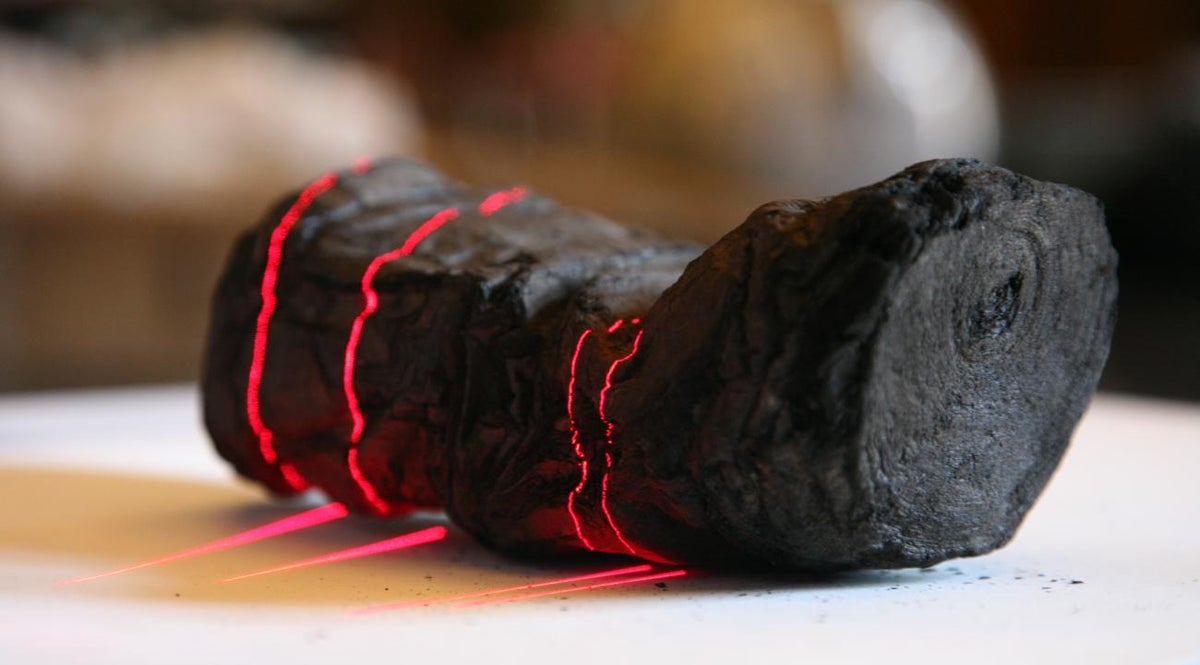
The achievement is remarkable considering the condition of the scroll: Called PHerc. 172, the scroll looks like a delicate piece of charred wood. It was among the hundreds of documents destroyed by the eruption of Mount Vesuvius, which obliterated Herculaneum and Pompeii, killing at least 1,500 people. As horrific as this disaster was, the volcanic ash also preserved everything in the towns where it lay, including the burnt scrolls. They were found inside a villa that has become known as the Villa dei Papiri, or Villa of the Papyrus. Some 400 of these papyrus scrolls remain intact, says Seales. And now, he and the Vesuvius Challenge can read them for the first time in nearly 2,000 years.
“To restore these lost voices, I feel like I myself am finding mine,” says Seales. Among the digitally unwrapped scrolls that the Challenge unveiled on Thursday is a previously unknown text by Philodemus, a leading Epicurean philosopher, called, “On the Gods, Booke Eight.” In fact, scholars had no idea that Philodemus had written any volumes “On the Gods,” let alone eight of them.
Papyrologist Federica Nicolardi said on Thursday at the same event that the team has already identified a number of intriguing passages, including some on the nature of deities and providence. “These are no longer anonymous ancient books,” she said. “Imagine being able to recover the titles of hundreds of still unopened scrolls. It would be like reconstructing the catalogue of an ancient library.”
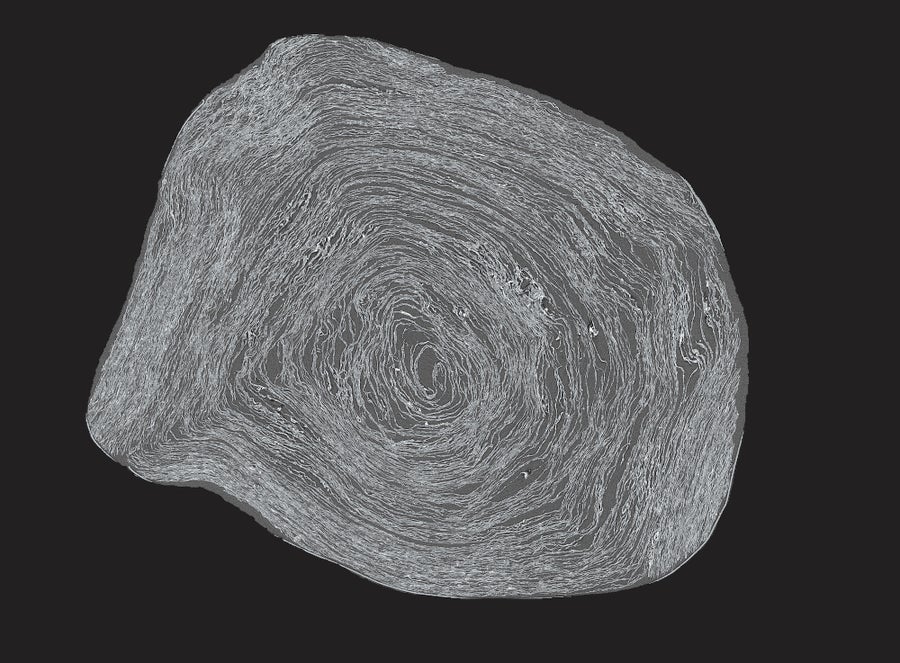
Slice image of Pherc. 172 from micro-CT.
Vesuvius Challenge
The achievement comes some two years after the Vesuvius Challenge first announced that three volunteers, Luke Farritor, Youssef Nader and Julian Schilliger, had managed to clearly pick out the ink on one of the Herculaneum scrolls’ layers of papyrus, making it legible by papyrologists for the first time. The manuscript, a treatise of Epicurean philosophy also likely written by Philodemus, was entirely unknown to scholars before the Challenge.
Seales says that having the Silicon Valley-backed competition may seem risky or unfamiliar to other academics used to more traditional research funding structures. But he felt confident in all the work his team at the University of Kentucky had done before Friedman and the Challenge’s co-founder, Daniel Gross, a tech investor who has led AI development at Apple, actually approached him.
“I may not have taken that risk earlier in my career, but at the point where I’m at now, I felt that this was absolutely a really fun thing to try, and you know, it ended up being a home run,” he says. “I think it can be a pattern for others who are in the right place in the right moment.”
Now, Seales and his team have scanned 45 scrolls. Already, papyrologists are deciphering new texts that indicate other possible authors in the Herculaneum collection, including one of the leaders of the Stoic philosophy school. For Seales, this feels like the moment where his work is effectively done—and others can now take the lead on reconstructing the voices within these scrolls.
“There’s this deep-seated feeling of completion that I haven’t had in a really long time, because Vesuvius has been looming over my life for two decades,” Seales says.
“We always go into our fields thinking that the field we go into is really the one we’re going to change, right? But it turns out I’m changing the field of classical philology and papyrology, and I’m not any of those things,” he says. “I’ve created a field of people who are like me … I’ve created a community, and we’re going to share this experience, so that feels really great.”
Seales is excited to take the technology and apply it to collections of photographic negatives from the birth of photography, such as by Eadweard Muybridge, whose 1878 “The Horse in Motion” is considered the first example of using photography to study a body in motion. These kinds of old negatives are often stored inside cans and are so fragile they can’t be unrolled without destroying them, Seales says.
“I think we never understand origins very well, right? Like, what were these guys really photographing on a bad day? What did they think they were just going to throw away? Sometimes that's the most interesting stuff.”
It’s Time to Stand Up for Science
If you enjoyed this article, I’d like to ask for your support. Scientific American has served as an advocate for science and industry for 180 years, and right now may be the most critical moment in that two-century history.
I’ve been a Scientific American subscriber since I was 12 years old, and it helped shape the way I look at the world. SciAm always educates and delights me, and inspires a sense of awe for our vast, beautiful universe. I hope it does that for you, too.
If you subscribe to Scientific American, you help ensure that our coverage is centered on meaningful research and discovery; that we have the resources to report on the decisions that threaten labs across the U.S.; and that we support both budding and working scientists at a time when the value of science itself too often goes unrecognized.
In return, you get essential news, captivating podcasts, brilliant infographics, can't-miss newsletters, must-watch videos, challenging games, and the science world's best writing and reporting. You can even gift someone a subscription.
There has never been a more important time for us to stand up and show why science matters. I hope you’ll support us in that mission.

Thank you,
David M. Ewalt, Editor in Chief, Scientific American
SubscribeBadenoch blasts 'moaning' female Labour MPs over Burnham jobs 'quota'

Kemi Badenoch has told Labour women to earn a job in Andy Burnham's Cabinet instead of demanding they are handed jobs because of their gender.
The Tory leader lashed out today amid reports that female MPs are demanding the de-facto new prime minister introduce a 50:50 gender split 'quota' in his government.
Amid reports that former foreign secretary David Miliband is being lined up to return to the role, possibly with his brother Ed as Chancellor, one female minister also complained that Burnham could not have 'more Milibands than women' in the top posts.
But in a scathing article in the Times today Mrs Badenoch told them to 'stop moaning' and get chosen on merit instead of retreating into 'more of the failed identity politics that is holding back our country'.
'There are many, many reasons why you shouldn't have any Milibands in the cabinet,' she said.
'But complaining that the boys haven't given them the right jobs or that the boys are taking all the jobs, just shows that Labour's women still don't get it.'
The idea of quotas was also attacked by Baroness Jacqui Smith, Labour's Skills Minister.
Asked by Times Radio if Mr Burnham should reserve jobs for women, she said: 'No, I think what Andy Burnham should be doing is building the very best team around him to change this country.'

A letter written by the Women's Parliamentary Labour Party has called on Mr Burnham to ensure a 50:50 split between men and women in government jobs

Amid reports that former foreign secretary David Miliband (above, right, in 2010) is being lined up to return to the role, possibly with his brother Ed as Chancellor, one female minister complained that Burnham could not have 'more Milibands than women' in the top posts

But Mrs Badenoch told them to pipe down and get chosen on merit instead of retreating into 'more of the failed identity politics that is holding back our country'
A letter written by the Women's Parliamentary Labour Party and seen by the BBC has called on Mr Burnham to ensure a 50:50 split between men and women in government jobs after he succeeds Sir Keir Starmer.
'We are asking you to demonstrate this change from day one and address the toxicity and misogyny within our own party and government,' it said.
Labour has never had a female leader, while the Conservatives have had three, and Mrs Badenoch urged the government to follow its meritocratic example.
'If you run a meritocracy, then you do not have to worry about jobs for the boys,' she wrote.
'Every woman who is a Conservative MP, every woman who has ever won the leadership, has had to fight to get where she is.
'By contrast, Labour women are demanding guarantees from Burnham. But the truth is he doesn't have to give any guarantees.
'If none of Labour's women are prepared to get their hands dirty and challenge him for the leadership, their demands are toothless.'
'In fact, it's quite revealing that the women's parliamentary Labour Party has written to Burnham asking him to commit himself to at least 50 per cent female ministers.
'This has nothing to do with meritocracy. It is yet more of the failed identity politics that is holding back our country.'