America's Data-Center Revolt Goes Local - And Bipartisan - As Towns Slam The Brakes
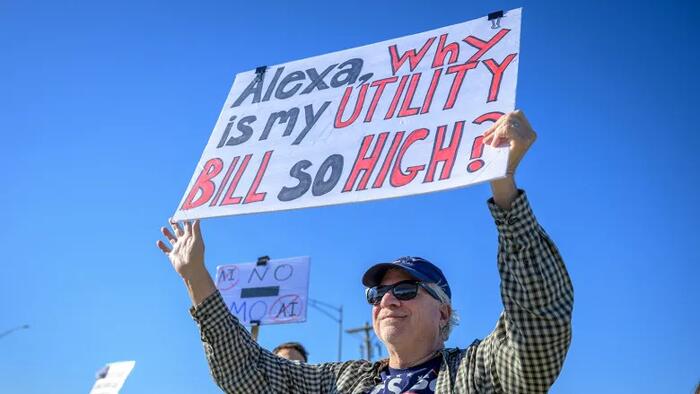


The pitchforks are out over the AI buildout - as drama unfolds in county commission chambers, where the people who will actually live next to the substations and cooling plants are starting to win.

Over the last week, local governments in at least three states have independently moved to pause hyperscale data center development - amid local revolts driven by the same three anxieties: water, electricity rates, and the suspicion that the deals were wired before anyone in town got a vote. One thing is clear; residents are pissed, and this pushback is bipartisan.
As we've previously noted, this revolt has been building all year - and it has already produced the first statewide moratorium, passed by New York's legislature this month. What follows is the local front of the same war, fought four counties at a time.
Florida: a unanimous pause, a preemptive one, and a lawfare wrinkle
In DeSoto County, commissioners sat through nearly three hours of public comment on Tuesday before voting unanimously (with one recusal) to direct the county attorney to draft a one-year moratorium on new data center applications. Not one resident spoke in favor of the pending project or against the pause.

The catch: the moratorium, once drafted and passed, wouldn't touch projects already in the pipeline. And there's a big one. DCIP Group is pushing a gas-powered hyperscale complex that a second rezoning application would expand past 800 acres - with longer-term maps reportedly sketching as many as 1,300 acres and more than a dozen facilities. The county had been fast-tracking it under a "Rapid Response" economic-development pilot; records obtained by Suncoast Searchlight show officials moving to prioritize the application.
Pressed on specifics, the developer couldn't supply them. Asked how much water the complex would draw, DCIP's CEO allowed it could be anywhere from zero to 3 million gallons a day - a range wide enough to drive a turbine through. The company points to "closed-loop" cooling and reclaimed water as mitigations (claims, not yet verified by the county). Commissioners bristled at the suggestion they'd been captured, with one insisting they were "not a bunch of bought and paid for puppets."
Central Florida's Lake County went a step further - a preemptive pause. By the county's own account it has no data centers and no pending applications, yet commissioners reached consensus on June 23 to have staff draft a moratorium, with a vote set for July 14 that Commissioner Anthony Sabatini expects to pass unanimously. He says he isn't seeking "an outright ban" because Florida's SB 180 - signed by Gov. DeSantis after the 2025 session and sold as hurricane-rebuild relief - has been read to bar local governments from tightening development rules at all, and to hand developers a tool to sue counties that reject rezonings. The law sunsets October 1, 2027, so a moratorium is the workaround until it does. Sabatini said 12 applications for "large data centers" have been filed statewide in the past year, and pointed to Citrus, Nassau and Pasco counties as having already imposed some form of pause.
The contrast is right next door. In neighboring Orange County, CoreSite - a subsidiary of publicly traded American Tower (AMT) - has filed plans for a second data-center building at its Orlando campus, adding roughly 76,000 square feet to an existing 129,000-plus-square-foot facility. The moratorium map and the buildout map are being drawn at the same time.
Pennsylvania: from coal country to the statehouse
In Brookville, a borough in western Jefferson County, PA, council members unanimously passed a 180-day moratorium last week, giving themselves until roughly December to write rules. The trigger was water. Council vice-president Randy Bartley said the borough was unofficially told that two data centers were eyeing the area, together capable of drawing about 2.4 million gallons a day from Brookville's supply - a massive amount for such a small borough. Bartley says their job is to "be sure when they turn on the tap, they have water."

Days earlier, the Pennsylvania House moved a package of data-center bills, including a 197-5 vote to repeal a sales-tax exemption on data-center equipment - a break projected to cost the commonwealth roughly $517 million a year by 2030 - and a 201-1 vote codifying Gov. Shapiro's certification-based "GRID Standards." Those standards only bind developers who want state tax perks, covering water use, noise and air pollution, and local energy affordability. The quiet part, said out loud by a bill sponsor: the breaks were flowing to companies clearing nine figures of net income a year.
Missouri: protests, secrecy, and a definition nobody wrote down
In Springfield, Missouri, some 60 residents rallied outside Plaza Towers on Tuesday ahead of a special City Council vote, set for this coming Monday, on a 120-day moratorium. Inside the building, a business panel on data centers featured Trent Overhue - Plaza Towers' owner and the developer of a contested small-scale data center going up near Marshfield - while the protest against projects like his played out on the sidewalk.

Then there's the secrecy... In nearby Webster County, residents say a developer quietly broke ground on a small AI data center in Marshfield before any public process - there's no county planning and zoning commission - and the county has since retained outside counsel to figure out its options. One Marshfield resident's summary: "no meetings, no transparency at all." Second, Springfield's city manager admits the city code contains no definition of "data center" at all - which is how a developer's pitch for a mixed-use building on South National Avenue, with a basement use the city gingerly calls "like a cousin to a data center," is becoming a fight. The 120 days would buy the city time to define the term and study impacts on water, wastewater and the grid.
The local anxiety is, again, about who pays. One self-described tenant leader warned that utility costs would climb for working-class residents if a data center lands - the same ratepayer-socialization fear driving the Pennsylvania votes. For scale, residents need only look up the road to the 2-million-square-foot "AI factory" rising in Independence. Meanwhile, the state is trying to get a grip on the situation: a Missouri House committee has set a September hearing on data-center rules, even as one lawmaker presses the governor for a special session that leadership has so far waved off.
Remember folks, AI-capex bulls assume that land, water, and power show up on schedule - and hyperscalers will have a hard time lobbying their way out of these local entanglements. The political economy is the story: the compute is centralized and the profits accrue to AMZN, MSFT, GOOGL and META (and, via CoreSite, to AMT), but the water draw, the grid strain, and the rate increases land on residents who increasingly get a vote before the concrete is poured. The Florida SB 180 angle adds a delicious contradiction - a "property rights" statute now functioning as a developer's shield against local democracy.
Badenoch blasts 'moaning' female Labour MPs over Burnham jobs 'quota'

Kemi Badenoch has told Labour women to earn a job in Andy Burnham's Cabinet instead of demanding they are handed jobs because of their gender.
The Tory leader lashed out today amid reports that female MPs are demanding the de-facto new prime minister introduce a 50:50 gender split 'quota' in his government.
Amid reports that former foreign secretary David Miliband is being lined up to return to the role, possibly with his brother Ed as Chancellor, one female minister also complained that Burnham could not have 'more Milibands than women' in the top posts.
But in a scathing article in the Times today Mrs Badenoch told them to 'stop moaning' and get chosen on merit instead of retreating into 'more of the failed identity politics that is holding back our country'.
'There are many, many reasons why you shouldn't have any Milibands in the cabinet,' she said.
'But complaining that the boys haven't given them the right jobs or that the boys are taking all the jobs, just shows that Labour's women still don't get it.'
The idea of quotas was also attacked by Baroness Jacqui Smith, Labour's Skills Minister.
Asked by Times Radio if Mr Burnham should reserve jobs for women, she said: 'No, I think what Andy Burnham should be doing is building the very best team around him to change this country.'

A letter written by the Women's Parliamentary Labour Party has called on Mr Burnham to ensure a 50:50 split between men and women in government jobs

Amid reports that former foreign secretary David Miliband (above, right, in 2010) is being lined up to return to the role, possibly with his brother Ed as Chancellor, one female minister complained that Burnham could not have 'more Milibands than women' in the top posts

But Mrs Badenoch told them to pipe down and get chosen on merit instead of retreating into 'more of the failed identity politics that is holding back our country'
A letter written by the Women's Parliamentary Labour Party and seen by the BBC has called on Mr Burnham to ensure a 50:50 split between men and women in government jobs after he succeeds Sir Keir Starmer.
'We are asking you to demonstrate this change from day one and address the toxicity and misogyny within our own party and government,' it said.
Labour has never had a female leader, while the Conservatives have had three, and Mrs Badenoch urged the government to follow its meritocratic example.
'If you run a meritocracy, then you do not have to worry about jobs for the boys,' she wrote.
'Every woman who is a Conservative MP, every woman who has ever won the leadership, has had to fight to get where she is.
'By contrast, Labour women are demanding guarantees from Burnham. But the truth is he doesn't have to give any guarantees.
'If none of Labour's women are prepared to get their hands dirty and challenge him for the leadership, their demands are toothless.'
'In fact, it's quite revealing that the women's parliamentary Labour Party has written to Burnham asking him to commit himself to at least 50 per cent female ministers.
'This has nothing to do with meritocracy. It is yet more of the failed identity politics that is holding back our country.'
Venezuela Fury and Noah Price subsidising their life by livestreaming

Venezuela Fury and her husband Noah Price look to be making their own way in the world by raking it in from their lucrative social media accounts.
The influencer daughter of Tyson and Paris Fury, 16, has become an internet sensation after tying the knot with her husband Noah, 19, earlier this year.
Since getting married and moving in together the couple have been earning thousands of pounds a month, livestreaming their life as newlyweds in their static caravan in the East Riding of Yorkshire.
And fans can't get enough of their regular life updates on TikTok and Kick, which have proved to be very profitable for the pair.
They look to be supporting themselves after Noah denied that he was given £5million by Venezuela's family as a wedding gift.
Despite his wife's huge family wealth, an estimated combined £160 million, Noah recently told his Kick followers that he 'pays for everything' for the couple.
Making light of the claims about Venezuela's millionaire financial status, Noah said: 'I actually pay for everything unfortunately. You'd expect the millionaire to pay for it wouldn't you.'

Venezuela Fury and Noah Price are earning thousands livestreaming their caravan life - after her new groom insisted he pays all the bills and denied he had £5m handout from her dad

The influencer daughter of Tyson and Paris Fury , 16, has become an internet sensation after tying the knot with her husband Noah, 19, earlier this year
Venezuela then asked their fans: 'Do you think I am a millionaire?'
Noah joked: 'She isn't a secret millionaire guys', before she broke into song and sang: 'But I live like a millionaire!'
But it seems according to estimated calculations from their social media work, Noah and Venezuela can more than afford to support themselves.
Noah has been livestreaming on platforms such as Kick and TikTok, where viewers can send paid gifts or donations.
He was previously encouraging viewers to send gifts on his honeymoon during livestreams, suggesting this is one revenue stream.
Both Noah and Venezuela have built substantial followings on Instagram and TikTok. They can potentially earn money through sponsored posts, brand collaborations, affiliate links and creator payouts.
Kick allows its creators to take home 95 per cent of the £4.99 subscription cost that fans pay.
Streamers keep 100 per cent of direct tips and donations, minus minor standard payment processing fees.
It is unclear how many subscribers Noah currently has because this information is hidden, but he does have 7,200 followers which is publicly viewable.
An industry insider has suggested Noah is making around £400 per video on TikTok, while Venezuela is likely to make £2,000 due to her following count of 1.3 million.

An industry insider has suggested Noah is making around £400 per video on TikTok, while Venezuela is likely to make £2,000 due to her following count of 1.3 million
In one video on their honeymoon, Noah asked his followers if they'd give them some more gifts now that they were married.
In a TikTok live viewed by 20,000 he said: 'Keep liking our videos people, keep sending gifts.'
After saying thank you to several of his followers he joked they should stick around on the livestream and 'watch Venezuela punch me in the mouth'.
The other half of the honeymooning couple said: 'I am, honestly!'
Noah previously confirmed that the pair don't share their finances after they were asked whether they have a shared bank account.
'She earns her money, I earn mine,' said Noah, as Venezuela joked: 'Yeah, what you gonna do about it.'
Noah went on to debunk the rumour that Tyson gave him £5million when he tied the knot with his daughter as he insisted: 'No Tyson did not give me £5million'.
Meanwhile Venezuela is being eyed up by executives for a fly on the wall TV series.

Noah went on to debunk the rumour that Tyson gave him £5million when he tied the knot with his daughter as he insisted: 'No Tyson did not give me £5million'
Boasting 1.3 million TikTok followers, Venezuela is already entertaining fans with her honest musings and candid moments, from cooking to kitting out her and Noah's static caravan home.
And following the success of the Netflix series At Home With The Furys, it is no wonder bosses are wanting to draw on the Fury popularity.
A TV insider said: 'The couple are not A-list celebrities but everyone has become obsessed with their love story.
'People are genuinely intrigued by them. Whether it’s the fact they have married so young, Venezuela’s famous family or their gypsy lifestyle, they have the ‘X factor'.
'Several TV executives think a proper fly-on-the-wall series following their lives as newlyweds in the gypsy community would be fascinating,' they told The Sun.
It is thought Netflix would be likely to produce the series due to their already established relationship with the Furys.
Venezuela's representatives told The Daily Mail: 'We have many offers on the table regarding Venezuela which we are discussing.'