75% Of US GDP Growth In The First Quarter Was Due To AI


On the surface, today's final revision (aka 3rd estimate) of the US Q1 GDP print was unremarkable: Real GDP grew 2.1% annualized in the first quarter, a reversal of last month's downward revision of 1.6%, but back to where the original print was when it was reported in April, when the BEA reported 2.0% growth.
The print reflected a downward revision to imports, which are a subtraction in the calculation of GDP, that was partly offset by a sharp downward revision to consumer spending.

Taking a closer look at the components, net exports contribution being revised sharply higher to -0.4% from -1.3% previously drove the improvement while consumption was much weaker. Real personal consumption expenditures revised sharply lower to 0.5% (saar) from 1.4% (saar). This is unexpected as virtually everyone was convinced that bumper tax rebates from Trump's OBBBA "stimulus" would push Q1 personal spending; in retrospect, spending in Q1 was far weaker than expected.

That said, real spending in May climbed 0.3% (3.2% annualized), while April was revised to 0% from 0.1%. This suggests an okay pace of spending but not boomy across the two months (1.6% annualized) considering bumper tax refunds putting extra money in people's pockets.
Yet, as before, when we get to fixed investment, something remarkable emerges: Residential housing investment declined 1.7% and subtracted 0.3% from the bottom line GDP print. This was the 5th consecutive decline as residential investment has declined, and 7th of the past 8 quarters. To be expected at a time of rising interest rates.
But Nonresidential fixed investment was the outlier, soaring by 8%, and responsible for 1.42% of the 2.1% bottom line print.
Let's take a closer look at the breakdown.
The chart below shows quarterly annualized GDP growth broken down by components. It shows that Q1 GDP grew at exactly 2.100% in Q1. Also notable is that traditionally strong consumption, added just 0.37% of the bottom line number, as per the discussion above; this was offset by net trade being a far smaller detractor from GDP growth at -0.37% with, inventories (0.23%) and government (0.74%) providing a modest offset.
The highlighted block is Fixed Investment, which contributed 1.11%. However, keep in mind that residential fixed investment subtracted 0.30% from the total number, which means that Nonresidential fixed investment was responsible for 1.42% of the 2.1% GDP print.

Focusing on the fixed investment component, we find the following: as noted above, it was all about non-residential fixed investment.

Zooming into this segment, we find that Nonresidential equipment grew by 5.8%, or contributing 0.8% to the 2.1% GDP, while Intellectual Property products grew just over 5.3%, and added 0.74% to the bottom line GDP.

While IP is clear - it consists primarily of Software, the kind that one uses to create and develop AI tools, as well as R&D - the components behind Nonresidential equipment need a closer look again, and here we find that Information Processing equipment, i.e., data centers, grew at a stunning 14%, comprising virtually all of the 0.81% contribution to 2.1% GDP growth.

And there you have it: between Software (0.74% of the GDP growth) and Nonresidential Equipment (0.81%), AI - which was the primary driver behind growth in both - contributed just over 1.5% to GDP growth of 2.1%; in other words about 74% of all US growth in Q1 was due to AI.
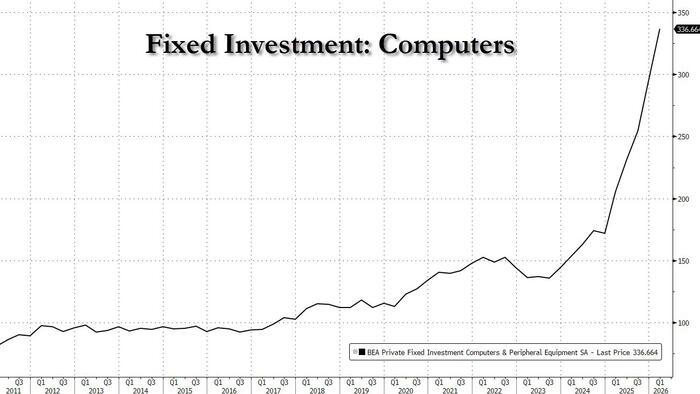
Another way to visualize the remarkable impact of spending on "computers" is the chart below: it clearly shows just how reliant the US has become on spending on computer products.

And that's why AI is now not only a market bubble, but it has become a core anchor propping up the entire US economy; it's also why the US government will have no choice but to backstop it once the inevitable AI bubble pops.
Badenoch blasts 'moaning' female Labour MPs over Burnham jobs 'quota'

Kemi Badenoch has told Labour women to earn a job in Andy Burnham's Cabinet instead of demanding they are handed jobs because of their gender.
The Tory leader lashed out today amid reports that female MPs are demanding the de-facto new prime minister introduce a 50:50 gender split 'quota' in his government.
Amid reports that former foreign secretary David Miliband is being lined up to return to the role, possibly with his brother Ed as Chancellor, one female minister also complained that Burnham could not have 'more Milibands than women' in the top posts.
But in a scathing article in the Times today Mrs Badenoch told them to 'stop moaning' and get chosen on merit instead of retreating into 'more of the failed identity politics that is holding back our country'.
'There are many, many reasons why you shouldn't have any Milibands in the cabinet,' she said.
'But complaining that the boys haven't given them the right jobs or that the boys are taking all the jobs, just shows that Labour's women still don't get it.'
The idea of quotas was also attacked by Baroness Jacqui Smith, Labour's Skills Minister.
Asked by Times Radio if Mr Burnham should reserve jobs for women, she said: 'No, I think what Andy Burnham should be doing is building the very best team around him to change this country.'

A letter written by the Women's Parliamentary Labour Party has called on Mr Burnham to ensure a 50:50 split between men and women in government jobs

Amid reports that former foreign secretary David Miliband (above, right, in 2010) is being lined up to return to the role, possibly with his brother Ed as Chancellor, one female minister complained that Burnham could not have 'more Milibands than women' in the top posts

But Mrs Badenoch told them to pipe down and get chosen on merit instead of retreating into 'more of the failed identity politics that is holding back our country'
A letter written by the Women's Parliamentary Labour Party and seen by the BBC has called on Mr Burnham to ensure a 50:50 split between men and women in government jobs after he succeeds Sir Keir Starmer.
'We are asking you to demonstrate this change from day one and address the toxicity and misogyny within our own party and government,' it said.
Labour has never had a female leader, while the Conservatives have had three, and Mrs Badenoch urged the government to follow its meritocratic example.
'If you run a meritocracy, then you do not have to worry about jobs for the boys,' she wrote.
'Every woman who is a Conservative MP, every woman who has ever won the leadership, has had to fight to get where she is.
'By contrast, Labour women are demanding guarantees from Burnham. But the truth is he doesn't have to give any guarantees.
'If none of Labour's women are prepared to get their hands dirty and challenge him for the leadership, their demands are toothless.'
'In fact, it's quite revealing that the women's parliamentary Labour Party has written to Burnham asking him to commit himself to at least 50 per cent female ministers.
'This has nothing to do with meritocracy. It is yet more of the failed identity politics that is holding back our country.'